


Get Indexology® Blog updates via email.

In This List

The King of the 21st Century Wears a Golden Crown

Duration Distress

Shifting Tides: Concentration, Dispersion and the S&P 500 Risk Landscape

Index-Based Investing in Islamic Finance: Trends and Implications

Measuring the Global Timber and Forestry Opportunity Set

The King of the 21st Century Wears a Golden Crown

Contributor Image
Brian Luke

Former Senior Director, Head of Commodities, Real & Digital Assets

S&P Dow Jones Indices

Once again, gold has taken the crown as the best-performing asset in the 21st century. From the turn of the century to year-end 2024, the S&P 500® recorded an annualized return of 7.7%, while the S&P GSCI Gold recorded 8.5% annually. While besting stocks for a quarter century, gold is still considered a safe-haven asset, especially during periods of economic uncertainty. However, 2024 highlighted how gold can also perform well during bull markets. The S&P GSCI Gold and S&P 500 posted supersized returns for the year, topping 26.6% and 25%, respectively.

In this post, we look at how the S&P GSCI Gold performed during up and down markets to better understand how it sustained long-term outperformance this century, while also maintaining its safe-haven reputation. Lastly, we expose how gold’s lack of income generation could be the chink in its (golden) armor. However, deploying popular index-based strategies, we discuss the possibility of generating income through the gold derivatives market.

Gold in an Up Market

In a thriving economy, gold may serve as a hedge against inflation and currency devaluation. For instance, during the 2000s, as the S&P 500 experienced substantial gains, gold prices also steadily increased, driven by rising demand from emerging markets and geopolitical tensions. Following the dot-com crash, equity markets rebounded, with the S&P 500 increasing 82% from 2002, trending upward until the next downturn in 2007. During that same time, the S&P GSCI Gold outperformed stocks, increasing 132%. Gold rose 30% between 2010 and 2020 but did not keep pace with the equity market after the Global Financial Crisis, but there have been more recent examples of gold outperformance since. Like the dot-com era, technology stocks have recently helped push the S&P 500 to all-time highs. Gold not only kept pace in 2024, it outperformed the market by 160 bps.

Gold in a Down Market

Conversely, in a downturn, such as the dot-com bubble burst in the early 2000s, gold has often shone as a refuge. During this period, the S&P 500 plummeted, while the S&P GSCI Gold surged as investors flocked to its perceived safety. From 1999-2002, the S&P 500 fell by 38%, but the S&P GSCI Gold rose 21%, demonstrating gold’s effectiveness as a protective asset. During the Global Financial Crisis, the S&P 500 fell 34% during 2007-2008, while the S&P GSCI Gold rose 34%, outperforming stocks by 6,800 bps of excess return during that period. In the past six calendar years when the S&P 500 produced a negative return, S&P GSCI Gold outperformed by an average of 20.8%.

Historically, gold has tended to retain value during economic downturns, providing a cushion against stock market volatility; however, it has also performed well during inflationary periods, preserving purchasing power. Adding gold to a multi-asset strategy may reduce overall risk and volatility, owing to its low correlation with other asset classes (see Exhibit 3). It has also demonstrated relative out-performance when the Fed maintains a restrictive monetary stance (see Exhibit 4).

One of the drawbacks to the S&P GSCI Gold is the lack of income generation. After all, gold is an “unproductive” asset that produces no income and creates zero shareholder value. However, employing a covered call strategy like the S&P GSCI Gold Covered Call has the potential to create a synthetic income stream, and the index has shown positive excess return over time. The S&P GSCI Gold Covered Call had excess return compared to the S&P GSCI Gold over the period from 2004 to 2024.

Looking ahead, factors such as global economic uncertainty, inflationary pressures and geopolitical tensions may drive demand for gold. Central banks around the world have pursued policies to “de-dollarize” and have increased gold holdings as part of their reserves, supporting its price. Gold’s role as a potential diversifier and hedge against economic instability could make it an important component of a well-rounded strategy.

The posts on this blog are opinions, not advice. Please read our Disclaimers.

Duration Distress

Contributor Image
Anu Ganti

Head of U.S. Index Investment Strategy

S&P Dow Jones Indices

We’ve written previously about the traditional sources of excess return for fixed income active managers, one of which is taking on higher term or interest rate risk. 2024 witnessed a sharp reversal in the excess returns from term risk, as long duration tilts that would have rewarded managers in 2023 hurt them in 2024. A key reason for this reversal was the dramatic rise in long-term yields, one of the consequences of which has been a steepening of the U.S. Treasury yield curve.

As a result, all eyes have been on the 10-year U.S. Treasury yield, which has whipsawed over the past year, rising above 4.7% as of Jan. 8, 2025, reaching levels last seen in April 2024 and close to the peak from October 2023. The surge in yields leading into and following the U.S. presidential election has been driven by a myriad of factors including robust economic growth and inflation concerns, as well as the U.S. Federal Reserve’s hawkish signaling on Dec. 18, 2024, of fewer-than-expected rate cuts in 2025.

Related to duration or interest rate risk, one way we can assess bond market nervousness is through market expectations for long-dated U.S. Treasury volatility, as reflected by the options market with the Cboe 20+ Year Treasury Bond ETF Volatility Index (VXTLT). VXTLT movements have generally paralleled the rise in U.S. Treasury yields over the past couple of years, reaching a high above 22 on Oct. 31, 2024, ahead of the election. Exceptions included turbulent days, such as the unwind of the global carry trade on Aug. 5, 2024, when yields plunged as investors sought the safety of U.S. Treasuries and VXTLT spiked to over 20. The index has risen since early December 2024 to 17.51 as of Jan. 8, 2025, perhaps driven by market unease over the election results and associated tariff policies, the Fed’s future rate trajectory, as well as inflation.

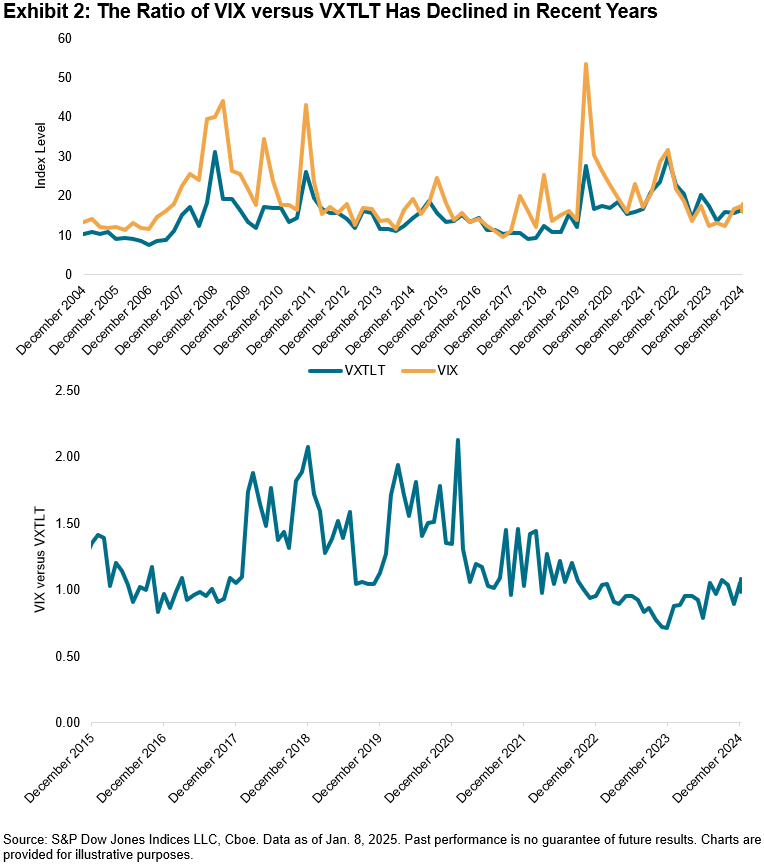
But how does the volatility of the bond market compare to that of the equity market? The first chart in Exhibit 2 shows that VXTLT levels typically have sat below those of the Cboe Volatility Index® (VIX®), a widely known measure of expected equity market volatility. However, while there was a small tick upward in 2024, the differential between the two has generally declined since 2020, as portrayed by the second chart in Exhibit 2, which calculates the ratio in VIX compared to VXTLT. Notable catalysts include uncertainty stemming from the pandemic and Fed rate hikes beginning in 2022 driving up bond implied volatility, coupled with relatively low equity implied volatility.

Coming off a rollercoaster 2024, as we look ahead to the Fed’s January 2025 meeting and a new presidential regime, the future path of U.S. Treasury yields may have important implications for multi-asset and fixed income asset managers and asset owners when thinking about their risk profiles.


The posts on this blog are opinions, not advice. Please read our Disclaimers.
Shifting Tides: Concentration, Dispersion and the S&P 500 Risk Landscape

Contributor Image
Tim Edwards

Managing Director, Index Investment Strategy

S&P Dow Jones Indices

Since the 2010s, the dynamics of large-cap U.S. equity risks have shifted. Fifteen years ago, the market was dominated by cycles alternating between risk-taking and risk aversion, often referred to as a “risk-on/risk-off” dynamic. A key feature of this period was the higher correlation between stock and sector performance, especially during market downturns.

Exhibit 1 illustrates this trend and what happened since, showing how the average monthly correlation among S&P 500® stocks has changed over time. Correlation was high relative to history after the 2008 Global Financial Crisis, but it attenuated over the next decade and, although the COVID-19 pandemic and 2022 bear market brought a temporary return, the most recent figures are close to the lowest observed so far this century. Overall, the trend since the early 2010s has been downward, albeit with a few bumps along the way.

Along with lower correlation in observed stock returns, the options market has also changed to reflect market participants’ expectations for a differing risk environment. Exhibit 2 compares two important indices: the Cboe Volatility Index (VIX®), which measures expected market volatility, and the Cboe S&P 500 Dispersion Index (DSPXSM), which measures expected dispersion, or how differently individual stocks in the S&P 500 are anticipated to perform. A higher DSPX suggests that options traders expect more unique stock movements, while a higher VIX indicates a focus on broader market risks. Over the past 10 years, the trend has shown a near-steady increase in expectations for single-stock dispersion, in both absolute and relative terms.

Just as higher correlation triggered changes in the way market participants managed risks, a decline in correlation and a rise in dispersion may have significant implications. With greater dispersion among stocks, active managers have more chances to outperform the market (but also more opportunities to underperform) through stock selection. Perhaps just as importantly, rather than seeking outperformance by concentrating in one part of the market, it also means there are potentially greater benefits that might be achieved through diversification. Just as a diverse garden with various plants is more resilient to pests and weather changes, a diversified selection of stocks tends to better withstand market volatility. If constituents behave more differently, then their combination is more diversified.

An example of how diversification effects may be strengthening is illustrated by another important way in which U.S. equity markets have evolved. The recent rise of the very largest of U.S. names has been much remarked upon (here and elsewhere). In concrete terms, the weight of the largest 10 companies in the S&P 500 more than doubled over a 10-year period, from 17.9% at the end of 2014 to 37.7% at the end of 2024. All else being equal, we might expect a higher correlation nowadays between the performance of those top 10 names and the benchmark S&P 500.

However, as illustrated in Exhibit 3, the fact that the other 490 companies’ stocks are behaving more differently means that, despite their rising weights, the correlation between the 10 largest stocks and the benchmark has not materially changed.  For reference, Exhibit 3 also shows the weight of the S&P 500 Top 10 Index constituents within the S&P 500, and the correlation between the S&P 500 Top 10 Index and a capitalization-weighted combination of the remaining 490 companies.

So, what does it all mean? On one hand, concerns about the concentration of U.S. equities may be exaggerated; the largest stocks haven’t dominated market behavior any more than usual. On the other hand, the widening performance gaps among S&P 500 stocks underscore the potential for more nuanced strategies as well as the potential advantages of diversification. As the risk landscape continues to shift, liquid, index-based tools could empower investors to adapt with it.

The posts on this blog are opinions, not advice. Please read our Disclaimers.

Index-Based Investing in Islamic Finance: Trends and Implications

Contributor Image
Sue Lee

Director and APAC Head of Index Investment Strategy

S&P Dow Jones Indices

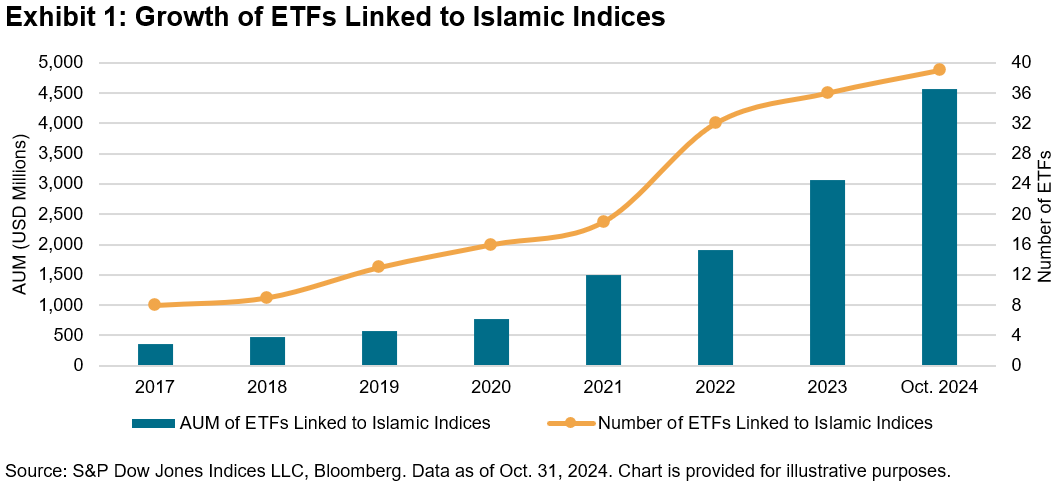
Indices play a crucial role in Islamic finance by identifying the universe of securities eligible for Shariah-compliant investments, establishing the benchmarks by which Islamic market participants assess performance and increasingly serving as the basis for index-linked investment products. Islamic finance has also embraced the global trend toward index-based or “passive” investing,1 with assets in exchange-traded funds (ETFs) linked to Islamic indices reaching USD 4.6 billion in 2024, a 49% increase YTD (see Exhibit 1).

Review of 2024

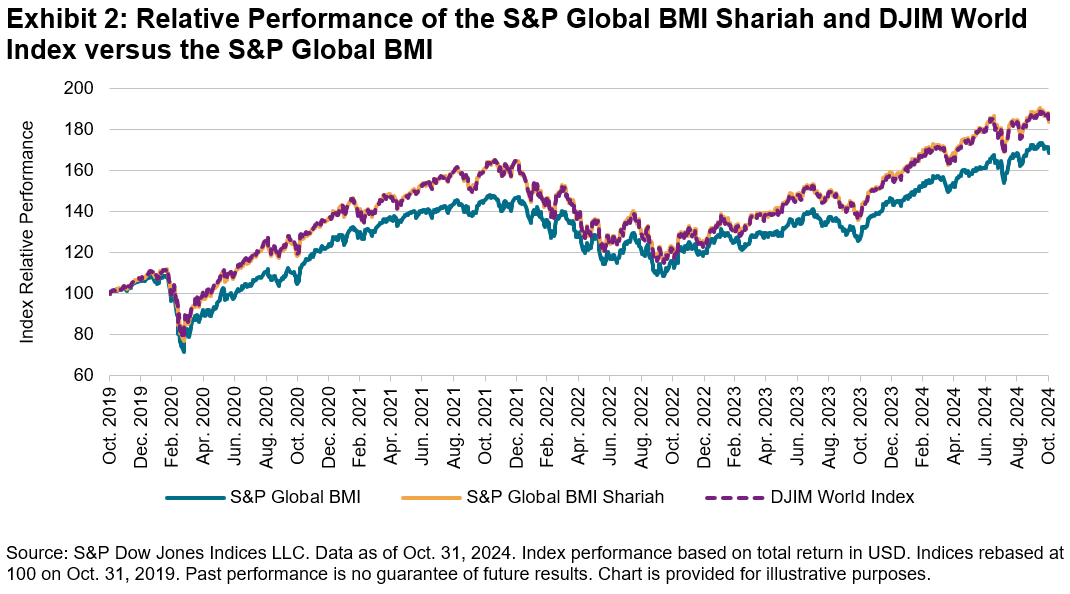
Global equities had a robust year, with the S&P Global BMI returning 15.4% by the end of October 2024. Shariah-compliant global equities outperformed slightly, with returns of 15.7% and 15.9% for the S&P Global BMI Shariah and Dow Jones Islamic Market (DJIM) World Index, respectively. Over the past five years, Shariah equity benchmarks have generated an excess return of more than 15% (2.0% annualized) over their conventional counterparts, as Exhibit 2 illustrates.

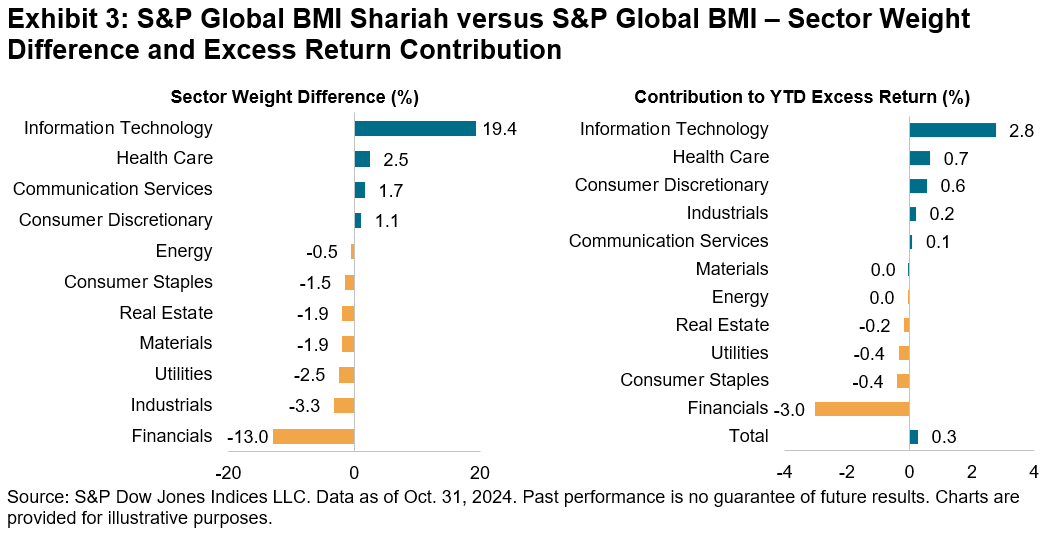
The relative performance of Islamic indices is partly attributable to their differing sector allocations. Information Technology, which accounts for 42.8% in the S&P Global BMI Shariah versus 23.4% in the S&P Global BMI, contributed 50% of the Shariah index’s return. This sector alone helped to generate an excess return of 2.8% against the conventional benchmark YTD. On the other hand, Financials brought the most significant negative effect on the index with a -3.0% excess return. This was due to its reduced weightings (3.6% in the S&P Global BMI Shariah versus 16.6% in the S&P Global BMI) as well as the underperformance of Shariah-compliant Financials companies against non-compliant ones (see Exhibit 3).

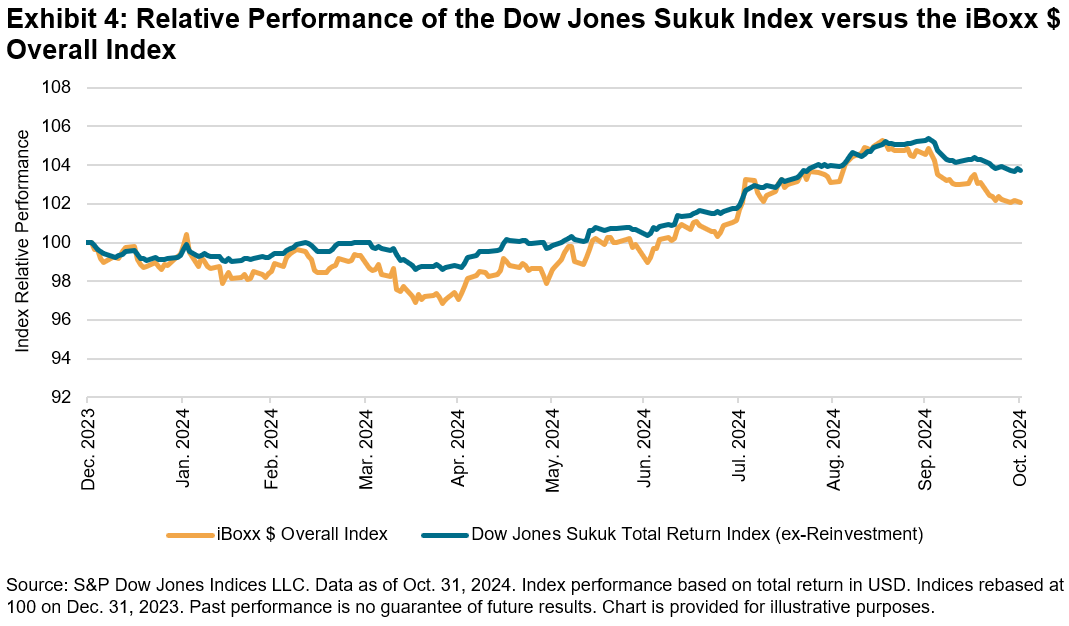
Meanwhile, fixed income markets were sluggish initially but rose in Q3, with U.S. dollar-denominated investment grade bonds (as measured by the iBoxx $ Overall Index) gaining 2.1% YTD as of the end of October 2024. Its sukuk equivalent, the Dow Jones Sukuk Index, had a higher return of 3.7% due to a larger compression in credit spreads and the lower duration of sukuk issues, which made them less sensitive to the repricing of rates2 (see Exhibit 4).

Against this backdrop, as already indicated by Exhibit 1, ETFs linked to Islamic indices have seen notable inflows. While the largest portion (46%) of assets under management are associated to U.K. primary listings, assets in U.S.-listed ETFs grew by 82% YTD and now account for 42% of the total. Islamic ETFs are predominantly in the broad-market equities space (94% of the total assets under management), while sukuk ETFs are growing fast with a 73% YTD increase as of the end of October 2024.

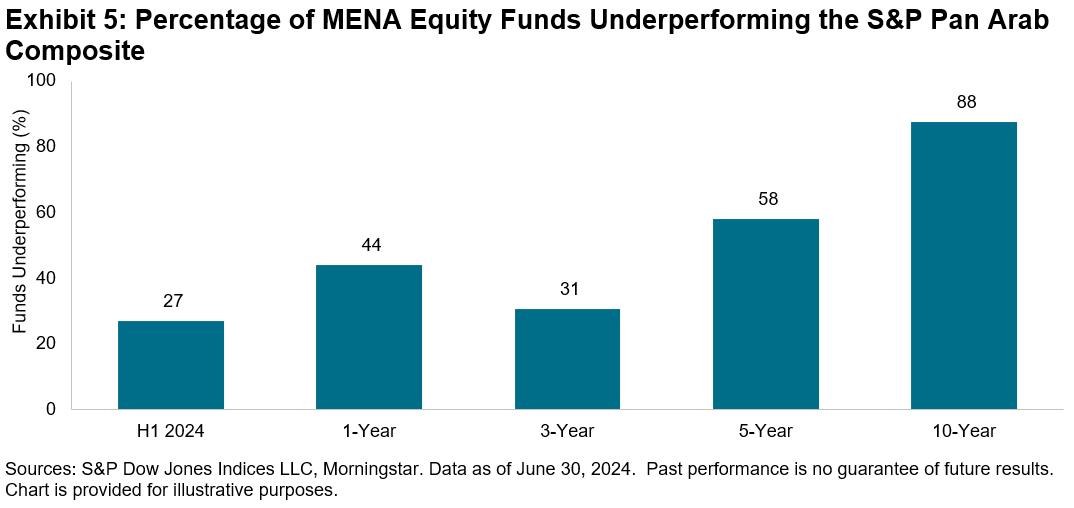
In the Middle East and North Africa (MENA) region, passive investing is still in its early stage. However, the U.A.E. and Saudi Arabia have been leading the development of the local ETF markets and introduced several new ETFs this year. The benefits of passive investing are resonating with MENA-based market participants, supported by empirical evidence from the S&P Indices versus Active (SPIVA®) research. Despite relatively encouraging results in H1 2024, actively managed MENA equity funds largely underperformed the S&P Pan Arab Composite over a 10-year period, as illustrated in Exhibit 5.3

Looking Ahead

A significant trend in Islamic indexing is the emergence of ESG Shariah solutions and increased interest in this space. Shariah and ESG principles share some common goals, such as promoting social and environmental stewardship. The S&P Pan Arab Composite ESG Shariah Capped Index exemplifies this concept, as the index measures the performance of the 40 companies with the highest-ranking ESG scores among the 60 largest constituents of its benchmark, the S&P Pan Arab Composite Shariah Index. Since its launch in May 2022, the index has achieved ESG score improvements and better temperature alignment, along with marginal outperformance compared to its benchmark.4 We will continue to observe how indexing evolves to help align Islamic values and ESG goals.

There are also some challenges ahead. In late 2023, the Accounting and Auditing Organization for Islamic Financial Institutions (AAOIFI), the Bahrain-based supervisory body for Islamic finance standards, released a draft standard aimed at redefining the concept and structure of sukuk.5 The proposal requires that sukuk be backed by underlying assets rather than merely referencing these assets in their structure, as has been the practice. S&P Global Ratings has stated that adopting this new standard could disrupt the market, lead to further market fragmentation, dampen the appetite of both investors and issuers, and potentially halt new issuance until sukuk structures find a middle ground.6 The publication and effective date of the standard are still unknown, and it remains to be seen how the final standard will be enforced and how the sukuk market will adapt in 2025.

Conclusion

The landscape of Islamic index-based investing is evolving, driven by increasing market participant demand and the adoption of global market trends. The outperformance of Shariah-compliant indices and the rapid growth of associated ETFs underscore the potential for passive investment strategies in this sector. However, challenges such as regulatory changes and market fragmentation must be addressed to maintain this momentum. As the market continues to adapt, ongoing innovation and alignment with market participant values will be essential for the future success of Islamic indexing.

This article was first published in IFN Annual Guide 2025.


1 See It’s Official: Passive Funds Overtake Active Funds, Morningstar, January 2024

2 As of the end of October 2024, the Dow Jones Sukuk Index had 4.35 years of effective duration and a yield of 4.89% with a 67 bps spread over U.S. Treasury bonds. In comparison, the iBoxx $ Overall Index had 5.99 years of duration and a yield of 4.85% with a 40 bps spread.

3 See SPIVA Global Mid-Year 2024, S&P Dow Jones Indices, October 2024

4 See Where Shariah Meets ESG, S&P Dow Jones Indices, July 2024

5 See AAOIFI Shariah Board Ratifies Landmark Sukuk Standard Draft, Solicits Banking and Regulatory Sector Feedback, AAOIFI

6 See Sukuk Market: The Calm Before the Storm?, S&P Global Ratings, July 2024

The posts on this blog are opinions, not advice. Please read our Disclaimers.

Measuring the Global Timber and Forestry Opportunity Set

How does the S&P Global Timber & Forestry Index work? Examine a benchmark tracking companies that own, manage, harvest and process these crucial natural resources, while also incorporating governance and sustainability screens.

The posts on this blog are opinions, not advice. Please read our Disclaimers.