











Moving beyond Narrative: A Fundamental Lens on Digital Assets
Digital asset markets have evolved rapidly, but the tools used to evaluate them have not kept pace. Many crypto strategies have historically been shaped by market narratives, momentum or broad exposure to the largest tokens.1 Designed with the crypto and blockchain investment firm Pantera Capital and powered by Artemis Analytics data, the S&P Pantera Digital Asset Index takes a different approach: it measures the market performance of a subset of digital assets that demonstrate observable and recurring economic activity through protocol-level revenue generation.
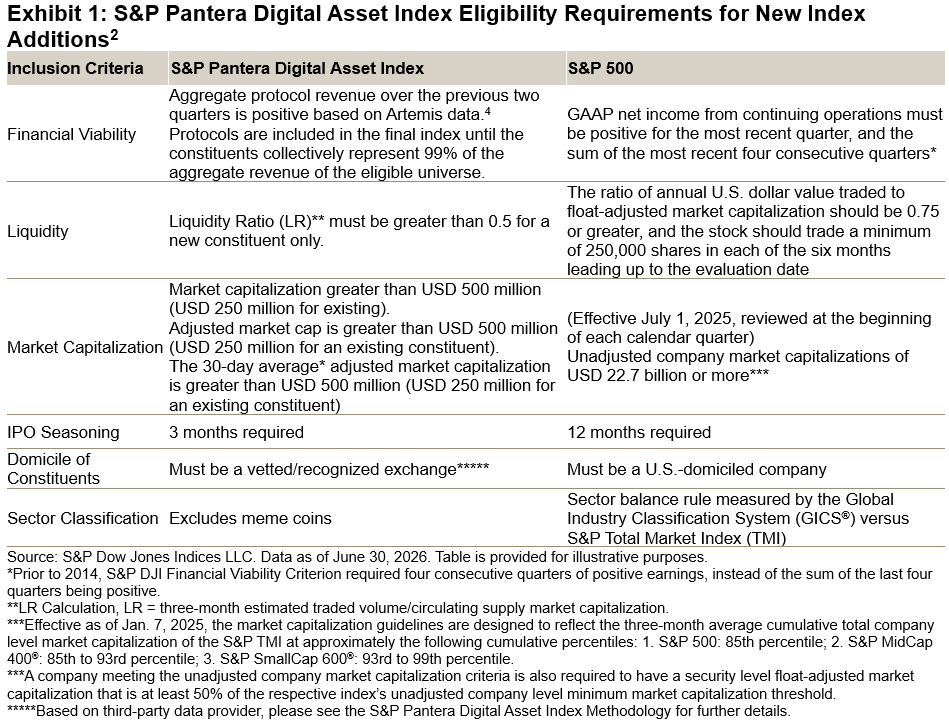
In traditional equity markets, investors often look for evidence of fundamental strength through measures such as revenues, earnings, margins or cash flows. Digital assets do not map as neatly onto that framework, but some protocols do generate measurable economic activity through mechanisms such as transaction fees, token burns or other protocol-level revenue streams. The S&P Pantera Digital Asset Index uses this activity as an indicator of financial viability, mirroring the higher entry threshold of the S&P 500® compared to other U.S. equity indices2 alongside standard index construction toolkits related to investability criteria and diversification.
Constructing the S&P Pantera Digital Asset Index
The starting universe, the S&P Cryptocurrency Broad Digital Asset (BDA) Index, applies a base level of filters to remove smaller assets. One unique feature of digital assets is that the barrier to creating a tradable token is extremely low. Unlike public equities, where exchange listings come with baseline disclosure requirements and business standards, crypto offers no equivalent universal filter. The S&P Pantera Digital Asset Index has a seasoning rule of three months and constituents must be listed on a vetted exchange, recognizing that some newly launched crypto projects may achieve high market capitalization and liquidity in the very short run post-initial coin offering (ICO). Please see the S&P Pantera Digital Asset Index Methodology for more details.
Composition and Constituents of the S&P Pantera Digital Asset Index
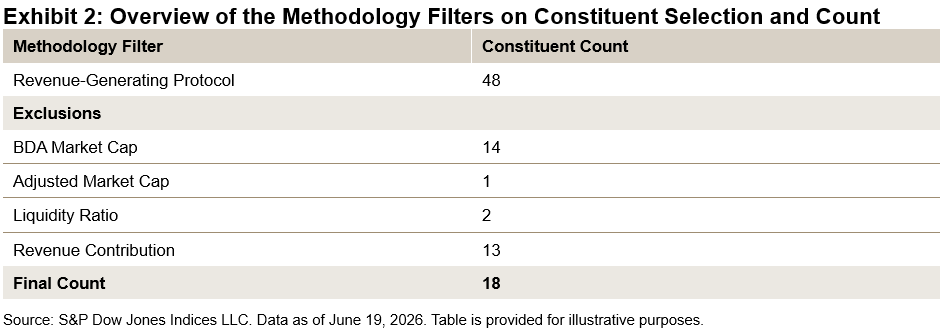
Here we look at the impact of the index filters on the final composition. The index doesn’t apply a fixed count, allowing constituents that meet the thresholds to be added over time. The current constituent count as of the June 2026 rebalance was 18, with a minimum constituent count of 5. While the early history had few protocols, over the last two years, the constituent count has been consistently above 10, perhaps indicating the increased maturity of the type of protocols available to market participants. While the number of protocols in our initial revenue pool was 48, around 15 were dropped based on the underlying benchmark and adjusted market cap, 2 failed to meet the liquidity threshold and 13 were excluded as their revenue falls within the bottom 1% of eligible constituents.
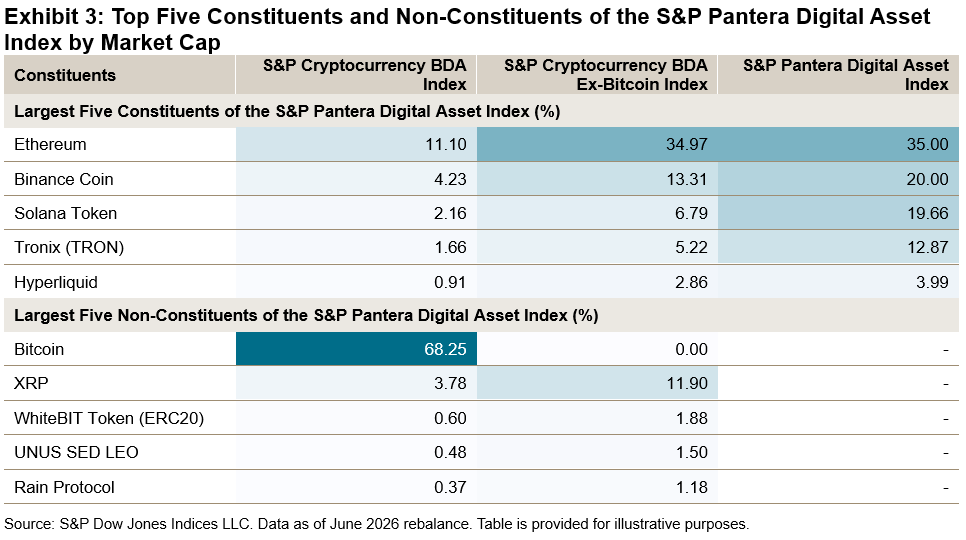
The revenue filter on the index means that, in practice, the type of protocols we typically see in the final selection are often smart contract platforms like Ethereum and Solana and decentralized finance applications like Hyperliquid. The largest five constituents are Ethereum, Binance Coin, Solana, TRON and Hyperliquid. The largest non-constituents when compared to the S&P Cryptocurrency BDA Index are Bitcoin and XRP, which are significant weights in standard market-cap-weighted indices.
Performance Characteristics of the S&P Pantera Digital Asset Index
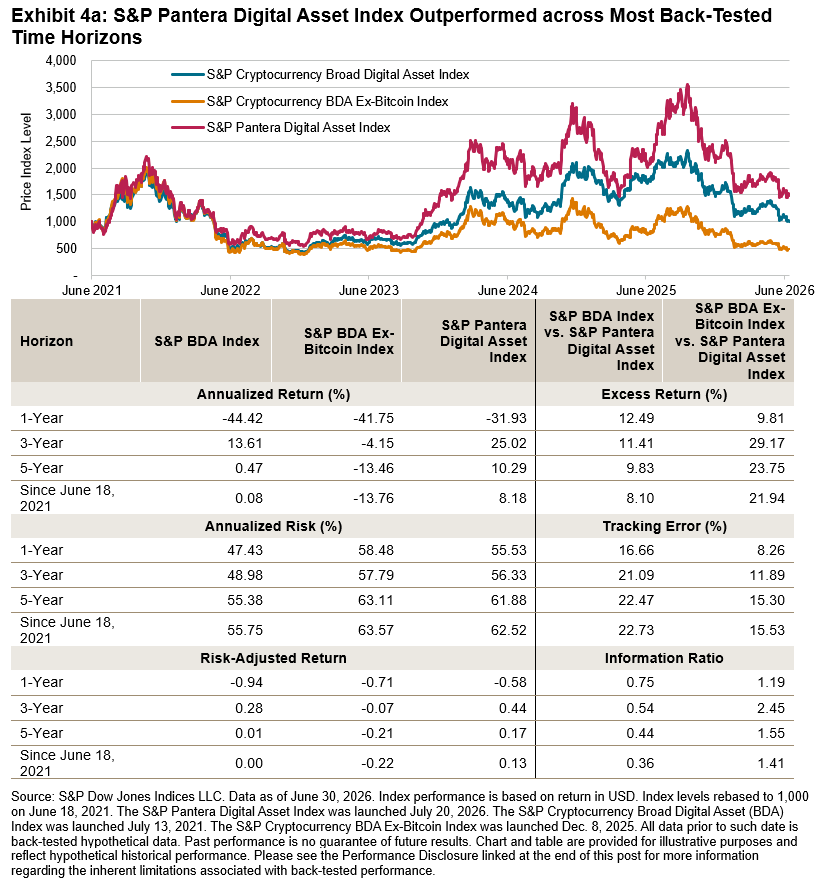
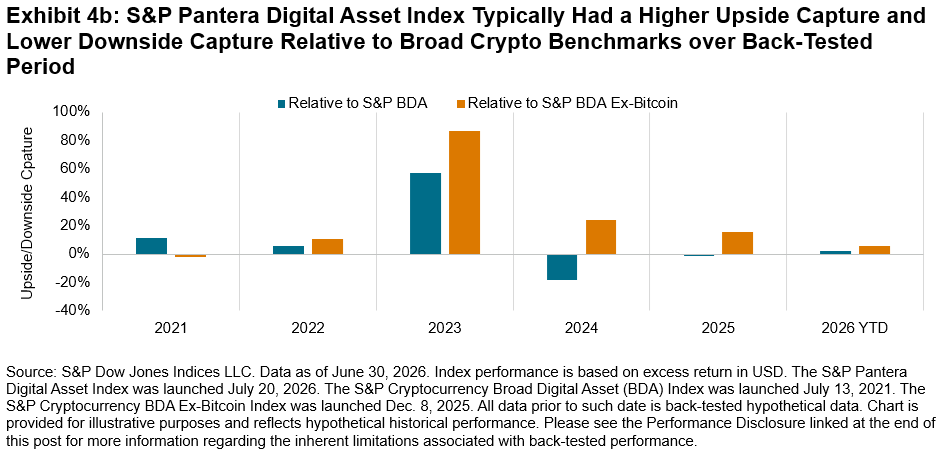
Despite not having Bitcoin in the index, based on back-tested analysis, the S&P Pantera Digital Asset Index has outperformed indices like the S&P Cryptocurrency BDA Index where Bitcoin accounts for approximately 70% of the index weight. Notably, over the three-year back-tested period ending June 30, 2026, the S&P Pantera Digital Asset Index had an annualized return of 25% versus 14% for the S&P Cryptocurrency BDA Index, an excess return of more than 10 percentage points, with a similar picture across the five-year period and since its first value date of June 18, 2021 (see Exhibit 4a and Exhibit 4b).
Conclusion
The S&P Pantera Digital Asset Index may serve a dual purpose: as a benchmark for actively managed crypto strategies and as a foundation for index-linked products. For different types of market participants, the S&P Pantera Digital Asset Index reflects the continued maturation of crypto benchmarking. By anchoring selection to observable protocol-level revenue, it offers a disciplined framework for evaluating digital assets through fundamentals. In a market often driven by narrative trading, the index’s emphasis on measurable activity offers a more data-driven way to understand where economic value may be forming in the digital asset ecosystem.
Learn more about the S&P Pantera Digital Asset Index in our brochure.
1 Watkins, Ryan, “The Productive Cryptoeconomy: A Thesis for Adoption,” Syncracy, Feb. 25, 2025.
3 Preston, Hamish, “Seasoning to Taste,” S&P Dow Jones Indices, March 3, 2026.
4 Weseley, Alex, “Crypto Revenue,” Artemis, Sept. 12, 2025.
The posts on this blog are opinions, not advice. Please read our Disclaimers.