











As U.S. equity markets continue to reach new highs, market leadership has become increasingly concentrated among a handful of large-cap stocks. The S&P 500 Capped 35/20 Indices use weight caps to maintain diversification within sector-specific benchmarks. Each index in the range comprises all constituents from its respective GICS® sector of the S&P 500® while mitigating single-stock dominance. Capped indices such as these have emerged to meet the need for benchmarks that may facilitate diversification rules, rather than as an endorsement of any single approach to managing concentration.
The 35/20 Capping Mechanism
The S&P 500 Capped 35/20 Indices implement a multi-tier capping framework1 to control concentration risk. The capping thresholds are designed to facilitate the ability of regulated investment companies to meet certain diversification requirements under Directive 2009/65/EC (the “UCITS Directive”)2 of the European Parliament. The UCITS Directive imposes obligations on such investment companies, not on the index or its providers, and replication of the index does not guarantee compliance with the UCITS Directive at any given time.
At quarterly rebalancing (effective after the close of the third Friday of March, June, September and December), constituents are weighted according to float-adjusted market capitalization (FMC), with the largest and second-largest companies capped at 31.5% and 18% of the total index weight, respectively. Reference prices for the rebalance are taken from the Wednesday prior to the second Friday of the quarterly rebalance month.
In addition, two further capping checks occur in all months of the year:
- Mid-Month: Checks are performed on the Wednesday prior to the third Friday using reference weights from that date. If the 35%/20% caps are breached, reweighting is effective after the close of the third Friday.
- End-of-Month: Checks are performed on the third-to-last business day of the month. If the 35%/20% caps are breached, reweighting is effective after the close of the last business day.
In all capping scenarios, excess weight is proportionally redistributed to uncapped companies through an iterative process.
Constituent weights may fluctuate between reference and rebalance dates due to market movements and may exceed the capping threshold during such periods.
The Impact of Capping across Sectors
Exhibit 1 shows the impact of different capping mechanisms on the weights of the largest companies within the S&P 500 Capped 35/20 Indices against their uncapped S&P 500 Sector counterparts and the Select Sector® range (which apply a different, 25/5/50 capping rule).3
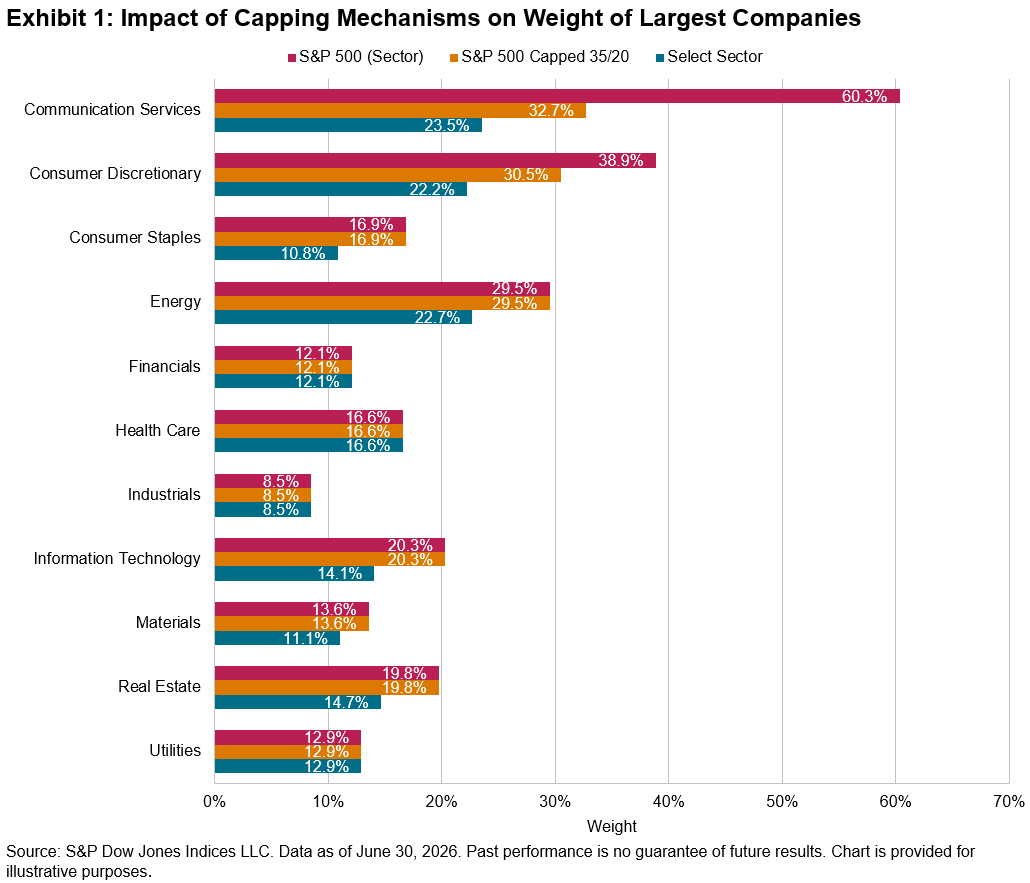
For broadly diversified sectors such as Industrials and Financials, the weights of the largest companies have naturally fallen below capping thresholds over the last 10 years. Consequently, the 35/20 indices mirror their capped and uncapped counterparts in constituent weighting and historical performance over the period.
On the other hand, sectors dominated by mega-cap names show the biggest variations in weight under the different capping methodologies. For example, Alphabet’s substantial 60.3% uncapped weight in Communication Services falls to 32.7% under the 35/20 methodology, and 23.5% under the Select Sectors’ 25/5/50 rules. Similarly, in Consumer Discretionary, Amazon’s 38.9% uncapped weight is reduced to 30.5% and 22.2% in the S&P Capped 35/20 and Select Sector indices, respectively.
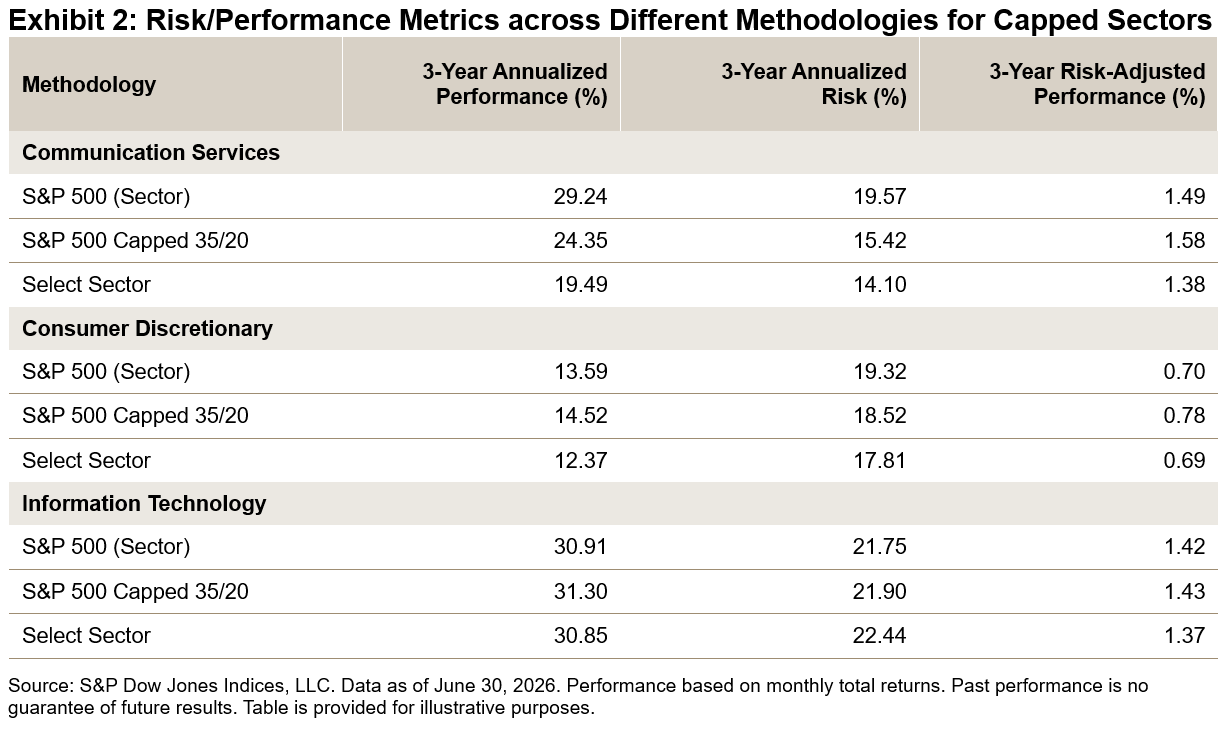
In sectors where capping has been triggered, the differences in constituent weights result in varying risk and performance profiles across the different methodologies. As the capping mechanisms act to redistribute weight away from the largest names, absolute performance can fluctuate depending on the relative performance of those companies versus their smaller peers over a given period. While this can lead to noticeable differences in absolute performance, risk-adjusted performance tends to align more closely across methodologies. Over the three-year period ending in June 2026, performance on this basis was largely similar, with the S&P 500 Capped 35/20 indices reflecting a marginally better performance per unit of risk in all three sectors compared to their uncapped and Select Sector counterparts.
Conclusion
The S&P 500 Capped 35/20 Indices measure S&P 500 sector constituents while utilizing a 35/20 capping framework that has historically provided diversification among companies within each index. By moderating single-stock dominance while maintaining weight in market leaders, the 35/20 methodology offers a more balanced approach to reflecting evolving market dynamics.
Disclaimer
S&P Dow Jones Indices is an index provider and does not provide investment advice. The index capping rules are designed to facilitate the ability of regulated investment companies to meet certain diversification requirements but do not guarantee compliance with the UCITS Directive or any other regulatory framework. Fund managers and other market participants remain solely responsible for ensuring that their products comply with all applicable regulatory requirements.
1 For the full index methodology of these indices, please see the S&P U.S. Indices Methodology.
2 For more information on capping thresholds, please refer to the Regulatory Capping Requirements section of S&P Dow Jones Indices’ Equity Indices Policies & Practices Methodology.
3 For further details of the Select Sector Indices, see Preston, Hamish “Explaining Changes to Select Sector Indices,” S&P Dow Jones Indices, Sept. 10, 2024.
The posts on this blog are opinions, not advice. Please read our Disclaimers.