


Get Indexology® Blog updates via email.

In This List

The Dow Jones Dividend 100 Indices Shine in a Strong Start to the Year

Why Do U.S. Equities and the S&P 500 Matter in South Korea?

Unveiling the Dow Jones Japan Select Dividend Index

Introducing a Low-Carbon Solution: The S&P 500 CTB Base+ Index

Tracking Next Gen Factors across Economic Regimes

The Dow Jones Dividend 100 Indices Shine in a Strong Start to the Year

Contributor Image
Wenli Bill Hao

Director, Factors and Dividends Indices, Product Management and Development

S&P Dow Jones Indices

As market volatility continues in the U.S., the Dow Jones U.S. Dividend 100 Index and Dow Jones International Dividend 100 Index have emerged as standout performers. Year-to-date (YTD) as of Feb. 28, 2026, both indices have posted double-digit gains (see Exhibit 1).

Notably, the Dow Jones U.S. Dividend 100 Index has outperformed its benchmark universe by 14.81% YTD. This outperformance has largely been driven by its overweights in the Energy and Consumer Staples sectors, as well as its underweight in Information Technology. The index’s top four holdings—Lockheed Martin, ConocoPhillips, Verizon and Chevron—have each posted returns exceeding 20% in 2025, helping drive index-level performance.

In this blog, we will examine their index methodology, historical performance and key characteristics.

Methodology Overview

What differentiates the Dow Jones Dividend 100 Indices—and has contributed to their long-term outperformance—is their emphasis on dividend consistency combined with a multi-factor selection process that blends two dividend metrics with two quality measures. The methodology begins by excluding companies that have not paid dividends for at least 10 consecutive years. Next, eligible stocks are ranked by their indicated annualized dividend (IAD) yield, with those falling below the median IAD yield removed (see Exhibit 2).

From the remaining pool, the top 100 companies are selected based on a composite score that combines the following four factors: free cash flow to total debt, return on equity, IAD yield and five-year dividend growth rate. For the Dow Jones International Dividend 100 Index, an additional screen is applied, removing the bottom half of stocks with the highest three-year price volatility before final selection.2

The selected constituents are weighted by capped float-adjusted market capitalization, with stock and sector caps in place that aim to reduce concentration risk and enhance diversification.

Performance History

Over the long term, including back-tested results, the Dow Jones Dividend 100 Indices have outperformed their benchmark universes, both in absolute total return and risk-adjusted terms. The Dow Jones International Dividend 100 Index has outperformed over short-, medium- and long-term horizons. Similarly, the Dow Jones U.S. Dividend 100 Index has outperformed across both short- and long-term periods.

In addition to outperformance, both indices have exhibited lower risk and reduced drawdowns compared to their benchmark universes (see Exhibit 3).

Enhanced Dividend Yield and Dividend Growth

The Dow Jones Dividend 100 Indices have consistently posted higher dividend yields compared to their respective benchmarks (see Exhibit 4). Over the period from Dec. 31, 2006, to Dec. 31, 2025, the Dow Jones U.S. Dividend 100 Index averaged a yield of 3.82%, significantly higher than the 1.75% yield of the Dow Jones U.S. Broad Stock Market Index. Similarly, the Dow Jones International Dividend 100 Index posted an average yield of 4.42%, outperforming the Dow Jones Global ex-U.S. Index, which averaged 2.99%.

By prioritizing dividend growth, strong fundamentals and high yield as primary selection criteria, the indices also posted significantly higher dividend growth rates than their respective benchmark universes over the 10-year period from Dec. 31, 2015, to Dec. 31, 2025. Importantly, these elevated dividend growth rates have historically outpaced long-term inflation rates in their respective markets, providing a potential hedge against inflation and helping to preserve purchasing power over time.

Quality and Value Tilts

The Dow Jones Dividend 100 Indices have tended to exhibit favorable value and quality characteristics relative to their respective benchmarks (see Exhibit 6). In valuation terms, as of Feb. 28, 2026, both dividend indices are trading at a discount relative to their respective benchmarks, while exhibiting comparable or higher profitability.

Conclusion

The Dow Jones U.S. Dividend 100 Index and Dow Jones International Dividend 100 Index have shown sustained dividend payment and dividend growth historically. From March 31, 2005, to Feb. 28, 2026, including back-tested analysis, they have outperformed their respective benchmarks in both absolute and risk-adjusted terms, while exhibiting lower risk and drawdowns. Furthermore, their distinct quality and value characteristics—such as higher profitability and discounted valuations—may help market participants navigate changing market conditions with greater confidence.

1 For the Dow Jones International Dividend 100 Index, we note we use the Dow Jones Global ex-U.S. Index as its benchmark comparison, as it also includes small-cap constituents, while its universe indices are the Dow Jones Global ex-U.S. Large-Cap and Dow Jones Global ex-U.S. Mid-Cap.

2 Please refer to the methodology of the Dow Jones Dividend 100 Indices for more details.

The posts on this blog are opinions, not advice. Please read our Disclaimers.

Why Do U.S. Equities and the S&P 500 Matter in South Korea?

S&P DJI’s Sue Lee examines the importance of the S&P 500 in the global equity opportunity set, key diversification and sector composition differences between notable U.S. equity and Korean benchmarks and the challenges faced by active managers in the U.S. and South Korea to outperform this iconic index. 

The posts on this blog are opinions, not advice. Please read our Disclaimers.
Unveiling the Dow Jones Japan Select Dividend Index

Contributor Image
Kevin Multhaup

Senior Analyst, Factors and Dividends Indices

S&P Dow Jones Indices

Japanese dividend payouts are meaningfully higher in cash terms than they were a decade ago, bringing Japan more in line with other developed markets. Importantly, dividend growth is now increasingly anchored in formal dividend policy. This shift matters for market participants seeking both yield and exposure to Japanese equity markets by setting expectations around dividend sustainability.

Much of this evolution has been due to improved corporate governance and stewardship standards in the 2010s as well as the normalization of payout ratios, and capital efficiency reforms introduced by the Tokyo Stock Exchange in 2023.1 These reforms have sharpened management’s focus on the cost of capital and share price performance. As a result, dividend increases, progressive dividend policies and share buybacks have become more common. Many companies now explicitly commit to maintaining or increasing dividends, contributing to greater stability in Japan’s dividend market.

On Dec. 15, 2025, the Dow Jones Japan Select Dividend Index was launched to track companies with higher dividend yields and more sustainable dividend profiles in Japan.

Index Construction and Methodology

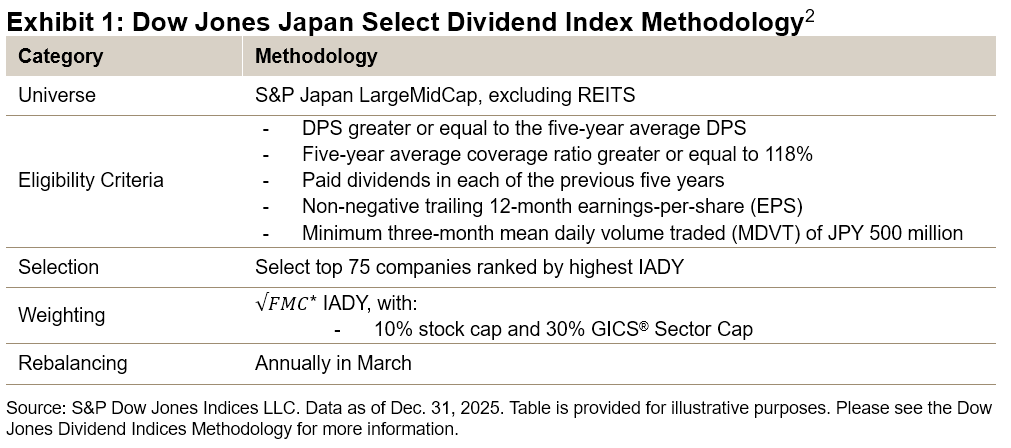
The Dow Jones Japan Select Dividend Index methodology (see Exhibit 1) follows the established approach of the Dow Jones Select Dividend Index Series. The starting universe is the S&P Japan LargeMidCap, excluding REITs. From this broad universe, a series of eligibility screens is applied to identify consistent dividend payments, adequate dividend coverage and higher yields.

Stocks passing these screens are then ranked by indicated annual dividend yield (IADY) with the top 75 selected subject to a buffer to reduce turnover. Constituents are weighted using the square root of free-float market capitalization (FMC) multiplied by IADY.

Dividend Yield Characteristics

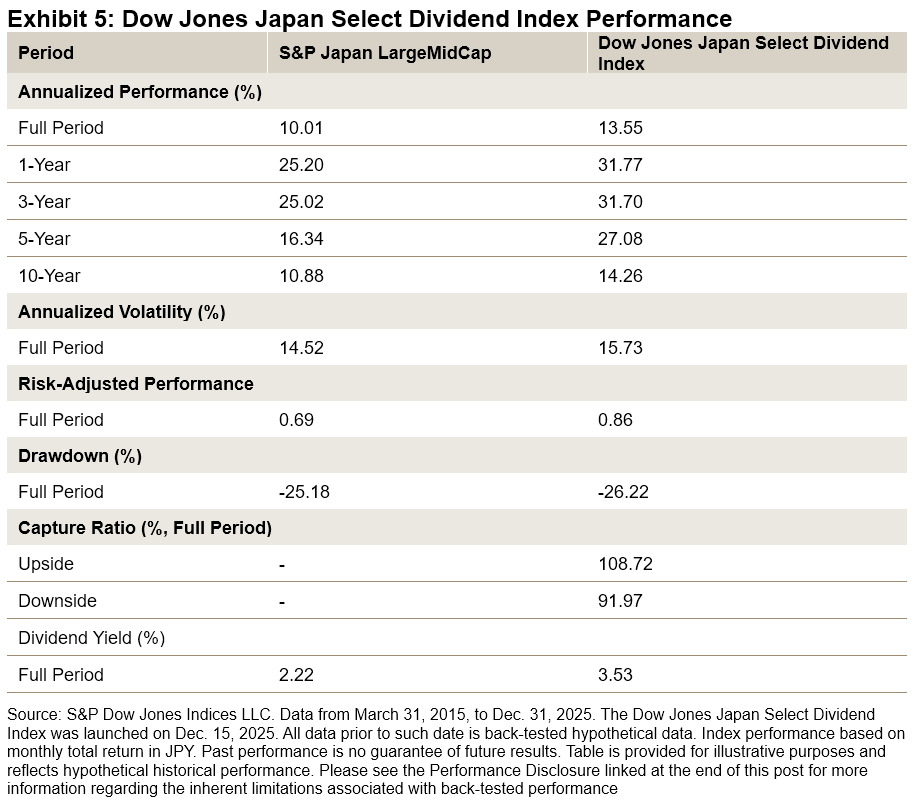
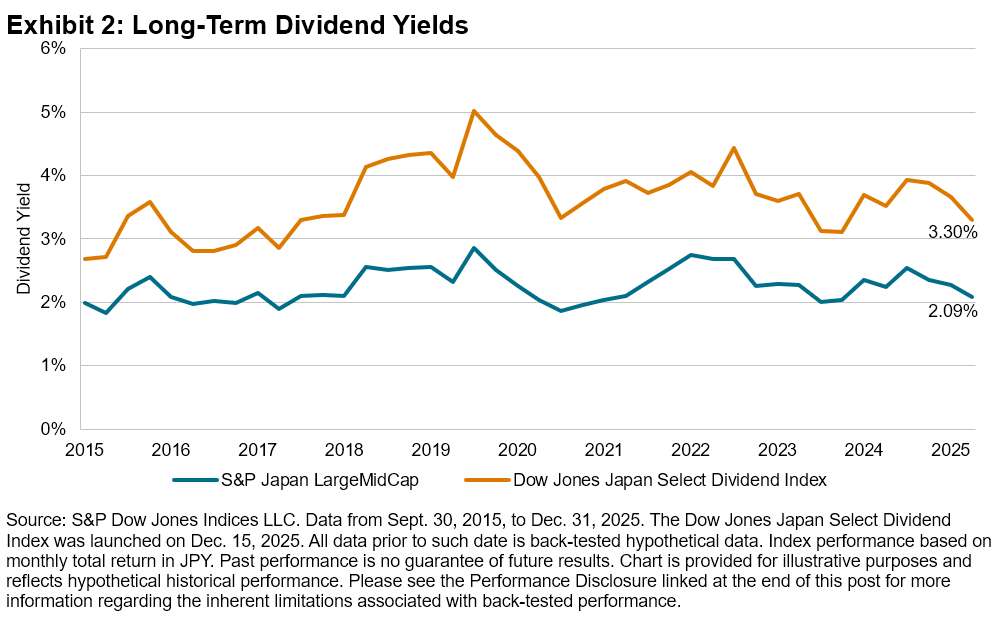
As shown in Exhibit 2, the long-term average dividend yield of the index since 2015 is 3.53%, approximately 130 bps higher than the benchmark universe.

As of year-end 2025, the index had a dividend yield of 3.30%, around 120 b above the benchmark, although slightly below its long-term average differential.

A Decade of Dividend Growth in Japan

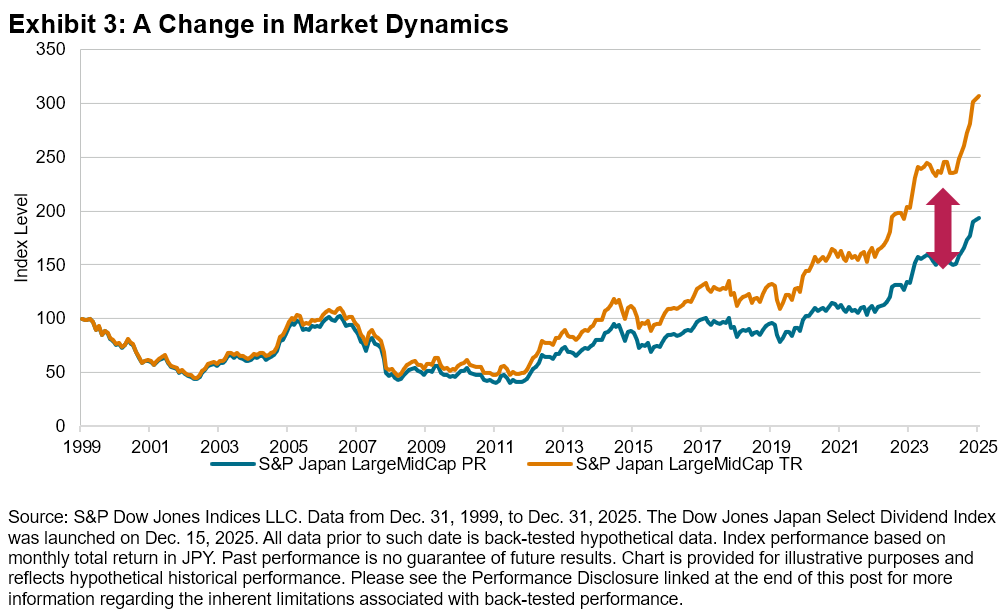
The Japanese market has witnessed significant dividend growth over the past decade. As illustrated in Exhibit 3, dividends gained prominence following the reforms of the 2010s, leading to larger and more consistent dividend payments, resulting in a widening between the total return (incorporating dividends) and price return versions of the benchmark, based on back-tested analysis.

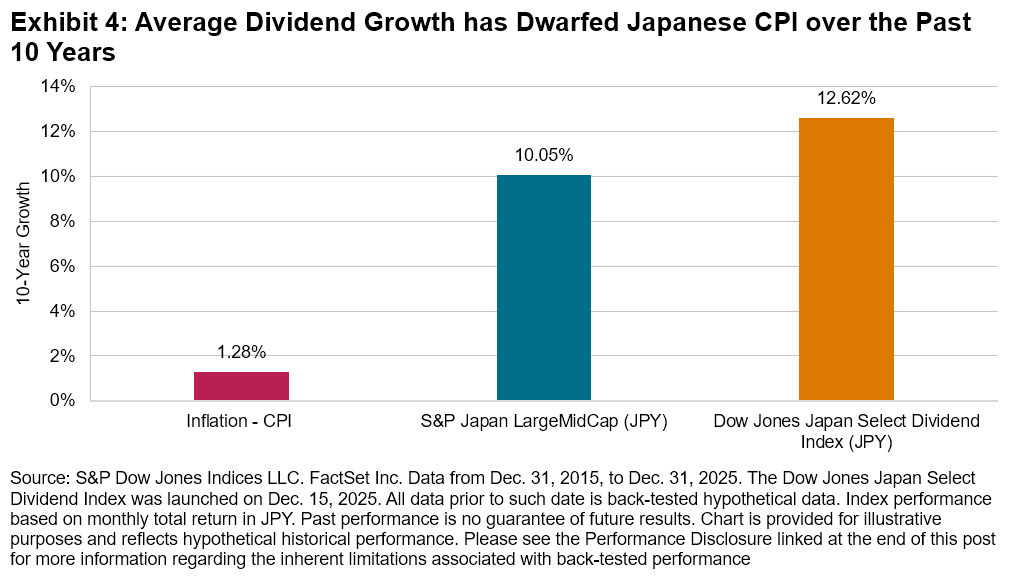
Exhibit 4 reveals that the Dow Jones Japan Select Dividend Index had an average annual dividend growth rate of 12.62% during this period, surpassing the benchmark universe by approximately 260 bps and significantly outpacing Japanese inflation. Irrespective of this growth continuing into the future, it underscores Japan’s market dynamics aligning more closely with developed market standards.

Long-Term Outperformance

Back-tested results show that the Dow Jones Japan Select Dividend Index has outperformed its benchmark universe on both long- and short-term horizons, while also delivering higher risk-adjusted performance. The index has provided a degree of defensiveness, with a downside capture ratio of 92%, while participating in rising markets as reflected by its upside capture ratio.

Sector Weights

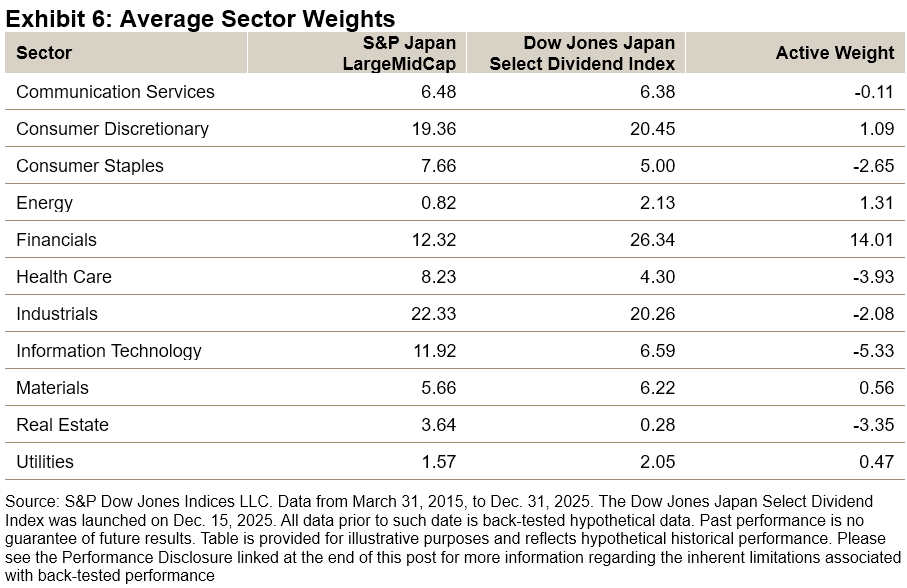
Over the long term, the index’s GICS sector weights have been concentrated in Financials, Industrials and Consumer Discretionary. Financials represent the largest active overweight, at 14.01%. Industrials and Consumer Discretionary also carry meaningful weights in the Japanese benchmark, resulting in relatively low active positions.

The largest active underweights are in Information Technology and Health Care, reflecting the index’s focus on income-oriented sectors rather than growth-oriented industries.

Conclusion

By systematically targeting high-yielding companies with demonstrated dividend stability, the Dow Jones Japan Select Dividend Index reflects Japan’s evolving income landscape. Based on back-tested data, its combination of high dividend yields, strong dividend growth and long-term risk-adjusted performance highlights the growing relevance of dividend strategies within Japanese equities.

1 Japan Exchange Group – Follow-up of Market Restructuring

2 Dow Jones Dividend Indices Methodology

The posts on this blog are opinions, not advice. Please read our Disclaimers.
Introducing a Low-Carbon Solution: The S&P 500 CTB Base+ Index

Contributor Image
Maria Sanchez

Director, Sustainability Index Product Management, U.S. Equity Indices

S&P Dow Jones Indices

Climate-focused institutional investors face the challenge of reducing carbon exposure while maintaining broad market representation and the ability to closely track the performance of the underlying market. The S&P 500® CTB Base+ Index offers a practical solution that can be used to measure the performance of constituents from the underlying index that meet specific climate and sustainability criteria.

CTB versus PAB: Understanding the Frameworks

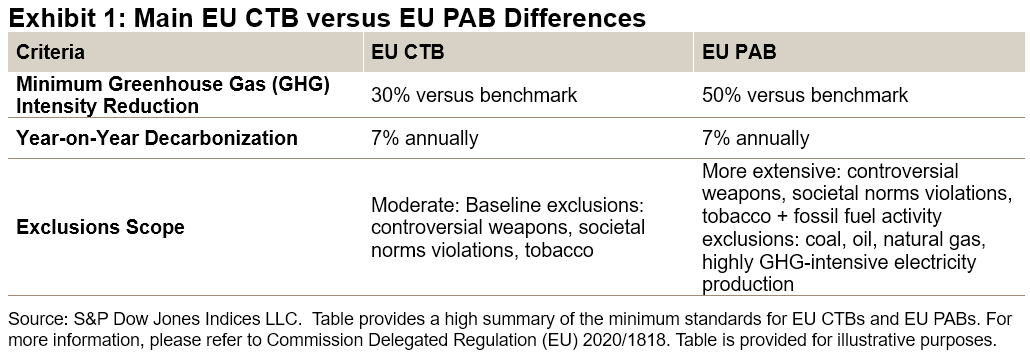
The EU offers two climate benchmarks: the EU Climate Transition Benchmarks (EU CTB) and the EU Paris-Aligned Benchmarks (EU PAB). Both benchmarks support the shift to a low-carbon economy, but they differ in their initial decarbonization levels and exclusion criteria.

S&P Dow Jones Indices (S&P DJI) offers index solutions that align with both the EU CTB and EU PAB frameworks,1 allowing institutions to select the approach that best fits their purpose, risk tolerance and climate objectives.

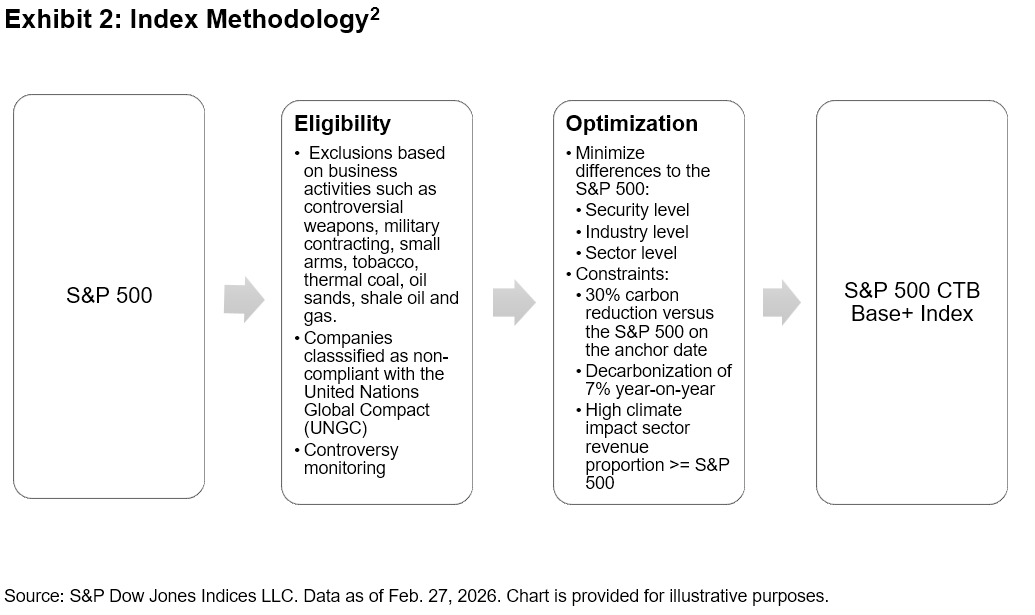
Building on the EU CTB minimum standards, the S&P 500 CTB Base+ Index adds exclusions for shale oil and gas extraction, stricter thresholds for military weapons, group-level military contracting exclusions and additional constraints on Scope 1 and 2 Weighted-Average Carbon Intensity (WACI) targets and decarbonization trajectory. Using our proprietary glass-box optimization approach, the index selects and weights constituents from the S&P 500 that meet low-carbon transition criteria while minimizing deviations from the underlying index.

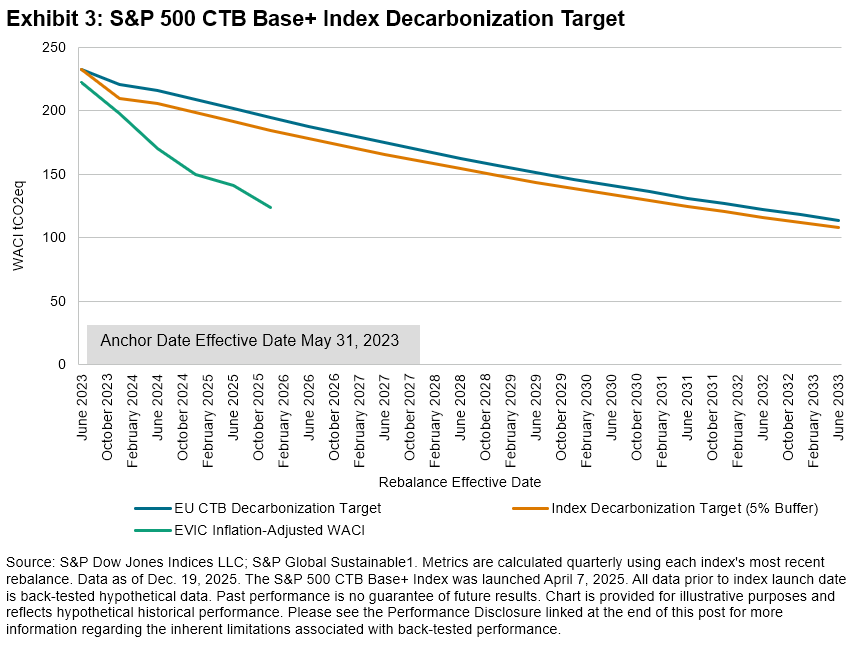
Exhibit 3 shows the decarbonization path of the S&P 500 CTB Base+ Index, which is represented by the index-level enterprise value including cash (EVIC) inflation-adjusted WACI considering Scope 1, 2 and 3 emissions (green line),3 the minimum standards for Scope 1, 2 and 3 emissions (blue line) and a 5% buffer (gold line), anchored to May 31, 2023. The impact of additional restrictions on controllable emissions (Scope 1 and 2) may become more evident.4

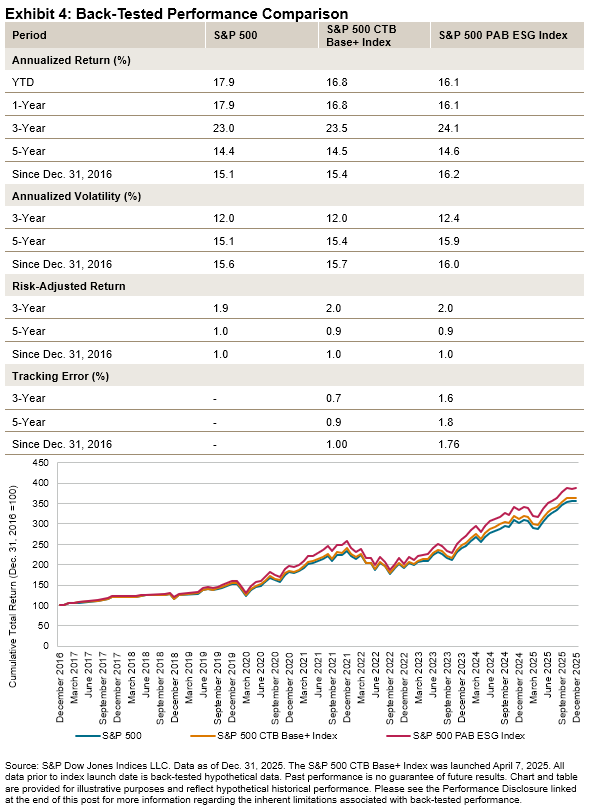
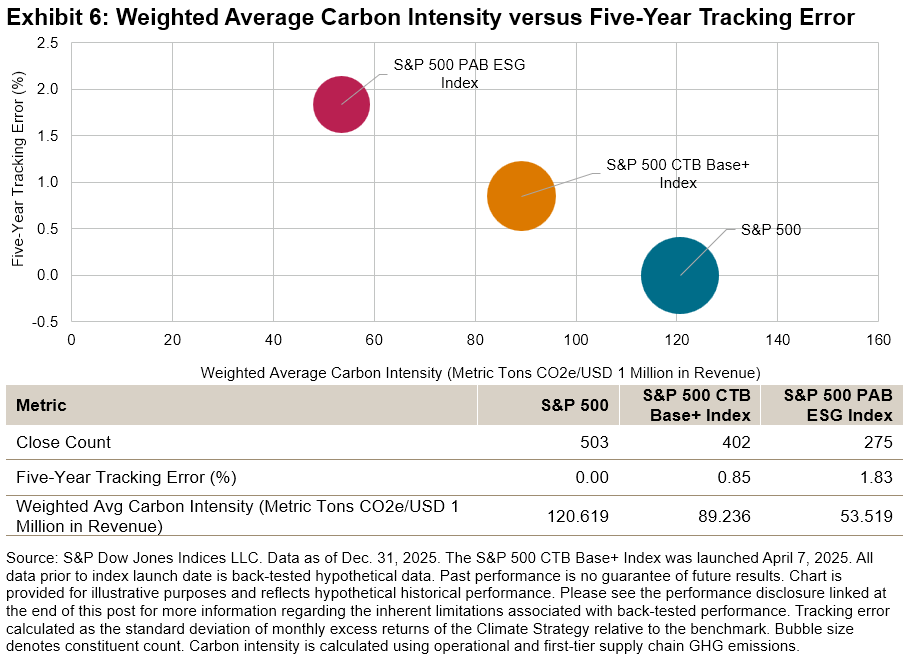
To visualize the potential benefits of the S&P 500 CTB Base+ Index, Exhibit 4 compares it with the S&P 500 PAB ESG Index, which exceeds the EU PAB minimum standards. The S&P 500 CTB Base+ Index has shown historical performance similar to the S&P 500, with slightly lower volatility and tracking error than the S&P 500 PAB ESG Index due to a broader set of constituents.

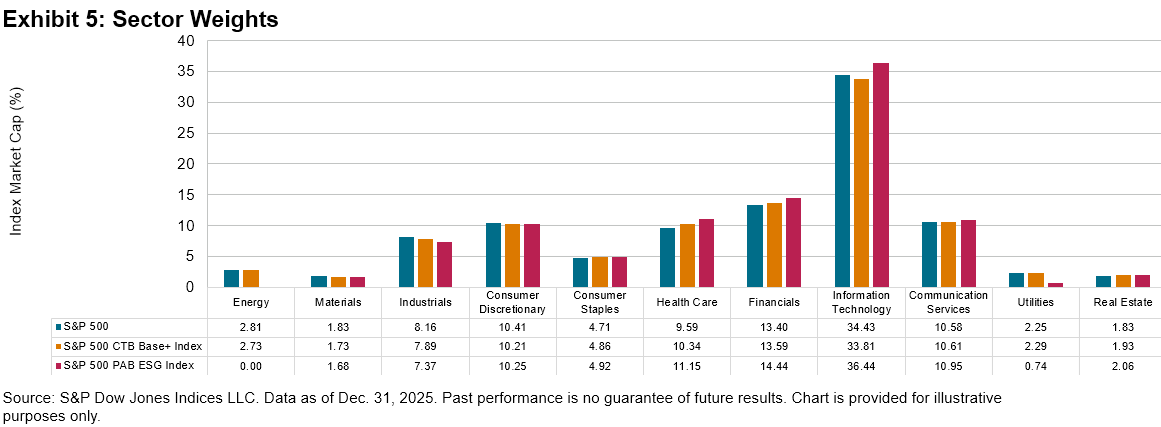
To achieve effective decarbonization requires directing capital toward companies that are actively reducing emissions, not just to those companies that are already low-carbon emitting. The minimum standards for EU CTBs offer a less exclusionary approach that helps maintain exposure to hard-to-abate sectors that are transitioning. Considering our example, the S&P 500 CTB Base+ Index mitigates sector biases, in contrast to stricter alternatives like the S&P 500 PAB ESG Index, which often underweight or exclude sectors such as Energy and Utilities (see Exhibit 5).

As an index adopts less-stringent exclusions and decarbonization goals, such as those contained in the S&P 500 CTB Base+ Index compared to the S&P 500 PAB ESG Index, a greater number of constituents become eligible, resulting in a reduced tracking error.

In summary, the S&P 500 CTB Base+ Index can potentially offer a pragmatic tool for climate-focused investors to align with the EU CTB minimum standards while potentially maintaining lower tracking error and offering a broader diversification when compared to EU PABs.

1 EU Climate Benchmarks based on the S&P 500 universe include indices such as S&P 500 PAB ESG Index, S&P 500 PAB ESG+ Index, S&P 500 PAB Sustainability Screened Index, S&P 500 CTB Index, S&P 500 CTB Base Pathway-Aligned ESG Index, S&P 500 CTB Base ESG Index and S&P 500 CTB Base+ Index.

2 For the full list of exclusions see the index methodology.

3 EVIC Inflation-Adjusted WACI. For more information on how the WACI is adjusted for EVIC inflation, see “Inflation Adjustment” in Section 3, Part 4 of the “EU Required ESG Disclosures Appendix” in the S&P Equity Paris-Aligned & Climate Transition Index Family Benchmark Statement. FAQ: EU Low Carbon Benchmark Regulation; S&P DJI Equity Sustainability metrics reference guide.

4 The forward-looking decarbonization trajectories for indices are calculated using the same sources of data as the weighted-average carbon intensity metrics calculated and disclosed elsewhere in the S&P DJI EU Low Carbon Benchmark Disclosure Report: The S&P Global Sustainable1 Environmental and Scope 3 datasets, and FactSet EVIC data.

The posts on this blog are opinions, not advice. Please read our Disclaimers.
Tracking Next Gen Factors across Economic Regimes

Why does index methodology matter when evaluating the next generation of factor solutions? S&P DJI’s Elizabeth Bebb and Xtrackers Sturmius Schneider explore the metrics powering the next generation of S&P 500 factor indices and how these new tools are helping inform market participants applying factors strategically and tactically. 

The posts on this blog are opinions, not advice. Please read our Disclaimers.