



Get Indexology® Blog updates via email.

In This List

Integrating Dividend and GARP Index Strategies in the Australian Market

Building the Future: How China Leverages Energy and Infrastructure to Supercharge Artificial Intelligence

Addressing Concentration with the S&P 500 3% Capped Index

Skewing Success

The Evolution of the S&P/BMV IPC Ecosystem

Integrating Dividend and GARP Index Strategies in the Australian Market

Contributor Image
Izzy Wang

Associate Director, Factors and Dividends

S&P Dow Jones Indices

The S&P/ASX 200 High Dividend Index measures a selection of high-dividend-yielding stocks, while the S&P/ASX 200 GARP Index (GARP standing for growth at a reasonable price) measures the performance of the top growth stocks with high quality and value composite scores selected from the respective underlying index universe. In this blog, we will explore how integrating these two index strategies potentially results in enhanced long-term risk-adjusted index performance based on hypothetical back-tested data.

Understanding the Indices

The S&P/ASX 200 High Dividend Index tracks the performance of 50 high-dividend-yielding companies from the S&P/ASX 200, after screening out A-REITS and low momentum stocks.1 Across back-tested time horizons, the S&P/ASX 200 High Dividend Index demonstrated a higher theoretical dividend yield and better total return performance than the S&P/ASX 200. Based on back-tested data, for the period July 31, 2011, to Aug. 31, 2025, the index would have had an average trailing 12-month dividend yield of 5.6% and an annual excess return of 1.91% when compared with the S&P/ASX 200.

On the other hand, the S&P/ASX 200 GARP Index could help to identify growth companies while considering valuation and quality. It starts with 150 stocks with high growth scores, then selects 50 stocks with the highest quality and value composite scores.2 Across back-tested time horizons, the S&P/ASX 200 GARP Index exhibited an ability to reflect growth opportunities. For the period from July 31, 2011, to Aug. 31, 2025, the S&P/ASX 200 GARP Index would have outperformed the S&P/ASX 200 by 2.05% per year.

Combination Results

While high-dividend index strategies are often concentrated in the Financials sector, the S&P/ASX 200 GARP Index tends to underweight Financials.3 As of Aug. 31, 2025, the Financials sector accounted for 43.6% and 6.6% of the S&P/ASX 200 High Dividend Index and S&P/ASX 200 GARP Index, respectively. Given these weights, the hypothetical combination of GARP and dividend index strategies would potentially complement sector weighting, demonstrate lower tracking error to the S&P/ASX 200 benchmark and ultimately improve risk-adjusted performance, all based on back-tested data.

We combined the two indices at various proportions moving from 100% in the S&P/ASX 200 High Dividend Index to 100% in the S&P/ASX 200 GARP Index by 10% increments, which resulted in 11 hypothetical combinations as illustrated in Exhibit 1. All hypothetical combinations are rebalanced semiannually. For the period July 31, 2011, to Aug. 31, 2025, a hypothetical composition of 50% in the S&P/ASX 200 GARP Index and 50% in the S&P/ASX High Dividend Index generated a higher total return at a lower volatility compared with either standalone index.

Comparing with the Regional Core Benchmark: S&P/ASX 200

Exhibit 2 shows the risk/performance profiles of the S&P/ASX 200, S&P/ASX 200 High Dividend Index, S&P/ASX 200 GARP Index and the 50/50 hypothetical composition. Across the back-tested time horizon from July 31, 2011, to Aug. 31, 2025, the 50/50 combination posted a higher annualized total return of 11.7% at a lower volatility of 12.82%, resulting in a better risk-adjusted return of 0.91. It outperformed the S&P/ASX 200 by 2.07% per year.

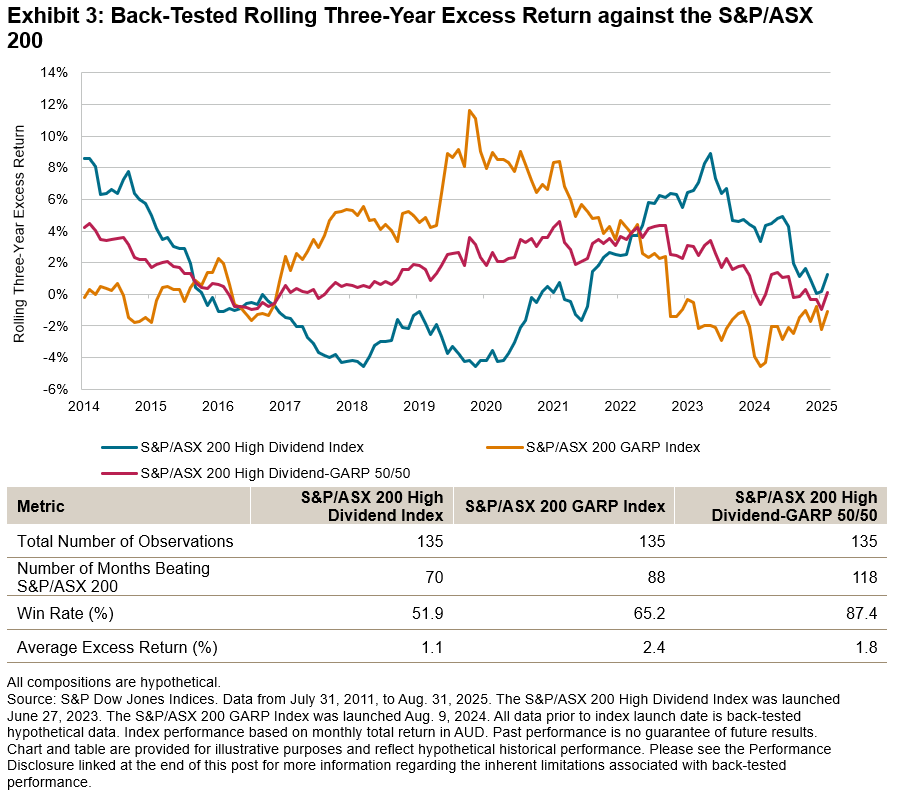
Exhibit 3 illustrates the rolling three-year back-tested performance of the S&P/ASX 200 High Dividend Index, S&P/ASX 200 GARP Index and a 50/50 hypothetical combination of the two indices. From the 135 samples observed from July 2011 to August 2025, the S&P/ASX 200 High Dividend Index and S&P/ASX 200 GARP Index would have outperformed the S&P/ASX 200 52% and 65% of the time, respectively. The outperformance rate was even higher after combining the indices. The 50/50 hypothetical composition outperformed the S&P/ASX 200 in 87% of the samples observed, with an average excess return of 1.8%. An outperformance rate of nearly 90% underscores the performance resilience of the 50/50 combination across various market conditions.
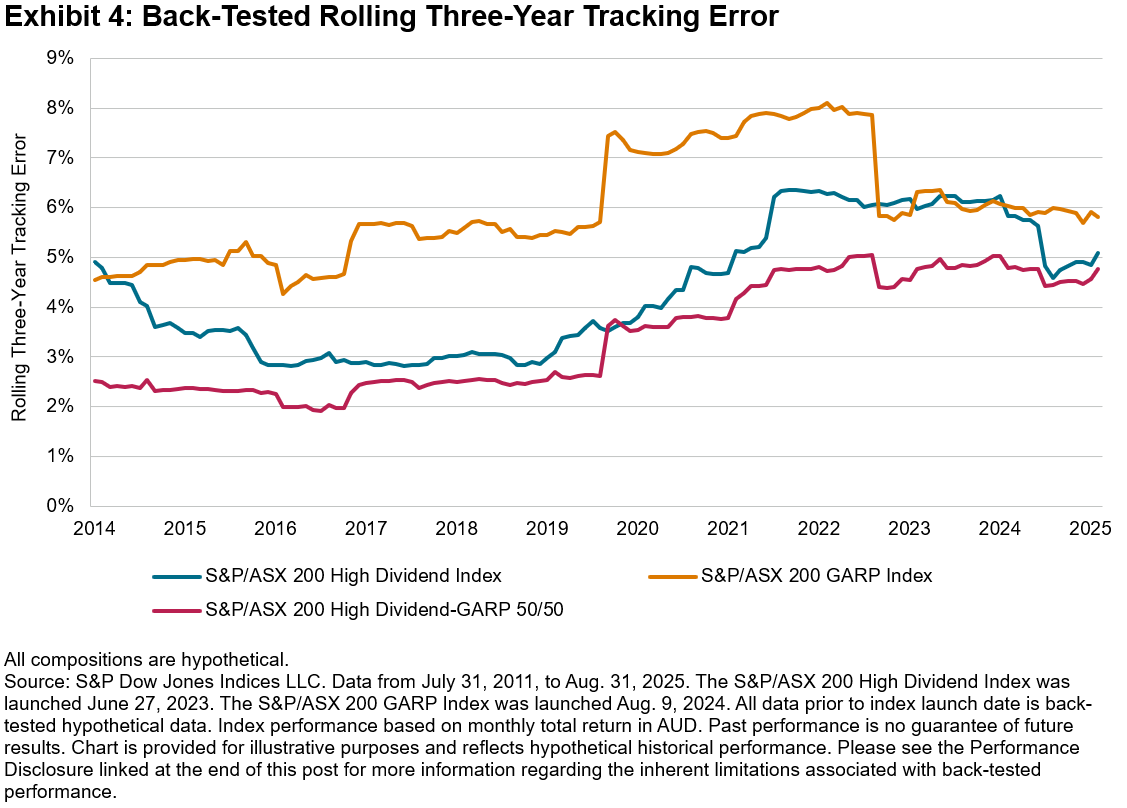
Thanks to diversification, a hypothetical 50/50 combination had a significantly lower tracking error against the S&P/ASX 200 than each component index. Exhibit 4 shows the rolling three-year tracking error. From July 31, 2011, to Aug. 31, 2025, the average tracking error of the 50/50 combination would have been 3.4%, which was lower than the 6.0% of the S&P/ASX 200 High Dividend Index and the 4.3% of the S&P/ASX 200 GARP Index.
In conclusion, the hypothetical combination of the S&P/ASX 200 High Dividend Index and the S&P/ASX 200 GARP resulted in a composition with a relatively low tracking error to its benchmark but better historical performance than the S&P/ASX 200, historically. This demonstrates the potential for factor index applications in the Australian market.

1 For index methodology, please refer to: https://www.spglobal.com/spdji/en/methodology/article/sp-high-dividend-indices-methodology/

2 For index methodology, please refer to: https://www.spglobal.com/spdji/en/methodology/article/sp-garp-indices-methodology/

3 Jason Ye (August 2025). Introducing the S&P/ASX 200 GARP Index


The posts on this blog are opinions, not advice. Please read our Disclaimers.

Building the Future: How China Leverages Energy and Infrastructure to Supercharge Artificial Intelligence

Contributor Image
Darius Nass

Associate Director, Global Equity Indices

S&P Dow Jones Indices

China’s vast development of renewable energy and infrastructure is more than just an engineering feat. It is the foundation for the age of artificial intelligence. From solar farms to high-speed rail and 5G networks, these investments provide the power and connectivity needed to operate AI at scale. The impact of these advancements is reflected by a variety of S&P DJI China benchmarks, which, through the inclusion of different share classes, offer distinct perspectives into the country’s capital markets. For example, the S&P China 500 and its subset, the S&P China 50 Index, provide a comprehensive view across listings, while the S&P China A 300 Index and S&P China A 50 offer a domestic perspective.

Energy as the AI Backbone

AI is energy-intensive, and China, the world’s largest electricity producer since 2011, has rapidly expanded renewables, lifting their share from 28% in 2021 to 36% today.1 In the first half of 2025, China added nearly 250 gigawatts of solar and wind energy, raising its total solar capacity above 1 terawatt, which accounts for over half of the global capacity.2

Despite its dominance, China is often underweighted in global benchmarks. In the S&P Global Clean Energy Transition Index, China accounts for approximately 13% of the index weight but 32% of the constituents. Structural factors such as state ownership, lower valuations and historical access constraints result in global benchmarks that understate China’s role. Interestingly, much of the index’s clean energy coverage (54%) falls under the GICS® Utilities sector, including electric and renewable power producers.3

In contrast, domestic benchmarks such as the S&P China 500 Energy Index and the S&P China 500 Utilities Index provide pure China coverage, measuring firms central to clean energy generation, transmission and distribution.

Infrastructure at Scale

Power alone cannot enable AI without logistics and networks. China operates 48,000 kilometers of high-speed rail (approximately 70% of global mileage),4 7 of the 10 busiest ports5 and is the global leader in shipbuilding.6 Digital infrastructure has expanded even faster—with 4.4 million 5G base stations and more than 1 billion subscribers, China accounts for approximately 60% of global 5G coverage.7, 8

These achievements are measured by the S&P Asia Infrastructure Index, which tracks leading regional infrastructure companies, with China accounting for approximately 21% of the index weight and one-third of its constituents.

Convergence in Markets

China’s “New Infrastructure” strategy integrates ultra-high-voltage grids, AI computing centers, 5G and smart transport, aligning energy and infrastructure directly with AI. This buildout is accompanied by scientific depth: in 2024 China spent CYN 3.6 trillion (approximately USD 500 billion) on R&D across science and technology, now ranking second globally. It leads in number of academic AI publications, AI patents and STEM PhDs, while the U.S. still leads in top generative AI models. The gap, however, is closing.9, 10

Over the past 12 months, broad-based strength has been visible across China’s sectors, with Information Technology (up 105.1%) benefiting from AI investment, Industrials (up 43.8%) supporting infrastructure buildout and Energy (up 13.9%) providing the foundation. Together, these results demonstrate how China’s strategic priorities are reflected in its markets.

Conclusion

As artificial intelligence becomes a defining theme of the next decade, China’s advances across energy, infrastructure and research provide a unique foundation for growth. This transformation is already visible in the capital markets, with S&P DJI’s China benchmarks offering complementary lenses that measure different aspects of the shift—whether broad, domestic or sector specific.

1 https://www.iea.org/energy-system/renewables

2 https://climateactiontracker.org/countries/china/policies-action/

3 Source: S&P Dow Jones Indices LLC. Data as of Sept. 12, 2025

4 https://www.scmp.com/economy/china-economy/article/3319006/china-vows-high-speed-rail-upgrade-after-years-record-breaking-expansion

5 https://www.ship-technology.com/features/the-top-10-busiest-container-ports-in-the-world/

6 https://www.csis.org/analysis/china-dominates-shipbuilding-industry

7 https://www.rcrwireless.com/20250428/5g/china-reaches-4-5g

8 https://www.mordorintelligence.com/industry-reports/5g-base-station-market

9 https://www.globaltimes.cn/page/202501/1327442.shtml

10 https://hai.stanford.edu/ai-index/2025-ai-index-report

The posts on this blog are opinions, not advice. Please read our Disclaimers.

Addressing Concentration with the S&P 500 3% Capped Index

Contributor Image
Cristopher Anguiano

Associate Director, U.S. Equity Indices

S&P Dow Jones Indices

Concentration within the S&P 500® has risen sharply in recent years, reaching multi-decade highs (see Exhibit 1) and reflecting broader trends in the U.S. large-cap equity market. As a result, more market participants are actively seeking ways to mitigate concentration risk. The S&P 500 3% Capped Index offers a practical approach by applying a straightforward capping rule: no single company may exceed a 3% weight at each quarterly rebalancing. This methodology enables market participants to measure U.S. large-cap equity performance with reduced concentration relative to the S&P 500.

A key measure of diversification is the diversification ratio, which compares the standalone risk of individual constituents to the total risk of the combined index. A higher ratio reflects enhanced diversification. Intuitively, indices that are highly concentrated or exhibit strong constituent correlations tend to have lower diversification ratios.

Over the past five years, as the S&P 500 became increasingly concentrated, the S&P 500 3% Capped Index consistently delivered positive excess diversification (see Exhibit 2). Interestingly, between December 2022 and December 2024—despite elevated market concentration—constituent correlations within the S&P 500 declined sharply from 40% to 19%.1 This drop in correlation contributed to an increasing diversification ratio during that period.

Beyond diversification, the S&P 500 3% Capped Index was historically more insulated against some of the largest market declines.  Exhibit 3 shows that during the S&P 500’s five worst drawdowns over the past 25 years, the S&P 500 3% Capped Index fell less in four out of five instances.

The S&P 500 3% Capped Index’s lower weight in some of the largest names contributed to it being more insulated during periods of market stress. During peak-to-trough periods, the largest companies typically experienced the sharpest declines (see Exhibit 4). For example, in the second-largest drawdown, the average total return from capped companies was -49.0%, more than 2.5 times that of the remaining companies (-18.5%). The S&P 500 3% Capped Index, with lower weight in these names, was less affected.

Lastly, while both indices experienced similar periods of stress, the smaller drawdowns helped the S&P 500 3% Capped Index to recover more quickly than the S&P 500 (see Exhibit 5).

Conclusion

The S&P 500 3% Capped Index follows a transparent, rules-based methodology and seeks to address concentration concerns. By capping individual company index weights, it has historically helped to mitigate the specific risks associated with dominant names and enhance diversification. A lower weight in some of the largest names contributed to the S&P 500 3% Capped Index’s smaller drawdowns during periods of market stress.

1 For more information, see Index Dashboard: Dispersion, Volatility & Correlation.

The posts on this blog are opinions, not advice. Please read our Disclaimers.

Skewing Success

Contributor Image
Anu Ganti

Head of U.S. Index Investment Strategy

S&P Dow Jones Indices

The results from our SPIVA® U.S. Mid-Year 2025 Scorecard demonstrate a relatively better start to the year for active managers, with 54% of U.S. large-cap funds underperforming the S&P 500®, slightly better than the 65% reported in 2024. However, Exhibit 1 shows that over the more than 24-year history of our SPIVA U.S. Scorecard, majority outperformance occurred in only 3 out of these 24 years. Most active managers underperform most of the time. 

Why is outperformance so difficult? A long-standing challenge that active managers face is the positively skewed nature of equity returns, with an average return greater than that of the median. Exhibit 2 plots the distribution of cumulative returns for the constituent stocks of The 500™ for the past 25 years. The median return was 59%, far less than the arithmetic average of 452%. When fewer stocks outperform, active management is harder. This is especially relevant for more concentrated portfolios that may be less likely to hold one of the relatively small number of outperforming stocks.

H1 2025 was no exception, characterized by positive skew in the S&P 500’s constituent performance, as shown in Exhibit 3, with the average return outpacing the median return by 1.3%. These results are not surprising, as the average return has been greater than the median for The 500’s constituents in 20 out of the past 24 years.

When the handful of stocks that outperform are also skewed toward larger capitalization companies, that can be an additional headwind for managers who are underweight the largest stocks. Offering an additional perspective on the prospects for stock pickers, Exhibit 3 shows the percentage of constituents that beat the benchmark by year. 44% of member stocks beat the S&P 500 in H1 2025, an improvement from the 28% witnessed in 2024 and the 26% in 2023, both challenging years driven by mega-cap dominance.

The fact that 46% of Large-Cap funds outperformed indicated there may been pockets of opportunity for nimble stock pickers to capitalize on. Although the largest stocks in The 500 were among the best performers, with the index’s return of 6.2% in H1 above that of the simple average of 5%, large-cap outperformance did not occur in a consistent pattern during the first half of the year, a period featuring a new presidential regime and fluctuating tariff policies.

One way to visualize the changing degree of large-cap dominance is through the relative performance of the S&P 500 Equal Weight Index, which offers a proxy for the performance of the average stock in the benchmark, versus its cap-weighted peer, by quarter. Equal weight’s outperformance in Q1 coincided with 62% of stocks outperforming The 500. However, as the market recovered speedily from tariff-related turmoil, mega caps returned to favor and only 29% of stocks outperformed in Q2, consistent with equal weight’s reversal into underperformance.

As we approach the end of Q3, recent conditions for stock pickers have remained challenging. 36% of stocks outperformed The 500 quarter-to-date, amid the S&P 500 Equal Weight Index’s continued underperformance coupled with a positively skewed distribution for The 500. If these trends continue, we may see headwinds for active managers throughout the rest of 2025.

The posts on this blog are opinions, not advice. Please read our Disclaimers.

The Evolution of the S&P/BMV IPC Ecosystem

Contributor Image
Eduardo Olazabal

Associate Director, Global Exchange Indices

S&P Dow Jones Indices

Since its inception in 1978, the S&P/BMV IPC has served as Mexico’s flagship equity index, tracking the performance of the 35 largest and most liquid stocks listed on the Bolsa Mexicana de Valores (BMV). Over the decades, the index has become a cornerstone of the Mexican financial market, and the ecosystem surrounding it has grown substantially. Today, there are more than USD 9 billion in assets benchmarked or tracking the index, including Latin America’s largest locally listed ETF, which manages over USD 4.5 billion in assets.1

An Expanding Ecosystem of Indices

The S&P/BMV IPC has not only served as a benchmark but also as the foundation for a wide range of derived indices. These indices cater to diverse investment strategies and preferences, enabling market participants to track Mexican equities in more targeted and innovative ways.

Global Accessibility and Market Integration

The S&P/BMV IPC is the most liquid and representative equity index in Mexico, making it a natural candidate for derivatives trading. Historically, futures and options linked to the index have been listed on MexDer, providing market participants with tools for hedging and exposure to Mexican equities.

The recent launch of e-mini S&P/BMV IPC futures on CME represents an expansion of this ecosystem, providing market participants with more options for access to the Mexican equity market. This milestone reflects the continued evolution of the S&P/BMV IPC ecosystem, which has been built over the years through robust infrastructure, regulatory alignment and market education.

Now, investors around the world can access the Mexican equity market nearly 24 hours a day, which may support:

  • Real-time risk management across time zones;
  • Capital allocation across regions and asset classes; and
  • Using margining frameworks that apply across multiple equity index products.

Moreover, the availability of these futures is expected to enhance cross-market participation and improve price discovery, ultimately contributing to greater liquidity in the Mexican equity market.

Unlocking New Opportunities

With the global availability of futures, market participants around the world have new tools to:

  • Hedge Mexican equity exposure;
  • Express tactical views on Mexico within global portfolios; and
  • Access one of the largest emerging equity markets.

As the S&P/BMV IPC ecosystem continues to evolve, these developments represent more than just new products—they symbolize a gateway to deeper liquidity, broader participation and greater integration of Mexico into the global investment landscape.


  1. Data from Morningstar as of Aug. 29, 2025.


The posts on this blog are opinions, not advice. Please read our Disclaimers.