











North American institutional asset owners have been using exchange-traded funds (ETFs) for more than a decade, but the way they use them has evolved. What began as a set of short-term tactical applications—manager transitions, portfolio completion and liquidity management—has expanded into long-term strategic uses. Sizable assets are now being deployed and held in ETFs for several years across a widening set of asset classes.
To learn more about this evolving dynamic, S&P Dow Jones Indices engaged Crisil Coalition Greenwich to survey 150 institutional asset owners across channels and sizes in the U.S. and Canada.1 The findings from the study shed light on asset owners’ ETF usage, the benefits from their perspective and their key evaluation criteria.
Why Asset Owners Are Turning to ETFs
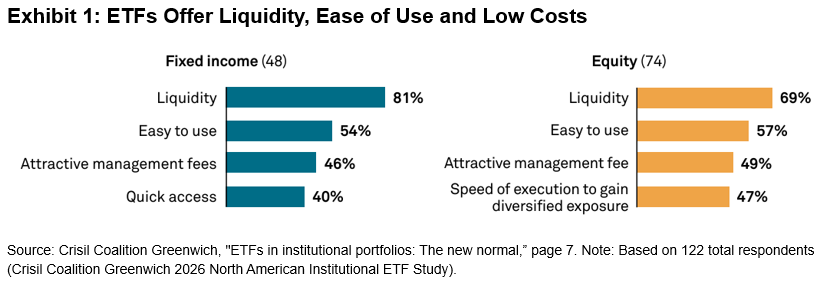
Institutional allocators point to a consistent set of characteristics when describing why they hold ETFs. Liquidity ranks first in both equities and fixed income. Ease of use, low management fees and quick access to markets follow closely behind (see Exhibit 1).2 Together, these attributes have outweighed the benefits of other investment vehicles in certain instances. In fact, institutional asset owners report using ETFs to replace wrappers they have historically relied on for index-based and active strategies, including index mutual funds, institutional separate accounts and active mutual funds.3
A Growing Range of Use Cases
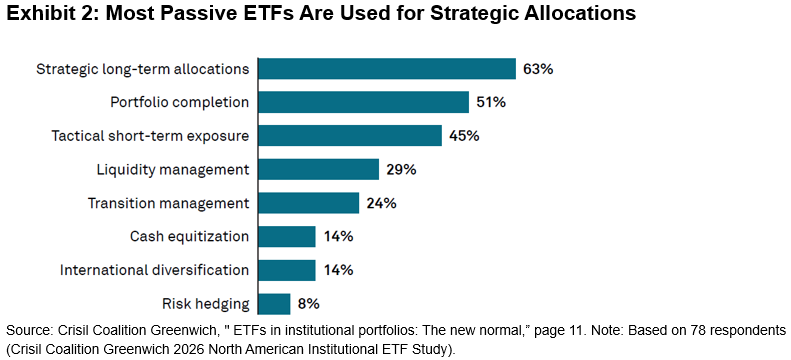
The study points to a clear shift in how ETFs are being applied. Nearly two-thirds (63%) of passive ETF assets in North American institutional asset owner portfolios are now categorized as long-term strategic allocations—the most common use cited—versus less than half (45%) for tactical short-term applications (see Exhibit 2).4 Holding periods reflect that view: 46% of allocators report average passive ETF holding periods of more than two years.5
Use cases are also extending beyond core equity beta. Institutional asset owners in the study describe using ETFs across fixed income segments and thematic strategies, and some report emerging interest in using ETFs to access private markets.6 Actively managed ETFs are in demand as well. More than 20% of institutions reported plans to increase active ETF allocations over the next three years.7
Who Is Using ETFs and What They Look For
ETF usage spans institutional asset owner types and asset bases. According to the study, over half (54%) of North American institutions now use ETFs.8 When looking across segments, 70% of insurance companies and 71% of endowments and foundations report allocating to ETFs, and adoption among public and corporate pensions continues to expand.9 Among these ETF users, the largest institutions represent the most significant investors; 62% of those with more than USD 10 billion in assets under management reported ETF holdings.10
When selecting an index-based ETF, decision makers look most closely at expense ratio, liquidity/trading volume, tracking error and benchmark construction. For active ETFs, similar criteria apply with an added emphasis on historical performance and asset manager reputation.11 Roadblocks remain, though, as the most common reason non-users cite for not investing in ETFs is lack of organizational approval. Still, more than half of non-users in the study reported they are actively considering ETF adoption.12
How Investment Universes Are Evaluated
Indices serve as the backbone for both passive and active ETF strategies, and the institutions surveyed reflect that in how they evaluate index providers. The top characteristics they look for are methodology consistency, rigor and transparency; cost efficiency for linked products; liquidity of underlying benchmarks; and historical track record.13 Those criteria align with the broader role index providers play in supporting transparency and governance across the market. As use cases extend into less-traveled corners of the market—including fixed income segments, thematic ideas and other specialized areas—the depth of index design and asset class expertise behind an ETF can become a more critical part of institutional allocators’ considerations.
A New Normal
The results of the Crisil Coalition Greenwich 2026 North American Institutional ETF Study reveal a market in which ETFs started as tactical tools and have now become a core part of institutions’ long-term investment strategies. Adoption has broadened, holding periods have lengthened and use cases continue to expand. To explore the results further, read the full report.
1 The Crisil Coalition Greenwich report “ETFs in institutional portfolios: The new normal” was sponsored by S&P Dow Jones Indices. Please see pages 2 and 3.
2 Please see page 7 of Crisil Coalition Greenwich’s “ETFs in institutional portfolios: The new normal.”
3 Please see pages 5 and 6 of Crisil Coalition Greenwich’s “ETFs in institutional portfolios: The new normal.”
4 Please see pages 2 and 11 of Crisil Coalition Greenwich’s “ETFs in institutional portfolios: The new normal.”
5 Please see page 11 of Crisil Coalition Greenwich’s “ETFs in institutional portfolios: The new normal.”
6 Please see pages 7, 12 and 15 of Crisil Coalition Greenwich’s “ETFs in institutional portfolios: The new normal.”
7 Please see page 14 of Crisil Coalition Greenwich’s “ETFs in institutional portfolios: The new normal.”
8 Please see page 3 of Crisil Coalition Greenwich’s “ETFs in institutional portfolios: The new normal.”
9 Please see page 5 of Crisil Coalition Greenwich’s “ETFs in institutional portfolios: The new normal.”
10 Please see pages 3 and 4 of Crisil Coalition Greenwich’s “ETFs in institutional portfolios: The new normal.”
11 Please see page 8 of Crisil Coalition Greenwich’s “ETFs in institutional portfolios: The new normal.”
12 Please see pages 2 and 17 of Crisil Coalition Greenwich’s “ETFs in institutional portfolios: The new normal.”
13 Please see page 10 of Crisil Coalition Greenwich’s “ETFs in institutional portfolios: The new normal.”
The posts on this blog are opinions, not advice. Please read our Disclaimers.