


Get Indexology® Blog updates via email.

In This List

Wrapping Up the 2024 SPIVA Institutional Scorecard

What is SPIVA?

Indicization Nation

Precious Metals Shine across August Thematics

The S&P 500 Christian Values Screened Index: A New Benchmark to Serve Faith-Based Needs

Wrapping Up the 2024 SPIVA Institutional Scorecard

Contributor Image
Michael Brower

Former Associate Director, Index Investment Strategy

S&P Dow Jones Indices

For over 20 years, the S&P Indices versus Active (SPIVA®) U.S. Scorecard has assessed how active mutual fund managers perform against their relevant S&P Dow Jones Indices benchmarks across various timeframes and asset classes. The scorecard’s methodology was enhanced in 2015 to include institutional accounts and was further extended in 2023 to include separately managed wrap accounts (SMAs), which have an annual fee structure that bundles (or wraps) all the administrative, commission and management expenses for the account.

Wrap accounts differ from institutionally focused separate accounts in that they allow smaller market participants to access professional portfolio managers, which were once only available to large institutional investors.1 The SPIVA Institutional Scorecard is important because it facilitates comparisons between institutional and SMA/wrap accounts on a gross-of-fees basis, eliminating any possibility that fees are the sole contributor to a given manager’s underperformance.

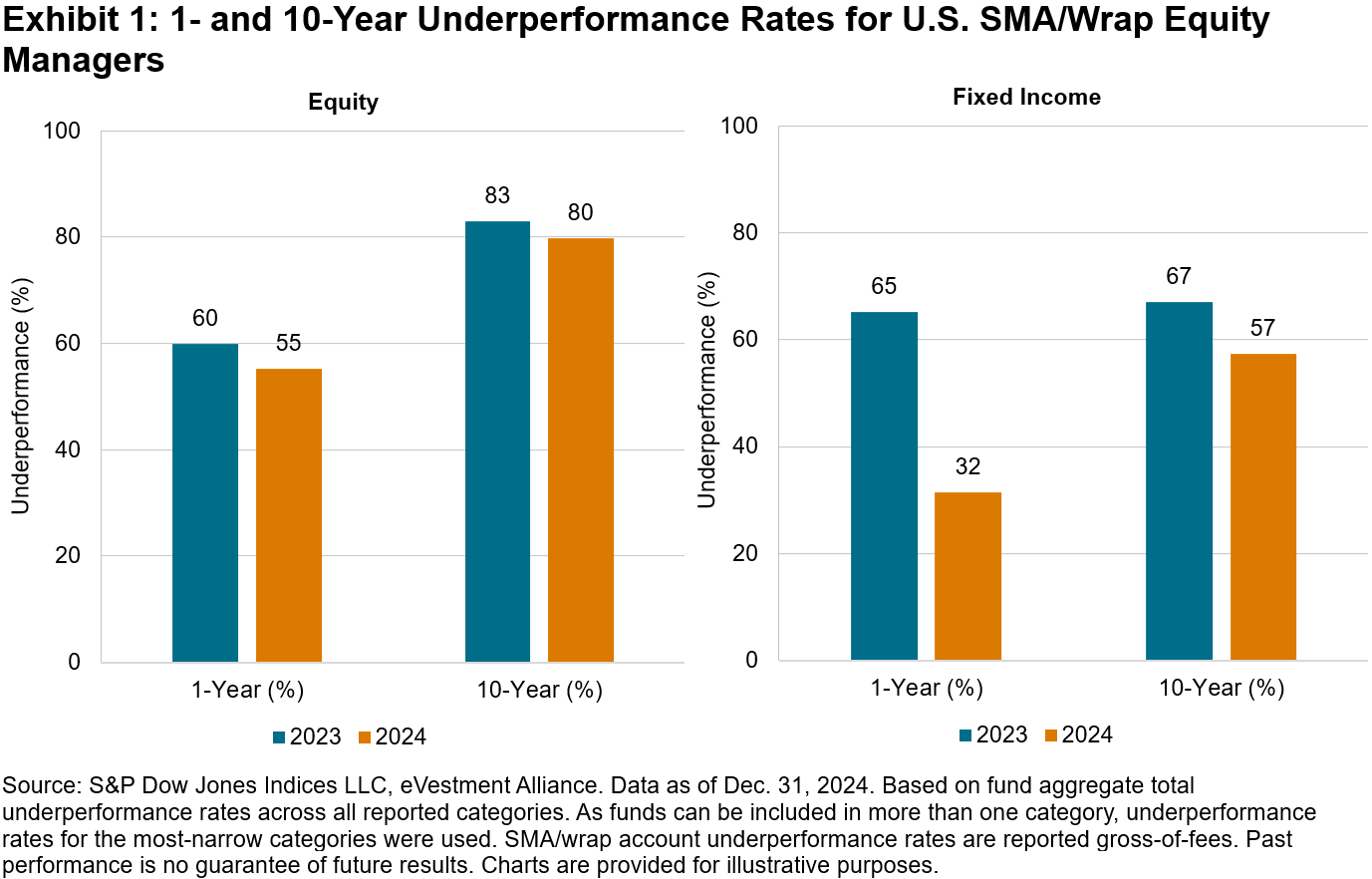
Exhibit 1 demonstrates that 55% of equity SMAs/wrap accounts underperformed their benchmarks in 2024, down 5% from 2023. This difference was more pronounced in fixed income, where only 32% of SMAs/wrap accounts underperformed in 2024 but over 65% underperformed in the year prior. Nevertheless, and consistent with past SPIVA research, rates of underperformance for equities and fixed income increased over longer measurement periods. 80% of equity accounts and 57% of fixed income accounts failed to outperform their respective benchmarks over a 10-year period.
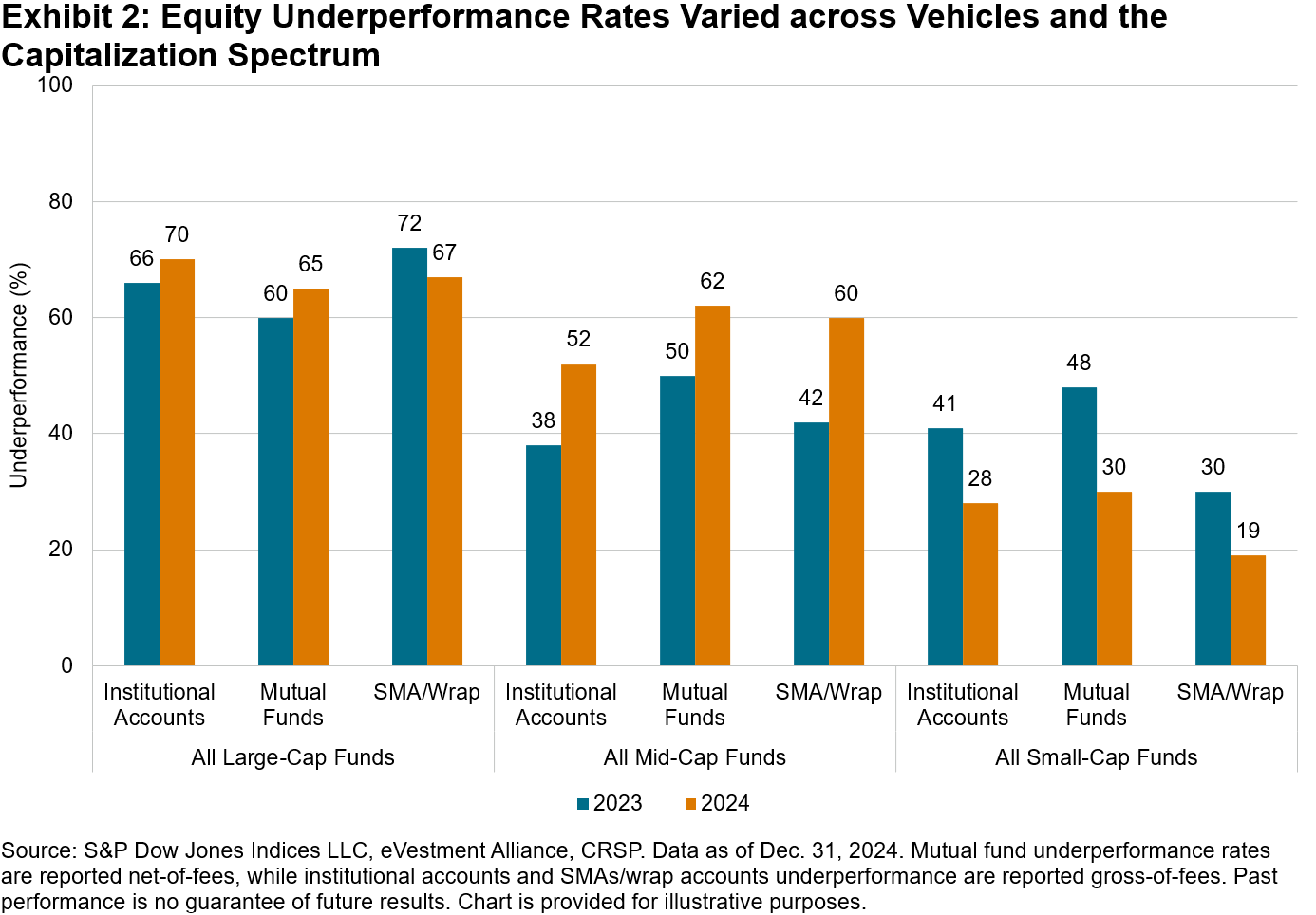
Active performance varied considerably by market capitalization. 67% of All Large-Cap SMA/wrap managers underperformed the S&P 500® in 2024, generally consistent with their institutional mutual fund peers. Small-cap managers fared better, with only 19% underperforming their respective benchmarks in 2024, outpacing the 30% underperformance rate in 2023. Managers were perhaps aided by style bias opportunities to tilt toward outperforming large-cap stocks. Last year, The 500™ outpaced the S&P MidCap 400® and S&P SmallCap 600® by 11.1% and 16.3%, respectively.
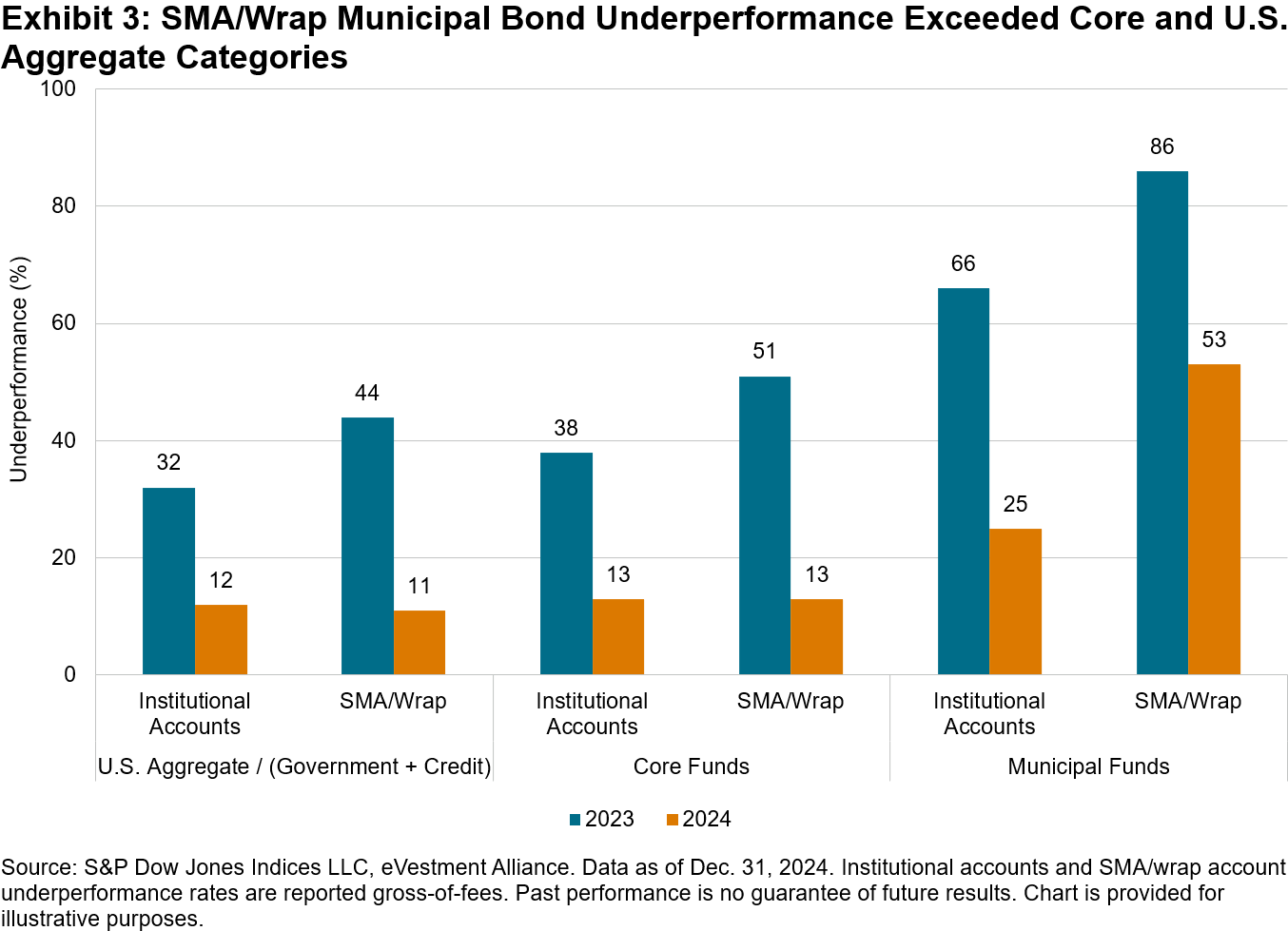
Turning to fixed income SMA/wrap performance, Exhibit 3 shows that U.S. Aggregate and Core accounts delivered majority outperformance, with only 11% and 13% of accounts failing to outperform their benchmarks, respectively, which was an improvement over their institutional peers. However, Municipal accounts may have had a tougher time, with more than half underperforming the S&P National AMT-Free Municipal Bond Index.
Beating the benchmark can be a challenge regardless of investment vehicle, and SMAs/Wrap accounts are no exception. For a more complete analysis of performance across segregated institutional and SMAs/wrap accounts, we invite you to read our full 2024 SPIVA Institutional Scorecard.

1 Comprehensive definitions for SMAs can be found in the eVestment Alliance Glossary of Terms.

The posts on this blog are opinions, not advice. Please read our Disclaimers.

What is SPIVA?

For over two decades, S&P Dow Jones Indices has measured the performance of actively managed funds against their index benchmarks across the world through the SPIVA Scorecards. Take a closer look at the fundamental principles that guide our SPIVA research and discover the insights these scorecards offer across asset classes, regions and market segments.

The posts on this blog are opinions, not advice. Please read our Disclaimers.

Indicization Nation

Contributor Image
Anu Ganti

Head of U.S. Index Investment Strategy

S&P Dow Jones Indices

To indicize means to provide, in passive form, a strategy formerly available only via active management. Until the early 1970s, there were no index funds; all assets were managed actively. The shift of assets from active to passive management is one of the most important trends in modern financial history. Our recent Annual Survey of Indexed Assets shows assets tracking the S&P 500® amounted to USD 13 trillion as of December 2024.1

One of the reasons for the popularity of indexing is its low cost relative to active management. As indexing has grown, investors have benefited substantially by saving on fees. We can estimate the fee savings by multiplying the difference between the average expense ratios of active and index equity mutual funds2 by the total value of indexed assets for The 500™, the S&P MidCap 400® and the S&P SmallCap 600®.

When we aggregate the results, we observe that the savings in management fees in 2024 was USD 52 billion (see Exhibit 1), an increase of USD 12 billion from the USD 40 billion in savings observed in 2023. Of course, this USD 52 billion estimate understates the full cost savings of the index industry, since it encompasses indices only from S&P Dow Jones Indices (and not even all of those).

Obviously, the cost savings generated by the shift from active to passive management would be inconsequential if market participants lost more in performance shortfalls than they gained in reduced fees. However, as readers of our SPIVA® reports are well aware, that’s decidedly not the case: most active managers have underperformed most of the time. Looking across our more than 24 years of history, large-cap active managers posted majority outperformance in only three years. Long-term underperformance has been even worse, with 91% of all large-cap U.S. managers lagging The 500 over the 20 years ending in June 2025. The rise of passive management has been a notable consequence of active performance shortfalls.

The lives of active managers have been further challenged by the indicization of markets, as the movement of assets to passive alternatives can cause the least capable active managers to lose the most assets and the quality of the surviving active managers to rise. As a result, the competition for outperformance becomes tougher,3 consequently raising the bar for surviving managers.

Advances in passive management have made it easier for investors to access efficient and inexpensive strategies spanning across the capitalization spectrum, geographies, sectors, factors and themes, compounding the benefits for numerous market participants globally.

1 S&P Dow Jones Indices Annual Survey of Assets. S&P Dow Jones Indices, 2024

2 See Ellis, Charles D., “The Loser’s Game,” The Financial Analysts Journal, Vol. 31, No.4, Jul/August 1975, pp. 19-26. New York: Financial Analysts Federation.

3 Expense ratios sourced from Investment Company Institute, 2025 Investment Company Fact Book.

The posts on this blog are opinions, not advice. Please read our Disclaimers.

Precious Metals Shine across August Thematics

Contributor Image
Sabatino Longo

Analyst, Global Equity & Thematic Indices

S&P Dow Jones Indices

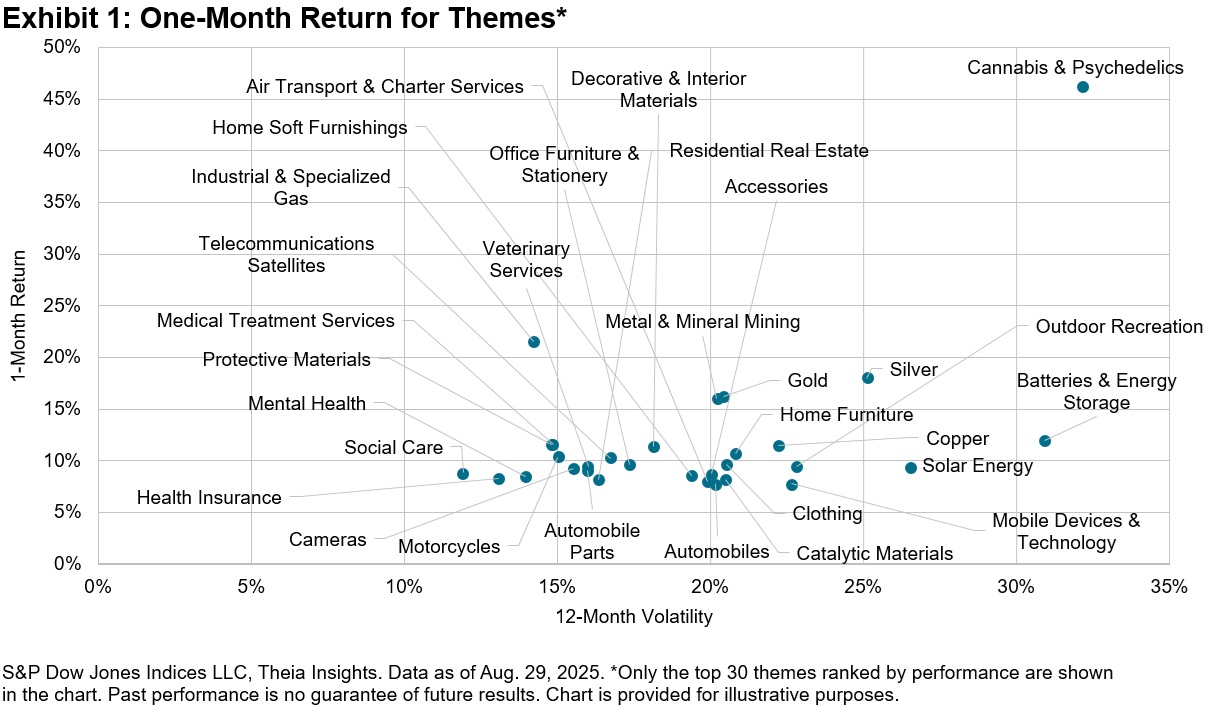
August’s S&P Thematics Dashboard captures a market in motion—from precious metals rallying to multi-year highs to energy and technology themes. With the ongoing macro-political uncertainty in the backdrop, Silver (up 18%) reached a 14-year high, with Gold up 16% on dovish Fed expectations and a weaker U.S. dollar.1 This momentum extended across the metals complex, with Metal & Mineral Mining up 16% and Copper gaining 12% on infrastructure spending prospects and supply-demand tightness.2

Alternative Medicine Takes the Stage

The standout performer of the month was Cannabis & Psychedelics, which soared 46%. Renewed investor enthusiasm was driven by shifting regulatory debates in Europe and the U.S.3 alongside new developments in the cannabis beverage market.4 Clinical confidence is also rising: mid-stage trials report that psychedelics might reduce anxiety symptoms—sometimes with effects lasting up to three months—highlighting renewed interest in psychedelic-assisted therapy’s potential.5 Strength also extended across the broader healthcare space, with Medical Treatment Services, Mental Health  and Health Insurance up 12%, 8.5% and 8%, respectively.

Energy Transition Shows Mixed Signals

Large-cap energy was among the top sector performers in the second quarter, with Batteries & Energy Storage climbing 12% on strong electric vehicle adoption, recycling breakthroughs and infrastructure buildout.6 Solar Energy gained 9%, while traditional power sources like Coal (up 6%) and Nuclear (up 4%) reminded investors of their persistence.

By contrast, Wind Energy declined 4% after federal funding cuts and policy reversals nearly completed halted offshore projects.7 The contrasting outcomes highlight how policy decisions and infrastructure investment trends are shaping winners and laggards within the energy transition.

Digital Assets and Regulatory Momentum

The digital asset space showed modest gains in August, with Cryptocurrency & Digital Assets up 3% and Blockchain & Distributed Ledger down -2%. Investor sentiment was positively shaped by regulatory debates, particularly around U.S. policy efforts to establish clearer rules for stablecoins and crypto market oversight. This shift in tone provided a constructive backdrop for the sector, even as price action remained relatively muted. By month’s end, the broader crypto market reached roughly USD 4 trillion in value, supported by growing optimism that regulatory clarity could open the door to greater institutional participation.8

Technology and Defense Overview

Technology themes lagged. Artificial Intelligence (-2%), Digital Transformation (-2%) and Cybersecurity (up 0.1%) all underperformed. Structural progress in AI and robotics continues: OpenAI launched ChatGPT Agent,9 Amazon reached one million robots with its DeepFleet logistic system10 and AWS debuted a marketplace for autonomous AI agents.11

Meanwhile, defense tech gained visibility as the U.S. Army signed a USD 10 billion enterprise AI contract with Palantir, highlighting the growing role of commercial AI in national security.12 European defense was down, with the S&P Europe Defense Vision Index falling 3%, while the S&P Kensho Global Future Defense Index was up 9%, driven largely by U.S. names.

Themes on the Radar: Powering the AI Era

AI-driven data center growth is supporting a renaissance of the U.S. grid dynamics. Electricity demand from AI data centers is projected to surge nearly thirtyfold by 2035, potentially accounting for 70% of all data center electricity consumption,14 and 13% of total U.S electricity demand.[14] In response to this rise, companies are also exploring the expansion of nuclear capacity, including Constellation Energy’s multibillion-dollar commitment to restart key facilities and expand generation capacity.15

These developments are translating into tangible market growth: the Data Center theme was up approximately 39% YTD, while energy infrastructure-linked names—reflected in the S&P U.S. Power Infrastructure Select Index—have climbed approximately 17% YTD.

Conclusion

August’s results highlighted the evolving market across multiple megatrends—from Healthcare & Wellness to Innovative Technology. Many market participants are balancing traditionally defensive positions such as precious metals with growth-driven exposures in areas like alternative medicine, energy transition and AI infrastructure. Track these developments and more in our monthly dashboard updates.

1 Gold Hits Record High on US Rate-Cut Bets, Growing Debt Concerns – Bloomberg

2 Base Metals ETFs Rally as Industrial Demand Surges—Here’s How You Can Benefit – Appreciate

3 Psychedelics regain momentum in 2025 on political tailwinds, clinical wins

4 The buzz around THC drinks is going flat – Business Insider

5 LSD shows promise for reducing anxiety in drugmaker’s midstage study – AP News

6 97% Battery Recycling Breakthrough”: Princeton NuEnergy Opens First U.S. Commercial Facility, Cutting Costs 38% and Slashing Environmental Impact – Energy Reporters

7 Trump administration cancels $679 million for offshore wind projects at ports – NPR

8 Crypto sector breaches $4 trillion in market value during pivotal week – Reuters

9 OpenAI’s new ChatGPT Agent can control an entire computer and do tasks for you – The Verge

10 Amazon DeepFleet AI Model for Robotics – Digital Commerce 360

11 The Next Big Theme: August 2025 – Global X

12 US Army pools contracts into up to $10 billion Palantir deal – Reuters

13 Deloitte Report: AI Data Center Power Demand to Surge 30x by 2035 – T&D World

14 Keller C., Thompson W., Utsav, A, “AI revolution: Meeting massive AI infrastructure demands” – Barclays

15 Constellation Commits to Billions of Dollars in Energy Investments at Inaugural Pennsylvania Energy and Innovation Summit – Constellation

The posts on this blog are opinions, not advice. Please read our Disclaimers.

The S&P 500 Christian Values Screened Index: A New Benchmark to Serve Faith-Based Needs

Contributor Image
Maria Sanchez

Director, Sustainability Index Product Management, U.S. Equity Indices

S&P Dow Jones Indices

S&P Dow Jones Indices (S&P DJI) launched the S&P 500® Christian Values Screened Index in September 2025. This milestone reflects S&P DJI’s philosophy as an independent index provider: offering choices to market participants while maintaining the objectivity and governance required by institutional investors.

Values-based investment can be traced back to 18th-century Christians in the U.S. and Europe who avoided slavery-related investments,1 establishing exclusion-based practices. However, Protestant Christian frameworks faced challenges in developing institutional-grade solutions due to diverse theological interpretations that necessitated specialized expertise. Bountiful Financial, a pioneer in faith-based investing, changed this through their newly available Evangelical Christian Investment Framework.

Using structured advisory councils, Bountiful incorporates authentic faith community insights into its Evangelical Christian Framework. This governance-driven approach strives to adhere to expressions of Christian values while maintaining institutional rigor. The Evangelical Christian Framework enables S&P DJI to more confidently meet market participant demand for specific faith-aligned solutions.

Methodology Overview

The S&P 500 Christian Values Screened Index uses a rules-based approach to screen the S&P 500 and exclude constituents in accordance with business activities aligned to Bountiful’s Evangelical Christian Framework. The index seeks to maintain similar sector weights to The 500™ as of the rebalancing reference date.2

Using Bountiful’s Religious Framework as a foundation for Evangelical Christian values and standards, S&P DJI mapped the framework against S&P Global Sustainable1’s revenue-based business involvement screens to create a precise exclusion methodology that integrates the key tenets of Christianity (see Exhibit 1).3

Historical back-testing reveals that on average, 93% of S&P 500 companies are retained (see Exhibit 2).

During the June 2025 rebalance, the index excluded only 34 companies representing 6.54% of The 500, with stem cell research being the largest exclusion category (see Exhibit 3).

The index maintains similar market weights as its benchmark through sector neutrality, using weight factors that proportionally adjust each stock based on free float market capitalization and sector representation. This approach helps to enable market participants to align with their Christian values while preserving comparable sector weighting and performance to the underlying index (see Exhibit 4). Historical back-testing indicates that the index has retained approximately 93% of companies from The 500. It exhibited a tracking error of 51-78 bps annually, with risk-adjusted returns comparable to The 500 (see Exhibit 5).

The index rebalances quarterly, effective after the close on the third Friday of March, June, September and December, aligning with the S&P 500 Catholic Values Index methodology and ensuring compliance with business activity thresholds as revenue percentages shift and market movements alter sector neutrality.

The S&P 500 Christian Values Screened Index helps to enable faith-based market participants to align their decisions with their Christian values without sacrificing rigor, coverage or performance. The index joins our comprehensive suite of values-based benchmarks, reinforcing our commitment to serving the evolving needs of global market participants and providing options to the market.

For more information about S&P DJI’s values-based index solutions, visit spglobal.com/spdji

Back-tested results are based on criteria applied retroactively with the benefit of hindsight and knowledge of factors that may have positively affected its performance. It cannot account for all financial risks that may affect actual results, and the actual performance of the index may vary significantly from the back-tested historical data.

1 Arkapretim, Roy. “The evolution of responsible investing.” Davy. June 6, 2025

2 The rebalancing reference dates are after the close of the third Friday of February, May, August and November.

3 For specific S&P Global category of involvement and description and S&P DJI level of involvement thresholds please review the S&P 500 Christian Values Screened Index Methodology.

The posts on this blog are opinions, not advice. Please read our Disclaimers.