






Get Indexology® Blog updates via email.

In This List

Exploring Tokenization: A New Era for Traditional Assets

Evolving Trends Redefining Index Usage

AI, Energy and Everything in Between: Thematics in July 2025

Expanding the S&P Quality FCF Aristocrats Indices to U.S. Mid and Small Caps

The Momentum Factor: Thriving beyond U.S. Borders

Exploring Tokenization: A New Era for Traditional Assets

Contributor Image
Stephanie Rowton

Senior Director, Tokenization and U.S. Equities

S&P Dow Jones Indices

In July 2025, S&P Dow Jones Indices (S&P DJI) announced its entry into the tokenization space1 via a strategic collaboration with Centrifuge, a decentralized infrastructure provider. The collaboration marks the first time that S&P DJI has licensed index data for the creation of a digital token and, in doing so, will bring the S&P 500® onchain—taking a significant step into the realm of tokenization. This leading-edge technology has the potential to create new opportunities for both investors and institutions with benefits spanning from operational efficiency and increased access to deeper liquidity and innovation. The tokenized asset market excluding stablecoins2 is estimated to be worth USD 25 billion as of July 30, 20253 (see Exhibit 1) and is expected to grow to between USD 1-4 trillion by 20304 (see Exhibit 2), highlighting the increasing relevance of this technology in finance.

What is Tokenization?

Tokenization refers to the process of allowing holders to transfer the rights to an asset through a digital token on a digital ledger technology such as blockchain.5 For example, physical assets such as real estate or art can be tokenized, as can investment tools such as bonds or equities.6

Tokens can both define the asset and specify what can be done with it.7 Additionally, the technology enables fractional ownership, allowing investors to own a portion of an asset rather than the entirety—potentially providing broader access to investment opportunities. By leveraging blockchain technology, tokenization may enhance transparency and operational efficiency, mitigating some of the potential risks associated with traditional asset management, such as errors from manual oversight.

Implications for Tokenized Traditional Assets

The implications of tokenizing traditional financial assets are significant. Firstly, it provides access to investments, enabling individuals who may be financially underserved to participate in the market. Secondly, tokenization can improve liquidity, as tokens can be traded across various platforms, potentially fostering a more dynamic market. Furthermore, the efficiency of blockchain technology can streamline processes, reduce costs and enhance settlement times. Traditional investment products typically involve intermediaries, such as brokers and custodians, which may introduce additional costs and inefficiencies. These fees can affect investor returns, as they reduce the overall profitability of investments. In contrast, tokenized assets may have the capacity to be traded directly between parties, potentially minimizing the need for intermediaries and facilitating quicker transactions. Additionally, the transparency of blockchain can potentially provide real-time insights into asset performance, a feature often lacking in traditional finance.

However, there are also potential hurdles, including regulatory challenges and market adoption. Regulatory bodies are still working to define the legal frameworks surrounding tokenized assets, which can create uncertainty for investors and institutions. Nonetheless, many market players are proactively engaging with regulators to establish clear guidelines, and some jurisdictions are already implementing frameworks that facilitate the growth of tokenization.8

Why S&P DJI is Entering the Tokenization Space

By licensing its intellectual property for use with tokenization, S&P DJI can provide a tool to offer cutting-edge products that resonate with a new generation of investors while continuing to meet the needs of its existing client base. This dual approach—licensing its intellectual property for both traditional finance and decentralized finance products—establishes S&P DJI as an index leader in both traditional and digital asset markets. As many financial institutions explore tokenization to enhance their offerings, S&P DJI’s proactive stance underscores its commitment to innovation and adapting to the changing demands of the market.

1 S&P Dow Jones Indices. “S&P Dow Jones Indices Collaborates with Centrifuge to Bring the S&P 500 Index Onchain, Expanding Access to the World’s Most Widely Recognized Benchmark.” July 1, 2025.

2 Bank of England. “What are stablecoins and how do they work?” Nov. 6, 2023.

3 Total RWA Onchain. RWA.xyz. Data as of July 30, 2025.

4 ~USD 1,900 billion by 2030 (baseline assumption) or ~4,000 billion by 2030 (optimistic assumption). See: Banerjee, Anutosh, et al. “From ripples to waves: The transformational power of tokenizing assets.” McKinsey & Company. June 20, 2024.

5 Birry, Alexandre and Chuck Mounts. “Toward a Tokenized Future.” S&P Global. Jan. 13, 2023.

6 Examples include the tokenization of publicly traded equities such as Tesla ($bTSLA) or Apple ($bAAPL) where each token represents a 1:1 ownership of an underlying security; and the tokenization of a U.S Treasury-backed money market fund, where tokenized shares are represented as BENJI tokens and the daily NAV and dividend distribution are handled by smart contracts (FOBXX).

7 Soni, Urav, Olivier Fines and Jinming Sun. “An Investment Perspective on Tokenization.” CFA Institute. January 2025.

8 Securitize testified before the U.S. House in June 2024; DTCC participated in the SEC’s May 2025 tokenization roundtable; the U.K. FCA has issued detailed policy guidance on tokenized assets; HKMA is piloting tokenized payment and asset frameworks as part of Hong Kong’s Project Ensemble.


The posts on this blog are opinions, not advice. Please read our Disclaimers.
Evolving Trends Redefining Index Usage

What’s the role of index providers in today’s markets? S&P DJI’s Brandon Hass joins Cerulli Associates’ Brendan Powers, Delta Wealth Advisors’ Niko Finnigan and Sunpointe Investments’ Rob Mooney for a deep dive into how advisors are putting an expanding range of index tools to work to build model portfolios, increase efficiencies and tailor strategies to meet client objectives.   

The posts on this blog are opinions, not advice. Please read our Disclaimers.

AI, Energy and Everything in Between: Thematics in July 2025

Contributor Image
Sabatino Longo

Analyst, Global Equity & Thematic Indices

S&P Dow Jones Indices

Building on the launch of the inaugural S&P Thematics Dashboard, the July edition analyzes the monthly performance of a broad set of themes to uncover key market dynamics. Designed as a thematic market lens, the dashboard—developed in collaboration with Theia Insights—offers rich perspectives on market performance by leveraging nearly 200 themes shaping the global economy. It highlights top- and bottom-performing themes, integrates macro and sentiment indicators and delivers multi-lens insights across regions, sectors, megatrends and factors.

This month’s thematic performance was shaped by AI-driven infrastructure demand, renewed investor enthusiasm for precision health technologies and sustained momentum in the energy transition space. In contrast, traditional healthcare segments (e.g., Healthcare Insurance) and consumer-linked themes underperformed. Additionally, recent legislation related to the crypto sector fueled investor optimism across much of the crypto ecosystem—particularly within the Stablecoins theme.

Infrastructure of Intelligence: AI Push Fuels Computing Demand

At the top of the leaderboard, Data Centers & High-Performance Computing posted a standout 13.40% monthly return, adding to its YTD surge (up 32.06%). Meta and Google’s multi-billion-dollar commitments to AI infrastructure, referred to as “AI factories,” were received positively by the markets. Their revenues showed gains partly due to this significant capital expenditure. Limited access to reliable power and grid capacity for energy-intensive AI infrastructure, once a critical bottleneck, is now being actively addressed through a wave of investment in nuclear energy and renewable-plus-storage solutions. These themes also delivered strong returns in July, as outlined later in the document.

Adjacent AI infrastructure sectors also benefited, with Optical Communications & Optoelectronics rising 10.65% to deliver strong double-digit returns, driven by record-setting breakthroughs in data transmission speeds and silicon photonics integration.

Healthcare Divide: Innovation Outperforms while Services Falter

A sharp divergence defined the healthcare space.

On one end, innovation-led biotech themes gained meaningful traction.

  • Cannabis & Psychedelics rose 13.23%, helped by clinical data validating psilocybin’s therapeutic potential and regulatory progress in Europe.
  • Genomics & Gene Editing gained 11.59%, as breakthroughs in AI-enabled gene diagnostics and newborn genome screening expanded the sector’s relevance.
  • Cancer Therapy also performed strongly, rising 10.36%, buoyed by developments in precision medicine.

In contrast, Health Insurance recorded the steepest decline, at 10.71%. Growing concern over rising costs for insurers and regulatory scrutiny, weighed heavily on traditional healthcare companies. The Pharmacy theme also decreased 9.92%, as falling reimbursement rates, inflation, softer consumer spending and rising competition continue to squeeze margins.

Energy Storage and “Old” Fuel Find New Purpose

Batteries & Energy Storage gained 11.61%, continuing a four-month streak of positive returns. The surge was fueled by accelerating grid-scale storage deployments, particularly those utilizing lithium iron phosphate (LFP) batteries, which supported lithium demand while reducing reliance on more expensive nickel and cobalt chemistries. This dynamic favored companies operating across the value chain, from lithium producers to residential and utility-scale integrators.

Coal’s 9.12% rise marked an interesting shift, underpinned by supportive policy dynamics and news of potential curbs on Chinese coal production. Nuclear Energy (up 6.72%) and Wind Energy (up 7.47%) also saw solid performance, suggesting broad investor interest across the traditional-renewable spectrum to achieve energy transition goals.

Solar Energy, however, lagged at 5.10%, pointing to investor caution amid policy uncertainty and a slowdown in new utility-scale installations following the rollback of clean energy subsidies.

Stablecoins Go Mainstream: The Corporate Adoption Wave

Fueled by landmark regulation, notably the U.S. GENIUS Act, the stablecoin market—expected to grow beyond USD 190 billion—is shifting from speculative assets to an essential backbone of the crypto economy. Global corporations are evaluating stablecoin payment integrations to streamline costs and enhance international settlements, particularly in emerging economies.

In parallel, Europe’s MiCA regulation is unlocking stablecoin activity across the continent, offering legal clarity for euro-denominated tokens and driving participation from traditional financial institutions. Major banks are piloting stablecoin issuance, custody and trading services to modernize payments and reduce reliance on legacy rails.

Notice and Disclaimer: Some of this content may leverage artificial intelligence in accordance with S&P Global’s Terms of Use.

The posts on this blog are opinions, not advice. Please read our Disclaimers.

Expanding the S&P Quality FCF Aristocrats Indices to U.S. Mid and Small Caps

Contributor Image
Wenli Bill Hao

Director, Factors and Dividends Indices, Product Management and Development

S&P Dow Jones Indices

Utilizing free cash flow (FCF) to evaluate a company’s quality can be a powerful way to identify financially resilient businesses. Unlike earnings, which can be influenced by accounting practices, FCF provides a clearer picture of a company’s ability to generate cash after covering essential expenses and investments.

In our paper published this year, we demonstrated this approach with large-cap companies using the S&P 500®. In the mid- and small-cap spaces, where earnings can be more volatile and transparency may be lower, using FCF may be even more valuable to help identify businesses with sustainable growth while offering stronger potential downside protection.

As of July 28, 2025, S&P DJI expanded the S&P Quality FCF Aristocrats® Index Series to include the S&P MidCap 400® Quality FCF Aristocrats Index and the S&P SmallCap 600® Quality FCF Aristocrats Index. In this blog, we will explore the design, performance, and sector and factor characteristics of these indices, alongside the S&P 500® Quality FCF Aristocrats Index.

Index Design

The S&P Quality FCF Aristocrats Indices highlight high-quality companies by focusing on the consistency and efficiency of FCF generation. To qualify, companies must first demonstrate a minimum number of consecutive years of positive FCF. From this subset, the top constituents are selected based on the average of their FCF margin1 and FCF return on invested capital (ROIC).2 These constituents are then weighted by their float market cap multiplied by their FCF score (see Exhibit 1).

Performance Comparison

Historically, the S&P Quality FCF Aristocrats Indices have outperformed their respective underlying benchmarks across all market capitalizations, outperforming on both a total return and risk-adjusted return basis while exhibiting reduced volatility over short- and long-term horizons (see Exhibit 2).

Importantly, each of these indices exhibits consistent capture ratios relative to their benchmark universes, achieving nearly one-for-one participation in up markets while outperforming in down markets. This highlights the historical effectiveness of this framework and its ability to identify companies with quality growth potential and resilient characteristics across market cap segments.

Sector Profiles

Next, we examine the relative sector weights5 of the S&P Quality FCF Aristocrats Indices in comparison to their corresponding underlying benchmarks. As shown in Exhibit 3, each of the indices has historically maintained a significant overweight in Information Technology, followed by Health Care, while exhibiting a notable underweight in Financials and Energy.

Factor Tilts

Exhibit 4 illustrates the factor tilts of the S&P Quality FCF Aristocrats Indices versus their respective benchmarks in terms of the FactSet Global Risk Model Factor Z-scores. Historically, they have exhibited lower volatility, larger size, higher growth, lower leverage and higher profitability tilts.

Conclusion

FCF serves as a valuable metric for identifying high quality companies across the large-, mid- and small-cap segments. By emphasizing consistent and efficient FCF generation, the S&P Quality FCF Aristocrats Indices offer a robust framework that has historically shown outperformance, defensive characteristics and solid fundamentals across all U.S. market capitalizations.

1 FCF margin is defined as FCF-to-revenue ratio.

2 FCF ROIC is defined as FCF-to-(total debt + equity) ratio.

3 For further details, please refer to S&P Quality FCF Aristocrats Indices Methodology.

4 All stocks classified in the following GICS® categories are not eligible for index inclusion: Real Estate (60), Banks (4010), Insurance (4030), Mortgage Real Estate Investment Trusts (REITs) (402040), Specialized Finance (40201040), Asset Management & Custody Banks (40203010) and Investment Banking & Brokerage (40203020). For more details, please see the index methodology.

5 Relative sector weight = Quality FCF Aristocrats sector weight – corresponding benchmark sector weight

The posts on this blog are opinions, not advice. Please read our Disclaimers.

The Momentum Factor: Thriving beyond U.S. Borders

Contributor Image
George Valantasis

Director, Factors and Dividends

S&P Dow Jones Indices

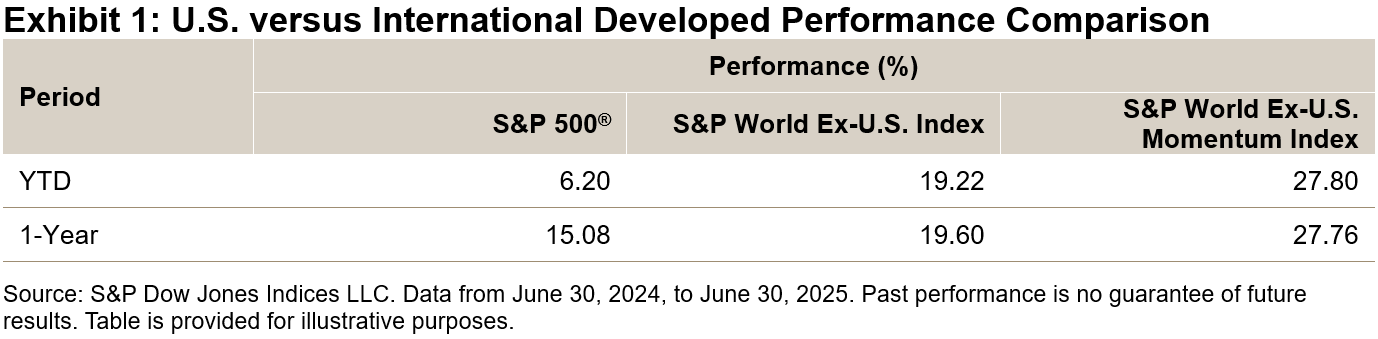
Many market participants have likely observed that the momentum factor has been among the top-performing equity styles in recent years. At the same time, a notable shift has occurred in regional performance: after years of underperformance, international developed equities are now outpacing U.S. equities—both YTD and over the past 12 months (see Exhibit 1).  By applying a momentum strategy to international markets, market participants can measure both regional and stock-level trends, allowing them to have a view of the strongest-performing developed market stocks outside of the U.S.

The S&P World Ex-U.S. Momentum Index serves as a benchmark for securities in developed markets, excluding the U.S., that exhibit strong momentum characteristics. In this blog, we will explore the index’s methodology, performance attributes and sector and region weights.

Index Methodology

The S&P World Ex-U.S. Momentum Index selects constituents based on 12-month risk-adjusted price momentum, excluding the latest month to account for short-term reversal effects. Securities are weighted by the product of their market capitalization and momentum score, utilizing a relatively unconstrainted approach to achieve a purer focus on momentum.

Performance Comparison

Exhibit 3 shows that the S&P World Ex-U.S. Momentum Index outperformed its broader universe across all timeframes analyzed. Furthermore, it has delivered greater risk-adjusted returns over the full period, exhibiting higher upside and lower downside capture relative to the S&P World Ex-U.S. Index.

Sector Weight Analysis

As of June 30, 2025, the S&P World Ex-U.S. Momentum Index showed a significant overweight in the Financials sector, resulting in slight underweights across most other sectors. Over the full period, while sector weights have fluctuated in response to prevailing trends, there has not been a consistent bias, resulting in average weights that are generally aligned with the benchmark universe. This contrasts with other well-known factors such as value, growth, low volatility and quality, which often exhibit persistent biases to specific sectors.

Region Weight Analysis

There were also some significant regional deviations, with Japan displaying a 13.5% underweight in the S&P World ex-U.S. Momentum Index, while Germany and Canada showed overweights of 9.2% and 5.3%, respectively. Over the full period, the indices aligned more closely, with the most significant difference being a 3.7% overweight in Canada for the S&P World ex-U.S. Momentum Index.

Conclusion

The S&P World Ex-U.S. Momentum Index has outperformed its broader universe in both absolute and risk-adjusted returns for nearly 30 years of back-tested history. Currently, the index shows significant overweights in the Financials sector, as well as in countries like Germany and Canada. Given the recent trends, the S&P World Ex-U.S. Momentum Index may be especially relevant for tracking top-performing developed market stocks outside the U.S.

The posts on this blog are opinions, not advice. Please read our Disclaimers.