





Big unicorns are outside the door waiting to join the public markets party. Recently, it has been reported that SpaceX,1 OpenAI2 and Anthropic3 are preparing for their initial public offering (IPO) in the near future. This has drawn attention not just for the size of these firms but for the impact they would have on financial markets. The timing and inclusion of private companies as large as these in indices could be more relevant than ever, especially for market participants who use benchmarks in their investing strategies.
As my colleague Hamish Preston highlighted on a recent blog, adding any of these stocks to the S&P 500® would take at least 12 months after the IPO. However, S&P DJI offers a number of rules-based indices that have specific criteria to decide whether, how and when to include stocks that recently went public.
The Fast-Track IPO Treatment for Broad Benchmarks
S&P Dow Jones Indices’ flagship global equity index, the S&P Global BMI, has the objective of tracking the entire investable global stock market using float-adjusted market cap (FMC). Similarly, the region, country and GICS® sector sub-indices that are part of this family aim to represent specific markets.
Based on constituent data from the S&P U.S. Private Stock Top 10 Index, as of the end of February 2025, SpaceX, OpenAI and Anthropic had a collective market cap of USD 1.4 trillion. If they all had a full IPO with all shares trading in the public market, they would represent together a weight of approximately 2.9% in the S&P World Index, a subindex of the S&P Global BMI. This is more than the entire weight of 19 regions in the index, including France, Germany, Australia and others (see Exhibit 1).
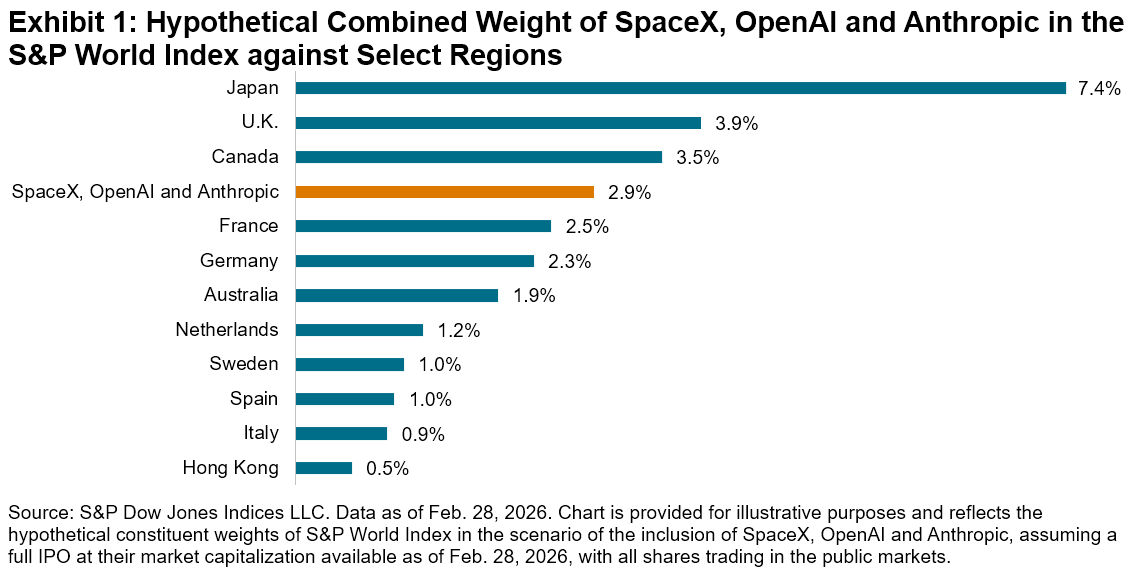
While the shares of such companies may not be fully issued to the public,4, 5 resulting in lower weights in broad-based benchmarks, the scenario above demonstrates that delaying additions until the next rebalance may distort the index’s representation of the broader opportunity set.
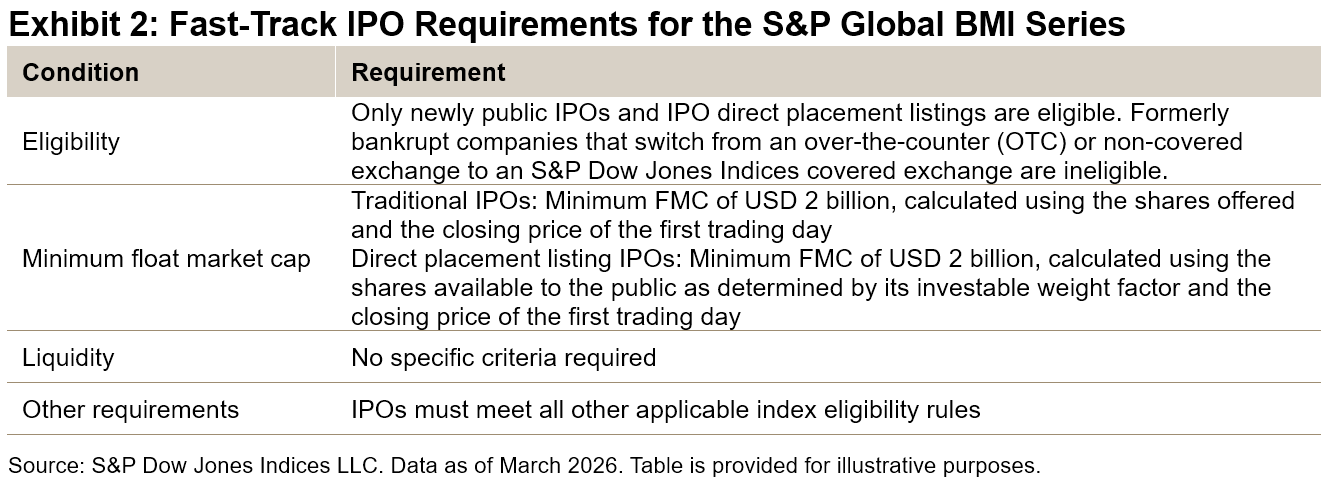
To ensure that benchmarks keep reflecting their target markets, if an IPO meets the criteria outlined in Exhibit 2, the methodology of the S&P Global BMI Series allows its inclusion within five business days; however, if circumstances warrant, the Index Committee may decide to postpone it until they consider it appropriate.6
The Variable Treatment of IPOs for Thematic Indices
Not all rules-based indices follow this treatment. Benchmarks that aim to provide a more targeted reflection of specific segments of the market generally don’t. Among those, we can find S&P DJI’s suite of thematic indices, which are designed to focus on emerging trends and structural shifts shaping the global economy and include the S&P Kensho Indices and the recently launched S&P Atlas Thematic Indices.7 These indices typically have fewer companies with tighter selection criteria. Adding stocks outside their rebalance could trigger unexpected turnover, causing elevated trading costs and risking a higher tracking error for investment products tracking these benchmarks.
When a mega-cap company goes public, indices with a more concentrated constituent base typically defer inclusion until the next scheduled rebalance, provided the IPO occurs before the reference date and the company satisfies all eligibility requirements. For example, if SpaceX were to go public in October, its position in the space economy could make it eligible to be added to the S&P Kensho Global Space Index.8 Assuming it meets all the requirements to be part of the index, the company would be added after the close on the third Friday of November, coinciding with the next rebalance. At that time, all constituents are equally weighted to mitigate concentration risk.
When those unicorns finally ring the bell to join the party, broad market indices may include them quickly to maintain market representation, while benchmarks with a targeted focus could wait until rebalance to prioritize stability. These different approaches are designed to balance market accuracy with practical replicability.
1 Wang, Echo and Joey Roulette. “Exclusive: Musk’s SpaceX in merger talks with xAI ahead of planned IPO, source says.” Reuters. Jan. 29, 2026.
2 Jin, Berber, Corrie Driebusch and Kate Clark. “OpenAI Plans Fourth-Quarter IPO in Race to Beat Anthropic to Market” Wall Street Journal. Jan. 29, 2026.
3 Butts, Dylan. “Anthropic reportedly preparing for massive IPO in race with OpenAI: FT.” CNBC. Dec. 2, 2025.
4 Wang, Echo, Manya Saini and Juby Babu. “Elon Musk’s SpaceX to raise over $25 billion in blockbuster 2026 IPO, source says.” Reuters. Dec. 10, 2025.
5 Wang, Echo et al. “Exclusive: OpenAI lays groundwork for juggernaut IPO at up to $1 trillion valuation” Reuters. Oct. 30, 2025.
6 For more information, please refer to the index methodology.
7 For more information, please see: Jalagani, Srineel. “S&P Atlas Thematics: The Compass for Evolving Markets.” S&P Dow Jones Indices. July 28, 2025.
8 For more information, please see: Zurita, Diego. “Houston, We Have an Index: Exploring the S&P Kensho Global Space Index.” S&P Dow Jones Indices. Jan. 20, 2026.
The posts on this blog are opinions, not advice. Please read our Disclaimers.