


Get Indexology® Blog updates via email.

In This List

The S&P Israel 30 LargeCap Index: Uncovering the Performance of Israel’s Large Caps

A Fundamental Approach to Weighting Stocks: The S&P 500 Revenue-Weighted Index

Cautioning the Clairvoyant

Rallies, Records and Relentless Restlessness: A Tale of Markets in 2025

Factors for All Markets

The S&P Israel 30 LargeCap Index: Uncovering the Performance of Israel’s Large Caps

Contributor Image
Carlos Mendizabal

Senior Analyst, Global and Thematic Equity Indices Product Management

S&P Dow Jones Indices

Opening the Door to Untapped Opportunities

As investors broaden their opportunity set beyond the most widely held markets, Israel’s large-cap equities have increasingly drawn attention. The S&P Israel 30 LargeCap Index offers a focused way to access this segment of the market, capturing many of the country’s most liquid companies across sectors such as Information Technology, Health Care, Financials, Industrials and Energy. In 2025, the index has been among the strongest performers in USD total return terms, highlighting Israel’s relevance within the global equity landscape.

Breaking Down the Index

The S&P Israel 30 LargeCap Index measures the performance of the 30 largest and most liquid companies listed and domiciled in Israel, drawn from the S&P Israel 100 Index as its underlying universe. The index follows a float-adjusted market capitalization weighting scheme and is rebalanced quarterly to reflect market dynamics. To mitigate concentration, single-stock weights are capped at 8% and single GICS® sector weights at 30% at each rebalance.

An important characteristic of the S&P Israel 30 LargeCap Index is its sector composition, which reflects the structure and diversity of Israel’s economy. As of Dec. 31, 2025, Financials represented the largest weight at 27.7%, providing a foundation of historic stability and liquidity through major banking institutions. Information Technology followed at 24.1%, highlighting the country’s strong presence in software, analytics and semiconductor development. Real Estate accounted for 9.5%, while Health Care contributed 8.4%, showing the presence of pharmaceuticals and medical innovation. Industrials (8.8%) and Energy (6.3%) added representation from manufacturing, defense and renewable energy segments. Smaller weights include Utilities (6.5%), Communication Services (4.2%), Materials (2.8%) and Consumer Staples (1.7%), demonstrating that the index reflects both growth-oriented sectors and essential services. This diversified structure offers a comprehensive view of Israel’s large-cap market, balancing innovation-driven industries with established sectors.

2025 in Review: The S&P Israel 30 LargeCap Index Led International Performance

In 2025, the S&P Israel 30 LargeCap Index stood out, punching above its weight. In USD total return (gross of tax) terms, the index gained 75.49%, materially ahead of major international large-cap peers. Over the same period, the S&P 500® gained 17.39%, the S&P Europe 350 gained 36.90%, the S&P Emerging LargeCap gained 26.70% and the S&P/Topix 150 gained 26.36%.

Positioned for Growth

Turning our sight toward valuations, the S&P Israel 30 LargeCap Index stands out. Despite a robust rebound from ’s levels, its historical forward valuation multiples remained strong on a relative basis. With a forward price-to-earnings ratio (P/E) of 14.07, the index currently trades at a significant discount compared to peers such as the S&P 500 (23.14) and S&P Europe 350 (16.41). This valuation is coupled with an expanding earnings growth outlook. Importantly, this growth trajectory is underpinned by Israel’s sophisticated, technology-driven corporate ecosystem, which has historically exhibited an ability to innovate while maintaining profitability.

Rounding Up the S&P Israel 30 LargeCap Index

The S&P Israel 30 LargeCap Index provides a focused view of Israel’s largest and most liquid companies, spanning both innovation-led industries and established financial and industrial leaders. After a strong 2025 performance, its valuation profile remains relatively strong versus several major large-cap benchmarks, making it a useful reference point for comparing global equity markets.


1 Source: S&P Capital IQ. Based on analysts’ consensus estimate for its future Earnings Per Share (EPS) for the next 12 months or fiscal year.


The posts on this blog are opinions, not advice. Please read our Disclaimers.

A Fundamental Approach to Weighting Stocks: The S&P 500 Revenue-Weighted Index

Contributor Image
Hugo Barrera

Senior Analyst, Product Management

S&P Dow Jones Indices

The S&P 500® Revenue-Weighted Index assigns company weights based on revenue rather than market capitalization. By anchoring weights to revenue, the index may help reduce concentration risk, limit weights in higher-valued stocks and increase representation of companies that generate more sales. In this blog, we review the index’s performance characteristics, valuation metrics and diversification profile.

Year-to-Date and Long-Term Outperformance

Year-to-date, the S&P 500 Revenue-Weighted Index has outperformed the S&P 500® by 2.18% and by 1.57% over the past year (see Exhibit 1). Over the long term, including back-tested performance, the index has also delivered strong results, with annualized performance of 11.92% and slightly lower volatility than The 500®.

Lower Valuations Relative to the S&P 500

Revenue-weighted indices have historically exhibited lower price multiples than market-cap-weighted indices, which naturally allocate the largest weights to stocks with the highest share price appreciation. As shown in Exhibits 2 and 3, the S&P 500 Revenue-Weighted Index’s price-to-earnings (P/E) and price-to-sales (P/S) ratios relative to The 500 currently stand at 0.75 and 0.25, respectively—well below their historical averages of 0.83 and 0.41, respectively. This reflects the index’s reduced weight in the most highly valued stocks and its increased weight in companies with large, established revenue bases.

Lower Weight in Magnificent 7 Stocks

As illustrated in Exhibit 4, the S&P 500 Revenue-Weighted Index assigns lower weights to each of the Magnificent 7 stocks compared to The 500. Overall, the index’s total weight in these stocks is 22.3% lower than that of The 500, further reducing concentration risk.

Sector Weight Comparison

As shown in Exhibit 5, Health Care (20.83%) and Financials (15.31%) currently represent the largest sector weights in the S&P 500 Revenue-Weighted Index, corresponding to overweights of 11.06% and 2.25%, respectively. In contrast, Information Technology is the most underweighted sector, with an 11.77% weight—22.81% below its weight in The 500. Overall, the S&P 500 Revenue-Weighted Index currently offers a more balanced sector distribution compared to The 500.

Conclusion

The S&P 500 Revenue-Weighted Index represents an alternative to traditional market-cap weighted benchmarks by prioritizing companies with strong top-line performance. By emphasizing sales, this approach aims to better reflect fundamental company strength, while offering reduced concentration risk and lower weight in higher-valued stocks.

The posts on this blog are opinions, not advice. Please read our Disclaimers.

Cautioning the Clairvoyant

Contributor Image
Anu Ganti

Head of U.S. Index Investment Strategy

S&P Dow Jones Indices

December is typically when we hear Wall Street strategists announce their forecasts for the S&P 500® for the year ahead, and this year has been no exception: 2026 forecasts have ranged from a relatively bearish 7,100 from Bank of America to a bullish 8,000 from Deutsche Bank. But how accurate have these forecasts been in the recent past?1

While 2025 is not quite in the books yet, we can look to forecasts from the end of 2023 and 2022 to understand how well strategists did at predicting S&P 500 performance in subsequent years. Exhibit 1 shows that what these forecasts had in common was they consistently underestimated the scale of market gains in both years, with The 500® up double digits in 2023 and 2024, a sharp contrast from the losses witnessed in 2022.

Complementing these top-down forecasts, a bottom-up forecasting approach involves industry analysts calculating price targets for individual S&P 500 constituents, the medians of which are then aggregated to arrive at a target price estimate for the index in the next 12 months. This target price can then be divided by the actual price to convert the estimate into an “implied” target return.

Exhibit 2 compares the actual S&P 500 12-month return to the implied target return on a quarterly frequency over a 20-year period. There were noticeable divergences between actual versus forecast returns, particularly during the financial crisis, when the S&P 500 decline of 39% in 2008 was significantly different from the gain of 17% predicted 12 months earlier. Another example occurred during 2022, when the actual index loss of 19% differed from the gain of 11% predicted a year earlier.

Predicting the S&P 500 target in a year may seem like a daunting effort, but what about forecasting market gains over a longer horizon? Exhibit 3 looks at the annualized average 10-year return forecast for the S&P 500 from the Philadelphia Federal Reserve’s Survey of Professional Forecasters2 and compares this statistic to the actual 10-year performance of the S&P 500. Spanning an almost 25-year period, predictions were generally bleak historically, most prominently in 2008 and 2009, with actual 10-year losses of 3% in each year for The 500 compared to forecasts of 8% and 9%, respectively, 10 years earlier.

Regardless of whether forecasts are top-down or bottom-up in nature, over one year or longer, history tells us that predicting future market performance may be a futile exercise.3 As we approach 2026, numerous unknowns remain, including the future rate trajectory of the Fed, the fate of Big Tech’s investment in AI, along with lingering inflation and tariff-related concerns globally. For those who decide to make asset allocation decisions based on these forecasts, caution may be warranted.

1 One of the earliest records analyzing the poor track record of forecasters is by Alfred Cowles in his paper, titled, “Can Stock Market Forecasters Forecast?” Econometrica, July 1933.

2 See “Survey of Professional Forecasters,” Federal Reserve Bank of Philadelphia.

3 Unless of course you have access to a genie, see indexologyblog.com/2025/11/13/animal-spirits-or-anxiety

The posts on this blog are opinions, not advice. Please read our Disclaimers.

Rallies, Records and Relentless Restlessness: A Tale of Markets in 2025

Contributor Image
Benedek Vörös

Director, Index Investment Strategy

S&P Dow Jones Indices

As 2025 draws to a close, U.S. large caps boast impressive gains: after a rocky start that saw a 19% drawdown, the S&P 500® is up 18% including dividends, as of Dec. 12, significantly above its annualized total return of 10.8% since inception in 1957. The U.S. bellwether also recorded 37 all-time highs this year.

The largest of blue chips continued to drive The 500®, although the index’s performance this year has been less top heavy than in 2024: year-to-date, the top 20 stocks by market capitalization contributed 61% of returns, less than last year’s 68%. Nevertheless, this year’s statistics are still on the high side in a historical context.

As a consequence of their robust returns in recent years, the weight of the 20 largest stocks in The 500 has increased from 37% to 48% since 2020. That said, mega caps earned the increase in their weights: their combined contribution to S&P 500 forward earnings rose from 32% to 42% over the past five years. Thus, the ratio of the top 20 stocks’ index weight to their projected share of S&P 500 net income was unchanged from 2020 to Q3 2025.

Turning to markets outside of U.S. large caps, gold’s performance immediately stands out both in absolute terms and relative to its own historical returns. The yellow metal soared 62% this year compared to a compound annual return of 7% over the previous 30 years, placing this year’s performance more than three standard deviations above the historical average. The S&P Developed Ex-U.S. BMI also had an exceptionally strong year: its 33% performance, including dividends, is over one standard deviation above its 30-year average of 6%. U.S. small caps, on the other hand, have had a slightly below-average year, up just 9% YTD.

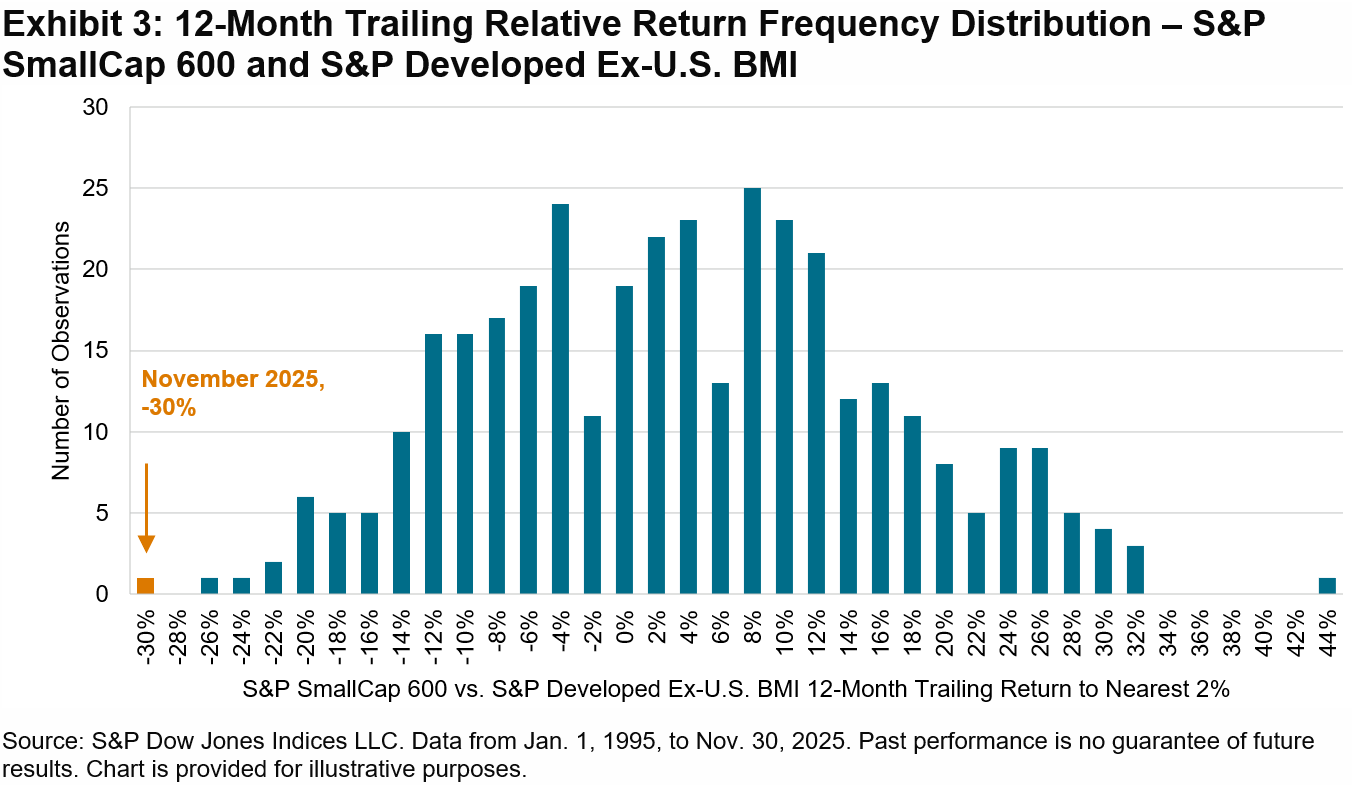
The combination of strong developed ex-U.S. performance and below par U.S. small-cap performance culminated in a significant differential between these two segments over the past 12 months. By the end of November, the S&P SmallCap 600® trailed the S&P Developed ex-U.S. BMI by 30%, the most of any 12-month period since January 1995.

Despite this year’s strong run for developed non-U.S. equities, their valuation has remained more compelling relative to the U.S.: the S&P World Ex-U.S. Index is currently trading at a forward price/earnings (P/E) ratio of 16.7, a discount of 9 points compared to U.S. equities. Many European equity markets are even cheaper, with Italy, Spain and the U.K. all trading below a P/E multiple of 15 as of the end of Q3 2025.

Notwithstanding this year’s impressive returns, some market watchers may feel as I do—although the scoreboard is telling a different story, the year felt volatile and even like a downturn. Such sentiment makes sense in one respect: as the S&P 500 continued to rise, there was never any real let-up in tension during the year; trade-related worries gave way to concerns about the labor market, which then shifted to questions about the payoff of AI-related corporate investments. Exhibit 2 illustrates the lowest end-of-day VIX® reading for each calendar year dating back to 2000. In 11 of the past 13 years, VIX dipped below its long-term mode of 14 at least once, but this year, we never saw that kind of breather.

As 2026 approaches and the Q4 2025 corporate earnings season draws closer, it remains to be seen whether developed ex-U.S. equities will continue to benefit from their lower valuation relative to U.S. markets or whether the coming year will mark a reversal of relative performance in global equity markets. In any case, attempting to forecast market outcomes for 2026 may prove futile, as the best guess of future returns is not dictated by the most recent past.

The posts on this blog are opinions, not advice. Please read our Disclaimers.

Factors for All Markets

Contributor Image
Euan Smith

Quantitative Analyst, Index Investment Strategy

S&P Dow Jones Indices

Recently, much of the financial media has been occupied with discussing the potential of a bubble in markets. Some have compared the current sentiment to the “animal spirits” of the late 1990s.1 Proponents of this view cite stretched valuations, retail-driven speculation and the circularity of transactions as evidence to support their claims. Whether or not one gives credence to these comparisons, understanding how different single- and multi-factor indices behave in such environments can help participants navigate conditions in a way that aligns with their level of conviction.

Factor performance can vary widely across regimes, particularly during periods marked by exuberance or correction. Reviewing S&P 500® Factor Indices through time highlights this fluctuation. First, observing the period from the mid-1990s to the peak of the first tech bubble in 2000, Exhibit 1 shows the performance of The 500® alongside the S&P 500 Quality Index, S&P 500 Enhanced Value Index and S&P 500 Momentum Index.

The back-tested data in Exhibit 1 shows that, prior to the bursting of the bubble, the S&P 500 Momentum Index was by far the best performer, while the S&P 500 Quality Index also outperformed The 500 and the S&P 500 Enhanced Value Index materially underperformed as growth-oriented stocks led the market upward.

In contrast, Exhibit 2 shows the back-tested performance of the same four indices in the period following the peak. The S&P 500 Enhanced Value Index was the strongest performer by a wide margin, while the S&P 500 Momentum Index struggled. The S&P 500 Quality Index again outperformed The 500, which remained nearly flat during the first part of its “lost decade.”

Finally, Exhibit 3 shows more recent performance, from January 2020 to November 2025. Compared with The 500, the S&P 500 Momentum Index has significantly outperformed, the S&P 500 Quality Index has also outperformed and the S&P 500 Enhanced Value Index has underperformed. This bares similarities to the late 1990s, though less extreme.

Exhibits 1-3 illustrate how factor performance can vary significantly across market regimes. Some may look to factor indices as short-term measures of performance. Others may view one, or several, factor indices for the long term, citing evidence of their risk and/or behavioral premia, while understanding the associated tracking error.

For those less enthused by the prospect of significant deviation from The 500’s performance, the S&P 500 Quality, Value & Momentum (QVM) Top 90% Multi-factor Index may be interesting. The index measures the performance of S&P 500 constituents after excluding the bottom 10% with the lowest combined quality, value and momentum multi-factor score, thus exhibiting some loading on each factor. Exhibit 4 shows that this approach has historically outperformed The 500 while maintaining low tracking error and lower volatility than The 500, S&P 500 Enhanced Value Index and S&P 500 Momentum Index.

No matter the view taken on whether or not the current market is a bubble akin to the late 1990s, our single- and multi-factor indices can assist in navigating all markets.

1 See: Makortoff, Kalyeena. “Bank of England warns of growing risk that AI bubble could burst.” The Guardian. Oct. 8, 2025; Wigglesworth, Robin. “The AI bubble has reached its ‘fried chicken’ phase.” The Financial Times. Oct. 31, 2025; and “Why Fears of a Trillion-Dollar AI Bubble Are Growing.” Bloomberg. Nov. 24, 2025.

The posts on this blog are opinions, not advice. Please read our Disclaimers.