

Get Indexology® Blog updates via email.

In This List

Defining Outcomes Systematically with Indices

Tariff Turmoil Shines Spotlight on S&P/ASX Geographic Revenue Exposure Indices

Examining Equal Weight Performance in Challenging Markets

20 Years at the Forefront of Dividend Indexing: The S&P 500 Dividend Aristocrats

How Have the S&P/BMV IPC Leverage and Inverse Indices Performed in Volatile Periods?

Defining Outcomes Systematically with Indices

How are index innovations helping market participants address volatility and uncertainty? S&P DJI’s Anu Ganti and Calamos Investments’ Matt Kaufman discuss index-based approaches to defined outcomes.


The posts on this blog are opinions, not advice. Please read our Disclaimers.

Tariff Turmoil Shines Spotlight on S&P/ASX Geographic Revenue Exposure Indices

Contributor Image
Sean Freer

Director, Global Exchange Indices

S&P Dow Jones Indices

With the surprisingly widespread U.S. tariff hikes announced by President Trump in early April, the geographic source of corporate revenues is coming under the spotlight, as reciprocal trade agreements are being redrawn globally.

The resulting volatility of share prices following Trump’s April 2 “Liberation Day” speech is not surprising, given the globalization and interconnectedness of company revenue sources and supply chains. Some companies are more exposed to a potential trade war than others; for example, those that have products or inputs to products that are highly reliant on foreign markets (such as miners and automakers), while other companies may be more domestically focused (such as banks, telecommunications and utilities companies).

The S&P/ASX 200 Geographic Revenue Exposure Indices offer insight into the performance of Australian companies. The S&P/ASX 200 Australia Revenue Exposure Index includes companies from the S&P/ASX 200 that have greater-than-average revenue exposure to Australia. Conversely, the S&P/ASX 200 Foreign Revenue Exposure Index includes the companies with greater-than-average exposure to markets outside Australia. The indices are weighted by float market cap.1

A Return to Domestic Outperforming

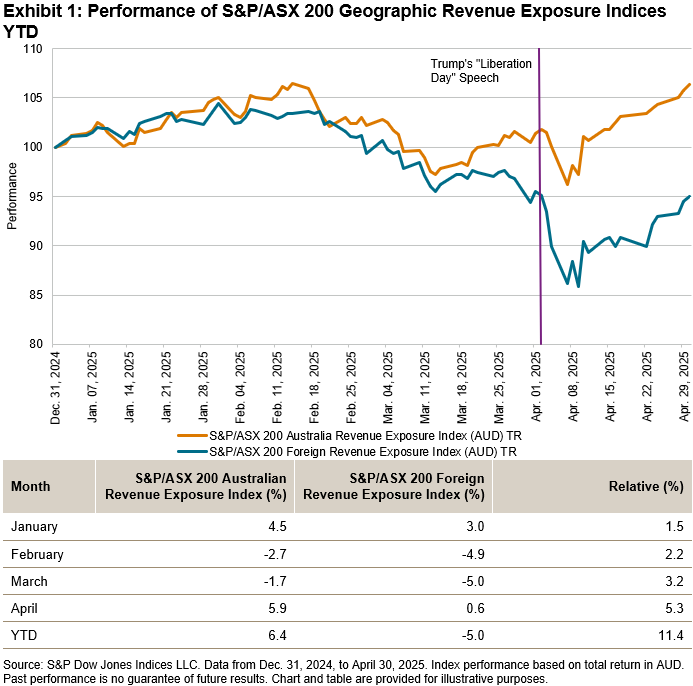
After a lengthy period of underperformance, the S&P/ASX 200 Australia Revenue Exposure Index has reverted to a strong period of outperformance over the past two years. More recently, the S&P/ASX 200 Australia Revenue Exposure Index has outperformed the S&P/ASX 200 Foreign Revenue Exposure Index in each of the first four calendar months of 2025, with April being a watershed month.


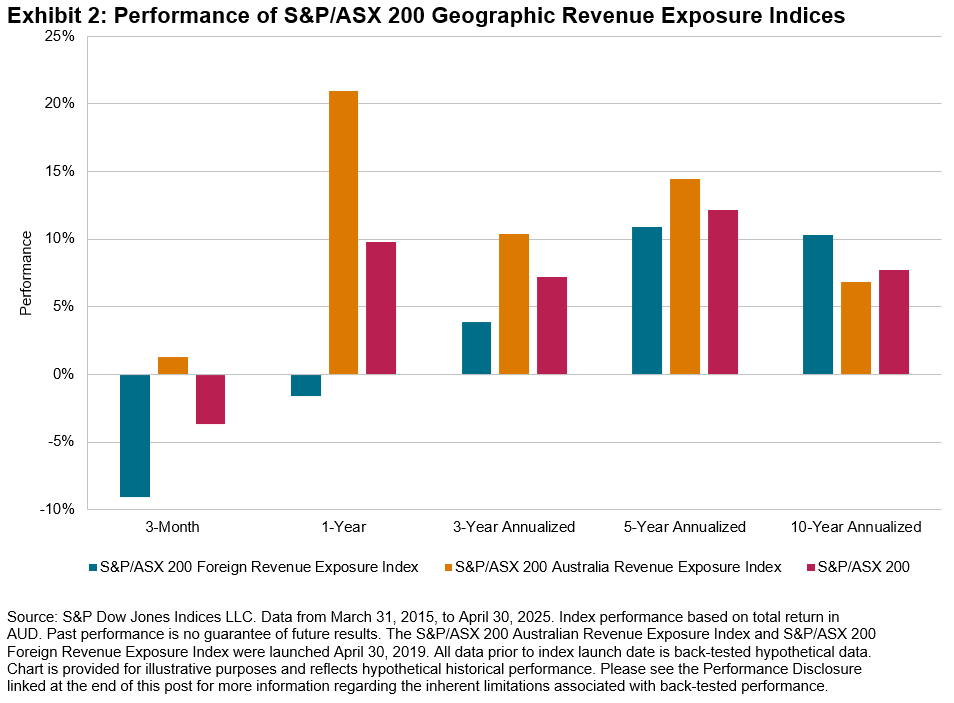
The recent strong performance numbers have resulted in the S&P/ASX 200 Australia Revenue Exposure Index outperforming within all the time periods up to the 5-year period ending April 30, 2025, whereas the S&P/ASX 200 Foreign Revenue Exposure Index outperformed over the 10-year period.

Performance Drivers

While trade policy has certainly influenced the short-term price movements, several other factors have influenced longer-term performance, including fluctuations in both currency and interest rates.

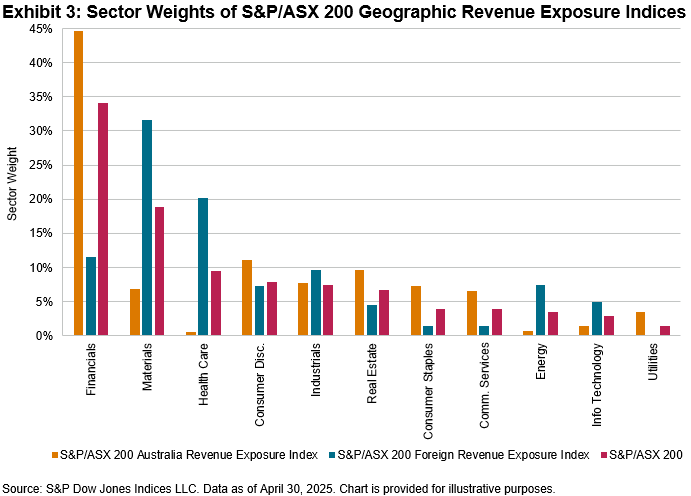
The types of companies and sectors represented in each index also help identify performance drivers. The S&P/ASX 200 Foreign Revenue Exposure Index is overweight in companies in the Materials, Health Care and Information Technology sectors relative to the S&P/ASX 200, while the S&P/ASX 200 Australia Revenue Exposure Index is tilted toward the Financials, Real Estate, Communication Services, Consumer Staples and Consumer Discretionary sectors.


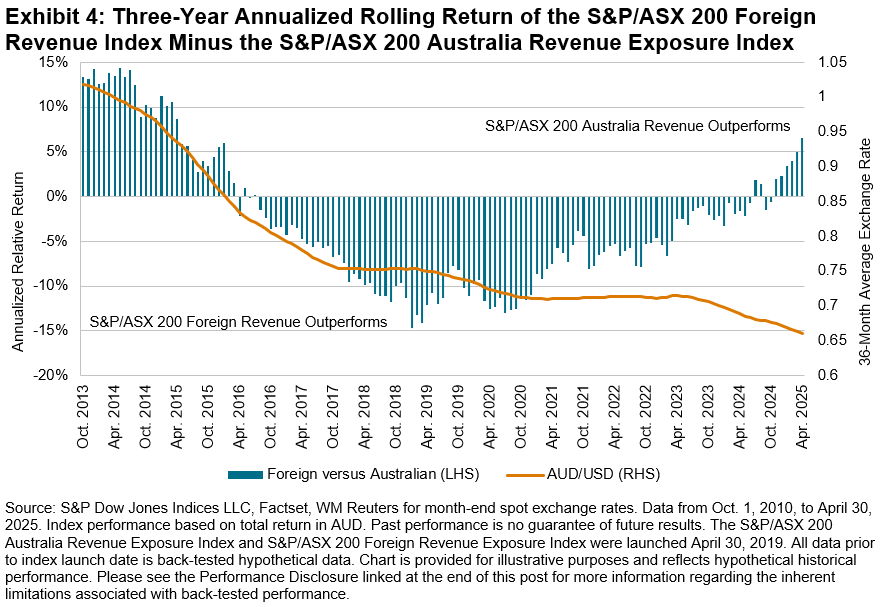
Over periods beyond five years, the S&P/ASX 200 Foreign Revenue Exposure Index has outperformed on the back of strong returns within the aforementioned overweighted sectors; Materials, Health Care and Information Technology. Many companies in these sectors have benefitted from a weakening Australian dollar from 2013 to 2022.

However, more recently, a somewhat stabilized exchange rate and the interest rate increases in 2022 and 2023 have supported the large banks, while domestic consumer companies and those in the Real Estate sector have also performed well during the past two years despite cost-of-living concerns.

If we review rolling three-year annualized periods, we can see more clearly the phases in which companies with greater domestic revenue exposure outperformed and vice versa. Since the Australian dollar dropped below 80 cents to the U.S. dollar, the foreign revenue exposure index consistently outperformed the Australian revenue exposure index by more than 5% until about two years ago, when the rising interest rates supported Financials—a large component in the S&P/ASX 200 Australian Revenue Exposure Index.

The S&P/ASX Geographic Revenue Exposure Indices highlight how trade policy, currency movements and interest rates can have a meaningful impact on differing segments of the Australian equity market. The S&P/ASX 200 Geographic Revenue Exposure Indices group constituents as either majority foreign or domestic earners and are a useful lens to analyze market performance during different macro events or stages of an economic cycle.

1 Please refer to the methodology document for S&P Global Revenue Exposure Indices for more information: https://www.spglobal.com/spdji/en/documents/methodologies/methodology-sp-global-revenue-exposure-indices.pdf

The posts on this blog are opinions, not advice. Please read our Disclaimers.
Examining Equal Weight Performance in Challenging Markets

How have the S&P 500 Equal Weight Index’s exposures influenced its performance over time and why could that matter in the current climate? S&P DJI’s Anu Ganti and Invesco’s Nick Kalivas explore the growing ecosystem and key performance drivers of the S&P 500 Equal Weight Index.


The posts on this blog are opinions, not advice. Please read our Disclaimers.
20 Years at the Forefront of Dividend Indexing: The S&P 500 Dividend Aristocrats

Contributor Image
George Valantasis

Director, Factors and Dividends

S&P Dow Jones Indices

For two decades, the S&P 500® Dividend Aristocrats® has been holding its constituents to a high standard, requiring them to increase dividends for at least 25 consecutive years. This simple yet effective requirement has stood the test of time, establishing the index as one of the most recognized global dividend benchmarks. In honor of this anniversary, this blog will examine the index’s robust live performance, defensive characteristics and quality attributes as we celebrate this significant milestone.

Risk-Adjusted Outperformance

Exhibit 1 illustrates that the S&P 500 Dividend Aristocrats posted an annualized return of 10.23% over the 20-year period since its launch, aligning closely with benchmark performance. However, its annualized volatility of 14.34% during this timeframe was notably lower than that of the benchmark, leading to a risk-adjusted return of 0.73. Additionally, the average dividend yield for the index was 2.54%, surpassing the S&P 500’s yield of 1.89% and the S&P 500 Equal Weight’s yield of 1.85%.

Dividend Growth That Preserved Purchasing Power

Exhibit 2 shows that the S&P 500 Dividend Aristocrats has preserved purchasing power over the long-term by comparing the dividend growth rate to the Consumer Price Index (CPI) rate. Over the 20-year live period, the S&P 500 Dividend Aristocrats achieved an annualized dividend growth rate of 8.1%, which is more than three times the 2.6% CPI rate for the same period.

Defensive Characteristics

Exhibit 3 shows the consistent downside protection that the S&P 500 Dividend Aristocrats has historically provided during market drawdowns, with average drawdowns materially lower than those of the benchmark. Most recently, during the tariff-related drawdowns, the index outperformed The 500™ and S&P 500 Equal Weight Index by 8.2% and 5.4%, respectively.

Exhibit 4 illustrates the performance of the S&P 500 Dividend Aristocrats relative to The 500 and the S&P 500 Equal Weight Index across various volatility environments. On average, the S&P 500 Dividend Aristocrats has significantly outperformed both benchmarks during periods of heightened market stress, specifically when VIX® levels exceed 20.

Higher Quality Constituents

Highly profitable companies are typically better positioned to consistently increase dividends for shareholders over the long term, even in fluctuating economic conditions. As illustrated in Exhibit 5, constituents of the S&P 500 Dividend Aristocrats demonstrated superior profitability, with an average return on equity (ROE) of 21.4%, compared to 17.0% for the S&P 500 Equal Weight Index.

Conclusion

Even with 20 years of noteworthy performance under its belt, the S&P 500 Dividend Aristocrats is still relatively young compared to some of its constituents. Nonetheless, this milestone is significant for a dividend index and deserves celebration. We invite you to explore this standout index further in our paper, “Celebrating 20 Years of S&P 500® Dividend Aristocrats® with 20 Fun Facts.”

The posts on this blog are opinions, not advice. Please read our Disclaimers.
How Have the S&P/BMV IPC Leverage and Inverse Indices Performed in Volatile Periods?

Contributor Image
Eduardo Olazabal

Associate Director, Global Exchange Indices

S&P Dow Jones Indices

Leveraged and inverse indices are widely used by investors looking for a measurement that magnifies performance or hedges against market downturns. For the Mexican equity market, S&P DJI provides market participants with an amplified or inverse view of the S&P/BMV IPC through the S&P/BMV IPC 2X Leverage Daily Index and S&P/BMV IPC Inverse Daily Index, respectively (see Exhibit 1).1

Introduction to Leveraged and Inverse Indices

Leveraged and inverse indices are designed to reflect multiplied or opposite daily performance of an index. For example, if the base index increases by 1% in a day, a 2x leveraged index would increase by 2%, while an inverse index would decrease by 1%.

These indices are often used in short-term investment strategies. Some asset managers use derivatives to replicate performance for their products. It’s important to note that the performance of these indices is measured daily and not cumulatively. They are rebalanced daily to maintain their leverage or inverse objective, which means returns are calculated from a new reference point every day. Over longer periods, especially during volatile market conditions, the performance of these indices can deviate significantly from their initial targets due to the compounding effect.

As shown in Exhibit 2, while the S&P/BMV IPC returned a cumulative 15% during this period, the S&P/BMV IPC 2X Leverage Daily Index underperformed the S&P/BMV IPC by more than 10%, and the S&P/BMV IPC Inverse Daily Index dropped around 30%. Due to the compounding effect and volatility, the return of the leveraged and inverse indices deviated significantly from their target at the end of this period

Case Study: The Hypothetical Performance of S&P/BMV IPC Leverage and Inverse Indices during High Volatility Periods

The below case study analyzes the performance of these indices during episodes of high volatility through a hypothetical index. A hypothetical index that assigns a 10% or 20% weight to the S&P/BMV Daily Leverage 2x or Inverse Indices during periods of high volatility and the broad Mexican equities market, as represented by the S&P/BMV IPC, are used for this purpose.

There were four short-term periods of sustained high volatility, defined as episodes where the annualized volatility of the S&P/BMV IPC was over 20% for more than 20 trading days (see Exhibit 3). For this analysis, we will focus on the second episode in 2018.

At the end of this second episode (from Nov. 1, 2018, to Dec. 24, 2018, around the inauguration of Andres Manuel Lopez Obrador as president of Mexico), the S&P/BMV IPC had negative performance of 5.83% for this two-month period. The hypothetical index that blends the S&P/BMV IPC and one of its leveraged/inverse indices demonstrates that even a small allocation to leveraged and inverse indices has the potential to significantly affect risk and return. For this same two-month period, the hedged blend would have demonstrated improved performance and reduced risk, while the leveraged blend would have amplified losses and volatility.

The case study above can help illustrate the hypothetical effects of leverage and compounding in the performance of leveraged and inverse indices. For the Mexican equity market, S&P Dow Jones Indices offers the S&P/BMV IPC 2X Leverage Daily and S&P/BMV IPC Inverse Daily Indices. However, due to the compounding effect and market volatility, the performance of these indices may deviate from their targets over longer periods.

1 For more information, please consult the S&P/BMV Indices methodology document.

The posts on this blog are opinions, not advice. Please read our Disclaimers.