


Get Indexology® Blog updates via email.

In This List

Stock Pickers and Style Bias

Picking a Path with S&P 500 Sectors

Cerulli Associates Publishes Whitepaper on Redefining the Role of Index Providers

Private Credit vs. Public Debt and Traditional Financing

The Market Measure: March 2025

Stock Pickers and Style Bias

Contributor Image
Anu Ganti

Head of U.S. Index Investment Strategy

S&P Dow Jones Indices

The results from our SPIVA U.S. Year-End 2024 Scorecard demonstrate another challenging year for active managers, with 65% of U.S. large-cap funds underperforming the S&P 500®, slightly above the report’s 24-year historical average of 64%. But small-cap managers fared significantly better, with only 30% of small-cap funds underperforming the S&P SmallCap 600®, the lowest underperformance rate on record. What might explain the widely contrasting fortunes between large-cap and small-cap managers?

2024 was characterized by positive skew in the S&P 500’s constituent returns, as shown in the top half of Exhibit 2, with the average return outpacing the median return by 1.6%, evidencing a longstanding challenge for more concentrated active managers, who may be less likely to own these top performers in their strategies. Because the largest stocks in the index were among the best performers, the index’s return of 25.0% was well above the simple average, an additional headwind for managers who were underweight in the largest stocks. These results are not surprising, as the average return has been greater than the median for The 500’s constituents in 20 out of the past 24 years.

Combining these elements of skewness and large-cap outperformance, a simple way to analyze the conditions for stock selection is to measure the percentage of constituents that beat the benchmark. Only 28% of member stocks beat the S&P 500 in 2024, which is the second-lowest percentage in 24 years and close to the 26% in 2023, which was another challenging year characterized by large-cap dominance.

Turning our attention to small-cap managers, the bottom half of Exhibit 2 shows that 44% of S&P SmallCap 600 constituents beat the benchmark in 2024, close to the long-term average of 45%. The S&P 600®’s return distribution was positively skewed as well, with an average return exceeding the median by 2.8%, consistent with the positive skew in 22 of the past 24 years. Just as we observed with large caps, the S&P 600 return of 9% was above the average, indicating that larger stocks within the small-cap benchmark outperformed.

Both large- and small-cap managers shared relatively slim prospects for stock picking, characterized by a positively skewed distribution of benchmark returns and the outperformance of larger stocks. But small-cap managers may have benefited from ample opportunities to tilt up toward outperforming large caps, with a 16% return differential separating the S&P 500 and the S&P 600, the widest differential in the SPIVA Scorecard’s history. Exhibit 3 illustrates that small-cap fund underperformance rates historically tended to improve with large-cap outperformance.

While conditions for stock picking were generally tough in 2024, small-cap managers had a banner year. The SPIVA U.S. Year-End 2024 results provide evidence that style bias may play a major role in explaining active manager outperformance across the capitalization spectrum and is importantly an indication that true stock selection skill may be more rare.

The author would like to thank Nick Didio for his contributions to this blog.

The posts on this blog are opinions, not advice. Please read our Disclaimers.

Picking a Path with S&P 500 Sectors

Contributor Image
Joseph Nelesen

Head of Specialists, Index Investment Strategy

S&P Dow Jones Indices

In February 2025, U.S. equity markets reflected general unease over an unpredictable future. Worries about the probability of tariffs and their impact on growth and inflation weighed on the minds of investors who also had to contend with weaker economic data and questions about the sustainability of mega-cap tech earnings. Against this backdrop, the S&P 500® exhibited striking bouts of intraday volatility yet finished the month in negative territory. In Exhibit 1, we show February performance of The 500™ along with each of its 11 component GICS sectors. February was the fourth month in a row that the sector spread (the difference between highest- and lowest-performing sectors) reached double digits, at 12.0%. Consumer Discretionary, Information Technology and Industrials finished the month trailing The 500, which itself dropped 1.3%. But beyond those three sectors, the other eight outperformed, exhibiting strength among traditionally defensive segments.

Headwinds and tailwinds affecting each sector in January generally persisted in February, as Consumer Discretionary and Information Technology extended their previous month’s underperformance, while eight other sectors outperformed The 500 in February, and nine sectors surpassed the broad benchmark YTD (see Exhibit 2). Industrials was the only sector that trailed slightly in February yet maintained excess performance YTD.

In a previous blog, we kicked off sector analysis in 2025 with a review of recent research detailing the performance of two blends of indices, each comprising traditionally cyclical and defensive sectors. Bucketing sectors into defensive and cyclical blends based on their risk characteristics and tendencies to outperform during rising or falling markets can allow for rational tilts based on owning sectors that offer relatively better performance in each environment.

As a reminder, we use the same two approaches below to understand sector performance YTD.1

  • Cyclical Blend: An equal-weighted combination of five cap-weighted cyclical sectors (Information Technology, Financials, Materials, Consumer Discretionary and Industrials), rebalanced monthly.
  • Defensive Blend: An equal-weighted combination of five cap-weighted defensive sectors (Utilities, Energy, Consumer Staples, Health Care and Communication Services), rebalanced monthly.

Exhibit 3 illustrates the hypothetical performance of each approach YTD through February 2025, showing both the widening outperformance margin of defensive sectors along with the resilience of equally weighting cyclical sectors, as both the defensive and cyclical blends outperformed The 500.

Although two months of 2025 are in the rearview mirror and, in many ways, the road ahead remains unclear, the performance of S&P 500 sectors sheds some light on how investors view prospects for different segments of the economy and provides a useful framework for making thoughtful tilts in preparation for whatever comes next.

1 Cyclical and defensive blends are comprised of the top five and bottom five sectors as ranked by historical beta and volatility. Real Estate, ranked in the middle of the 11 S&P 500 sectors, is excluded from this analysis.

The posts on this blog are opinions, not advice. Please read our Disclaimers.

Cerulli Associates Publishes Whitepaper on Redefining the Role of Index Providers

Contributor Image
Michael Brower

Former Associate Director, Index Investment Strategy

S&P Dow Jones Indices

The financial services consulting firm, Cerulli Associates, recently published a research study on the use of index-based products within the U.S. retail wealth management market. Their whitepaper aims to shed light on how asset managers, asset allocation model portfolio providers, wealth manager home offices and financial advisors can better utilize index provider solutions.1

The study is the culmination of 293 financial advisor survey results, which are diversified across channel, practice assets under management (AUM), core market client size and advisor age. It excludes advisors with less than USD 50 million in AUM and those with more than 25% in institutional assets or defined contribution plans. The paper also aggregates the findings of 25 executive interviews with asset managers, technology providers, wealth manager home offices and individual financial advisors.

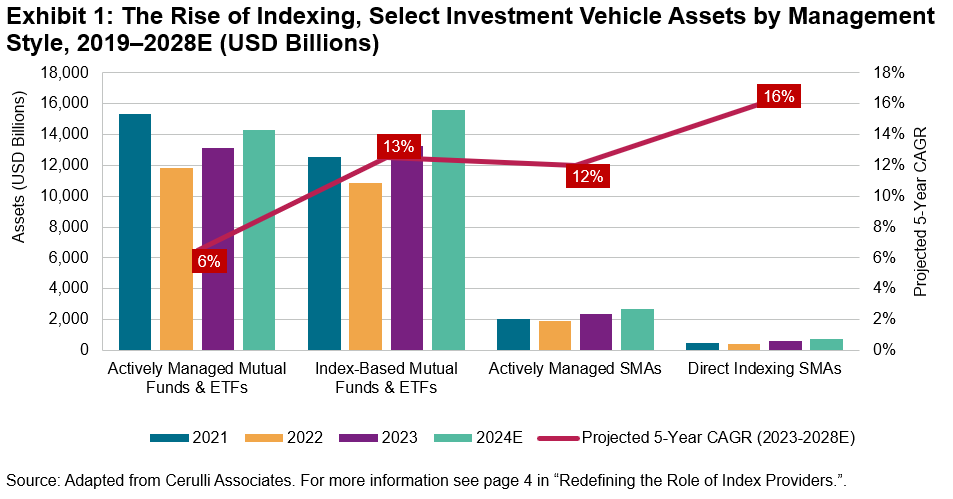
According to the research, the U.S. wealth management industry is experiencing a shift in value proposition where end-investors are increasingly relying on their financial advisor for their financial planning expertise rather than their investment management acumen. When asked to identify which factors are most important when selecting an advisor, 57% of affluent (i.e., USD 100,000 or more in investable assets) clients indicated that an advisor who takes the time to understand their needs and goals is extremely important, while only 45% said the same about the performance of their investments relative to the overall market.2 Fund flow data supports this shift as the positive growth of index-based exchange-traded funds (ETFs) and mutual funds, as well as direct indexing separately managed accounts (SMAs), have outpaced their actively managed counterparts, a trend that is projected to continue through 2028 (see Exhibit 1).

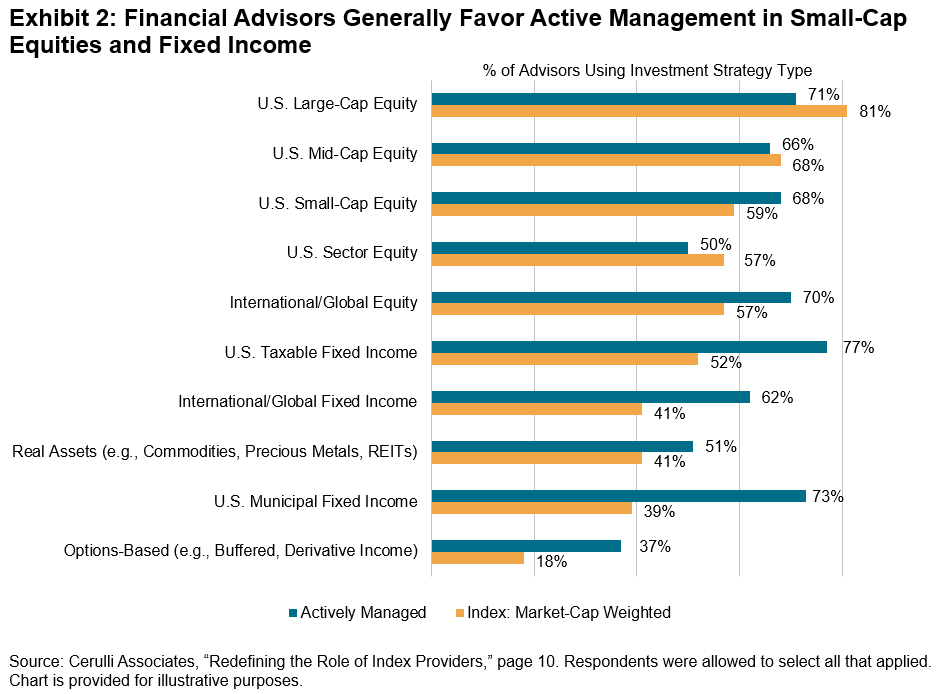
Although Cerulli Associates forecasts increased usage of index-based strategies, Exhibit 2 indicates that advisors currently pursue an active approach in sub-asset classes they perceive as being less informationally efficient, such as small-cap equities, international fixed income, U.S. taxable and municipal fixed income, options-based assets and real assets. However, a future shift could be in the cards. Cerulli Associates’ research suggests that financial advisors could expand their usage of index-based products beyond equities to fixed income as well,3 paralleling the growth of indexing in fixed income.4

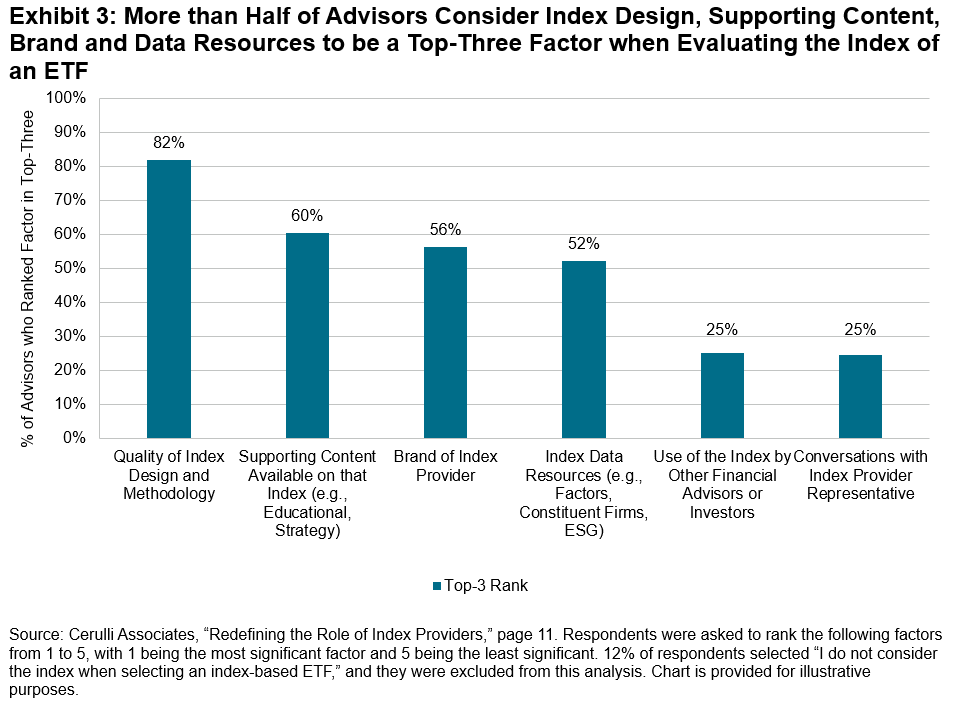
In addition to surveying advisors on how they utilize index-based products, they also extracted insights on how they evaluate them. For example, Exhibit 3 shows that 82% of advisors indicated that the quality of the index design and methodology was a top-three factor when considering the index that underlies an ETF, and 60% of advisors said the same of index provider content and education. To learn more about how financial advisors think about index providers, Cerulli Associates created a series of advisor profiles located in the appendix of the whitepaper.

As the landscape of index-based products becomes increasingly crowded, the recent findings from Cerulli Associates highlight that asset and wealth managers should thoughtfully consider how to leverage index providers’ solutions to stand out from the crowd.5 Strategies include going beyond traditional index data to drive product development and leveraging brand and content for product marketing and distribution. Embracing these strategies can not only differentiate firms but may also position them for success in the evolving retail wealth management market.


1 The Cerulli Associates whitepaper “Redefining the Role of Index Providers” was sponsored by S&P Dow Jones Indices.

2 Please see page 4 of Cerulli Associates’ “Redefining the Role of Index Providers”.

3 Please see page 10 and 11 of Cerulli Associates’ “Redefining the Role of Index Providers” for more information on ETF product growth.

4 For more information on the growth of indexing in fixed income, please read “The Hare and The Tortoise – Assessing Passive’s Potential in Bonds”.

5 Please see section 4, pages 12-17 of Cerulli Associates’ “Redefining the Role of Index Providers” for more information.

The posts on this blog are opinions, not advice. Please read our Disclaimers.

Private Credit vs. Public Debt and Traditional Financing

Contributor Image
Nicholas Godec

Senior Director,​ Head of Fixed Income Tradables & Commodities

S&P Dow Jones Indices

The private credit market has grown significantly, becoming a key component of the global financial landscape. Traditional banks have tightened lending practices due to increased regulatory scrutiny and risk aversion following the 2008 Global Financial Crisis. In response, private credit has emerged as an alternative for businesses facing challenges in securing financing from traditional sources.

This blog explores the factors driving private credit’s rise and how it compares to public debt and traditional financing.

A Multi-Layered and Growing Market

Several factors have fueled private credit’s expansion, including institutional investors’ pursuit of yield, increased market sophistication and greater awareness of the segment’s unique characteristics.

Private credit includes diverse debt strategies, such as senior debt, subordinated capital and credit opportunities. Senior debt funds offer secured loans for acquisitions and restructurings, benefiting from priority claims on assets. Subordinated capital (mezzanine funds) sits between equity and secured debt, often financing buyouts while generating interest payments. Credit opportunity funds invest in various credit instruments across global markets, including distressed debt and structured finance, providing potential for diversification.

Private Credit vs. Public Debt: Liquidity and Accessibility

Private credit and public debt differ in liquidity and market accessibility. Private credit refers to debt investments that are not publicly traded and typically issued by non-bank lenders. These instruments are often illiquid, with lock-up periods restricting sales. However, this illiquidity may result in higher yields compared to public debt.

Public debt, including corporate bonds and government securities, trades in the public bond market, offering greater liquidity with expanded access for prospective buyers or sellers. This accessibility allows individual and institutional investors to easily participate. However, increased competition often results in lower yields.

For investors, the liquidity tradeoff is crucial. Private credit’s illiquidity requires a longer investment horizon, whereas public debt’s liquidity provides flexibility but potentially lower yields than can be found in private debt markets.

Transparency and Reporting Standards in Private vs. Public

A key distinction between private credit and public debt is transparency. Public debt is subject to strict regulatory requirements, including standardized disclosures and regular reporting. This enables investors to make informed decisions based on widely available financial data.

Private credit, however, lacks uniform reporting standards. Borrowers are not always required to disclose financial information publicly, and reporting practices vary across issuers. This opacity makes due diligence and fund manager expertise critical in assessing credit risk.

To mitigate transparency challenges, private credit lenders rely on strong borrower relationships, detailed covenants and negotiated reporting requirements. Even so, investors must be comfortable with less readily available information, making trust in their fund managers essential.

Private Credit: Filling the Gaps Left by Banks

The lending landscape has evolved since the 2008 financial crisis. Traditional banks—once primary credit providers—face stricter regulations, limiting their ability to lend, particularly to middle-market businesses and specialized sectors. Higher capital requirements and risk management constraints have reduced their exposure to certain loan types.

Private credit lenders have stepped in, offering capital alternatives to businesses that may not meet traditional lending criteria. These non-bank lenders provide financing solutions with greater flexibility, including tailored repayment schedules, customized covenants, and the ability to underwrite complex transactions.

By serving businesses overlooked by traditional banks, private credit supports economic growth, particularly among small- and medium-sized enterprises (SMEs), which are widely viewed as key contributors to innovation and employment.

Synergies Between Private Credit and Traditional Lending

While private credit and bank lending are often seen as competitors, they also complement each other. Banks may originate loans and syndicate portions to private credit funds, managing risk while continuing to serve clients.

Additionally, banks and private credit firms may co-lend on larger transactions, combining resources and expertise. Such partnerships allow banks to remain engaged in lending while meeting regulatory requirements, while private credit firms gain access to larger, more complex deals.

Learn more in our recent analysis, “The Rapid Rise of Private Credit.”

Don’t miss our next blog where we explore the opportunities and risks associated with private credit.

This blog was co-authored by Ricky LaBelle and Greg Vadala.

The posts on this blog are opinions, not advice. Please read our Disclaimers.

The Market Measure: March 2025

Which factors weathered the mega-cap slump that dragged The 500™ down in February? Explore highlights from the latest SPIVA U.S. Scorecard and the defensive factors standing up to challenging markets.

The posts on this blog are opinions, not advice. Please read our Disclaimers.