






Defense has had more than just its 15 minutes this year.
On the football pitch, Spain demonstrated the value of a formidable defense, conceding just once en route to winning the 2026 World Cup.1 Yet the rhetoric surrounding England’s exit fixated on almost the opposite claim: too much defense can cost you.
Building From the Back
In Europe’s rather more consequential defense debate, one common refrain has been that more spending is a must. Russia’s invasion of Ukraine, conflict in the Middle East and a changing geopolitical order have sharpened the focus on military preparedness.
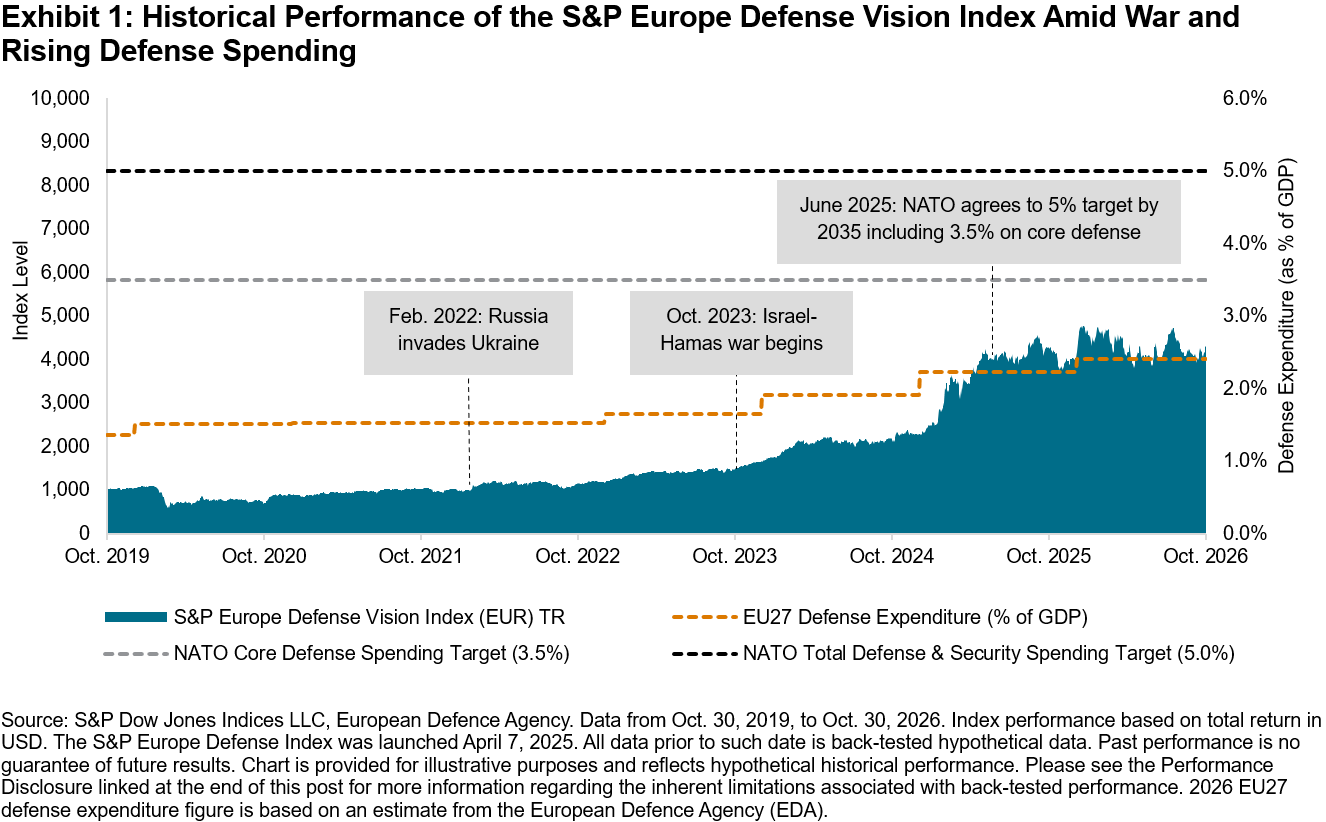
EU member states spent EUR 418 billion on defense in 2025, equivalent to 2.2% of GDP, with expenditure estimated to reach EUR 454 billion, or 2.4%, in 2026.2 At the 2025 NATO Summit, Allies committed to spending 5% of GDP annually on defense and security-related requirements by 2035, including at least 3.5% on core defense.3 Europe is also turning commitments into procurement through instruments including the EU’s EUR 150 billion SAFE facility.4
Against this backdrop, Exhibit 1 charts the historical performance of the S&P Europe Defense Vision Index alongside rising European defense expenditure. Geopolitical events have punctuated performance, but the spending trajectory points to a potentially more structural shift underpinning Europe’s defense story.
Rethinking the Arsenal
What Europe spends that money on matters too.
A modern military still requires missiles, ships and armored vehicles. But increasingly, it also relies on drones and autonomous systems, radar and guidance systems, battlefield communications, satellites, cyber capabilities and software. NATO Allies have committed more than USD 40 billion to counter-drone capabilities over five years, while the U.K. has allocated more than GBP 5 billion to drones and autonomous-system transformation.5, 6
Private capital is moving in the same direction. European defense start-ups had raised USD 7.4 billion by Sept. 20, 2026, versus USD 2.6 billion in all of 2025, with drones and autonomous systems accounting for 74% of EU defense-tech funding.7 German-based Helsing alone raised USD 1.8 billion at a USD 18 billion valuation.8
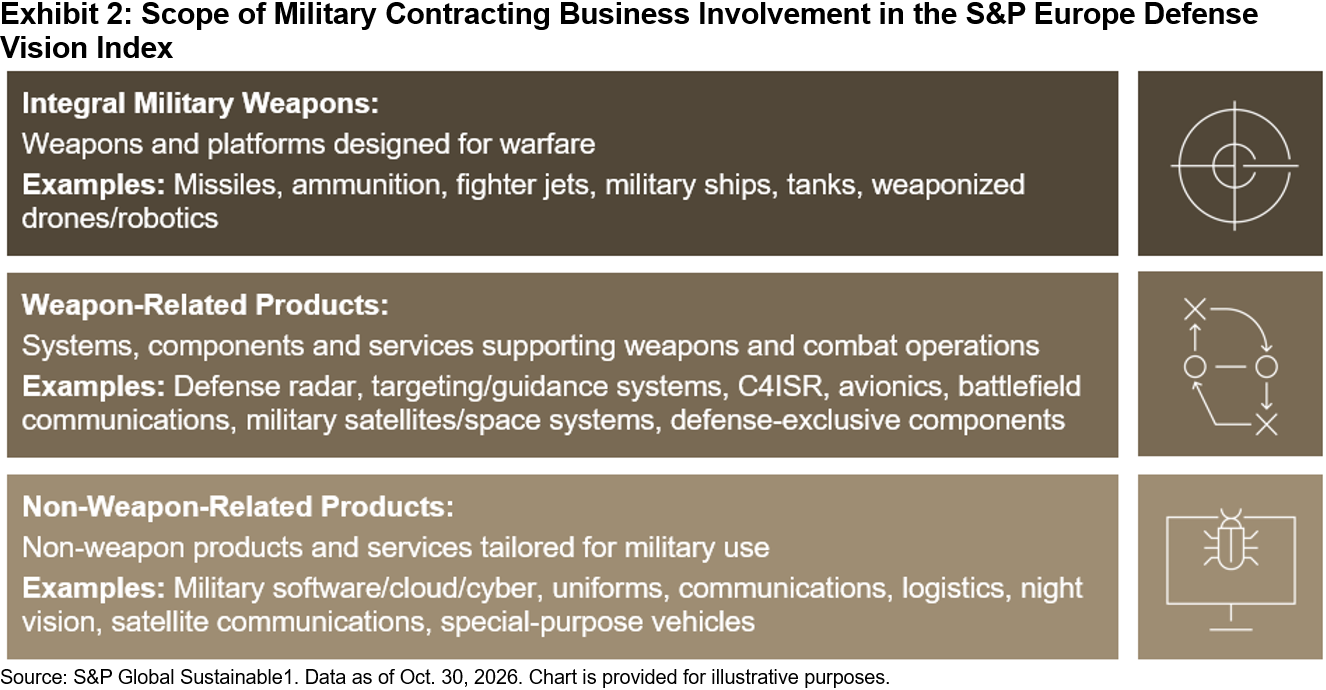
This is where S&P Global Business Involvement Screens data adds an important dimension. Military Contracting revenue exposure spans Integral Military Weapons, Weapon-Related Products and Non-Weapon-Related Products. As Exhibit 2 illustrates, this reflects not just weapons, but the technologies, components and services underpinning modern military capabilities.
Making the Cut
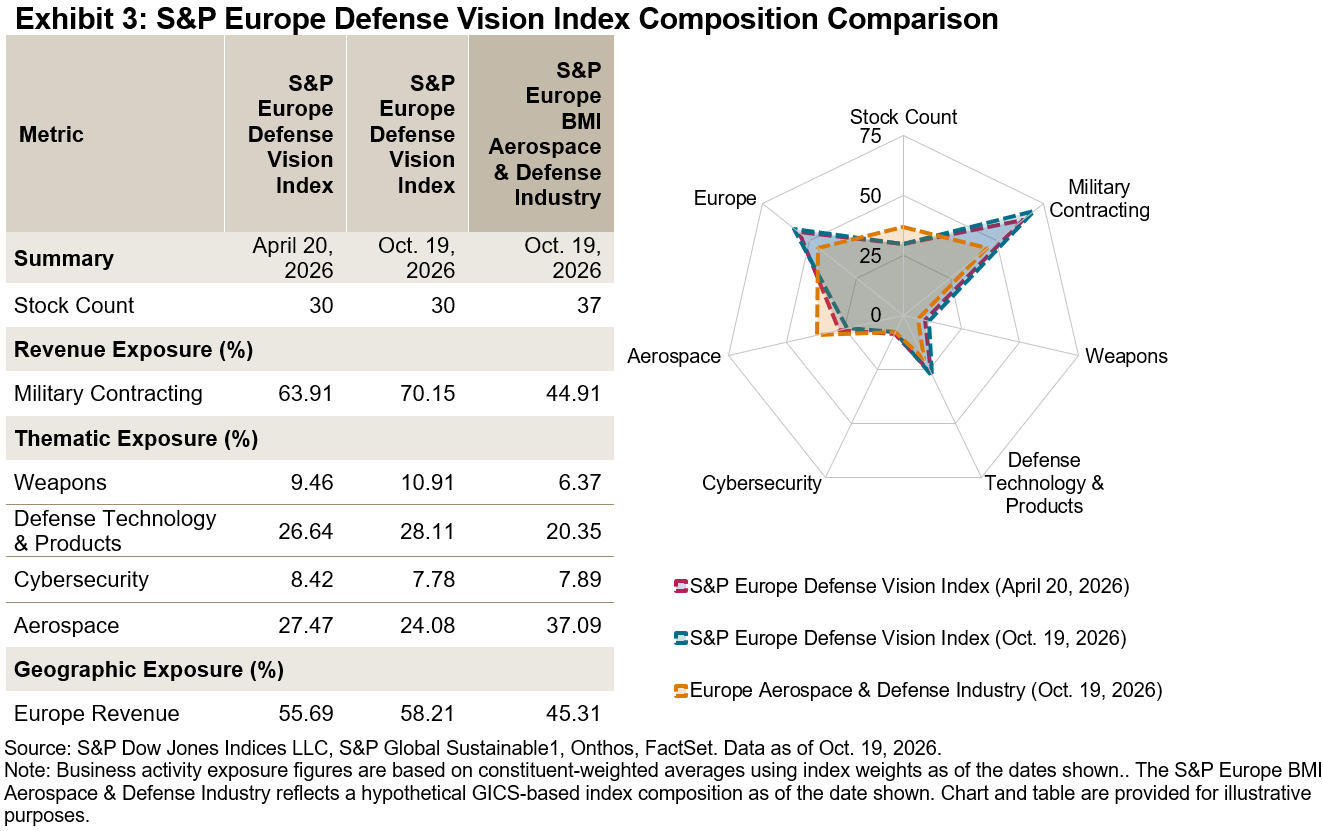
That broader interpretation is reflected in the index. At the October 2026 rebalance, Military Contracting involvement represented 70.2% of the S&P Europe Defense Vision Index on a constituent-weighted basis, while Weapons exposure stood at just 10.9%. Defense Technology & Products accounted for 28.1%, alongside activity in other areas including cybersecurity.
Exhibit 3 puts these characteristics into context. Relative to both the April 2026 rebalance composition and a more traditional GICS® industry approach, the October rebalance emphasizes military contracting and defense technology more heavily, with less exposure to aerospace. The increase in Military Contracting involvement, a sign of greater thematic purity, also reflects a growing pool of eligible, pureplay European defense companies. Although not explicitly targeted, greater European revenue exposure also aligns with the push for regional defense autonomy.
Europe’s defense landscape is no longer confined to conventional aerospace and defense. Weapons and combat platforms remain critical, but drones and autonomy, cyber, communications, space and software increasingly form part of the wider ecosystem.
And Europe’s defense plans extend well beyond a halftime team talk. As Europe commits more resources to defense, the threats it faces and capabilities required to address them will continue to evolve. Keeping pace with that evolution will likely require not only greater spending, but a longer-term vision of what defense may become.
By looking beyond traditional sector boundaries while retaining a direct link to military business involvement, the S&P Europe Defense Vision Index offers a distinct lens for tracking Europe’s evolving defense era.
References:
1 FIFA. “Spain Complete Unprecedented Global Double as New Milestones on the Pitch Define Historic FIFA World Cup 2026 Finale.” July 20, 2026.
2 European Defence Agency. “EU Defence Spending: €418 Billion in 2025, Projected to €454 Billion in 2026.” July 16, 2026.
3 NATO. “The Hague Summit Declaration.” June 25, 2025.
4 European Commission. “SAFE”.
5 NATO. “NATO Allies Invest 40 Billion Dollars in Counter-Drone Capabilities and Drone Training.” July 7, 2026.
6 UK Ministry of Defence. “UK Drone Transformation to Strengthen Armed Forces Backed by More Than £5 Billion.” June 29, 2026.
7 Dealroom.co and Resilience Media. “State of Defence Tech 2026.” October 2026.
8 Defense News. “Helsing Raises $1.8 Billion in Europe’s Biggest Defense-Startup Round.” July 13, 2026.
The posts on this blog are opinions, not advice. Please read our Disclaimers.