






U.S. equity markets have been volatile recently, driven by a sharp sell-off in tech stocks, followed by a rebound, as investors struggle to assess the sustainability of the AI trade, with the S&P 500® up 1% month-to-date.1 Anthropic’s public IPO filing makes the question especially timely: is the market’s long-standing reliance on AI-related optimism a cause for anxiety or an opportunity for investors?
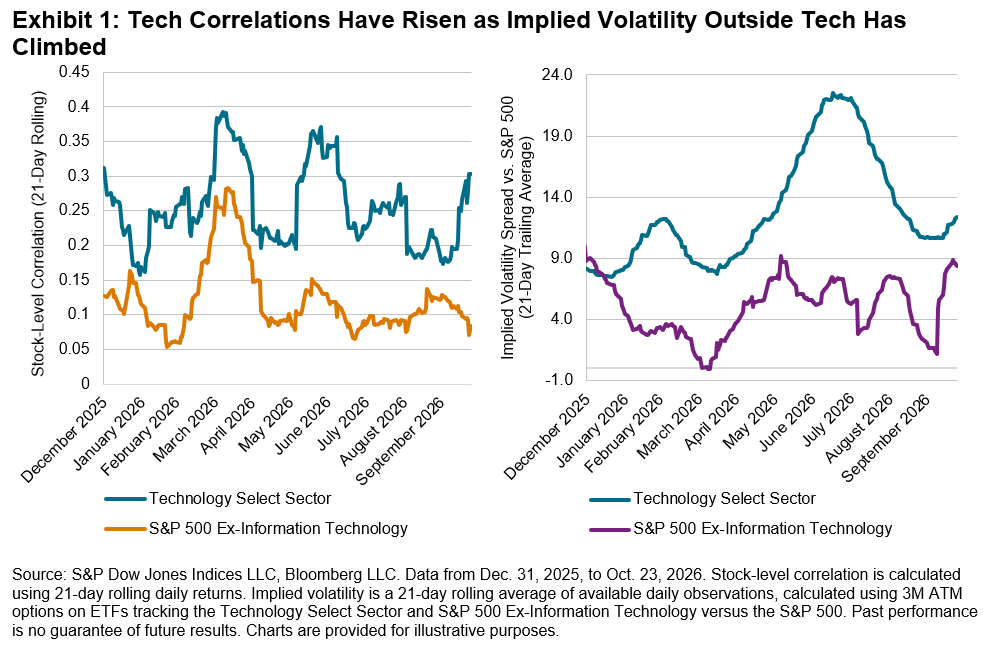
As fears have grown over the impact of AI capex on corporate balance sheets, Exhibit 1 shows that stock-level correlations have risen for the Technology Select Sector and declined for the S&P 500 Ex-Information Technology since the end of Q3, suggesting the rest of the market has been relatively immune so far.
Yet forward-looking measures suggest investors may not be convinced that the rest of the market can stay insulated. The implied volatility for the S&P 500 Ex-Information Technology relative to the S&P 500 has been rising, narrowing its gap with the Technology Select Sector, which may signal that the equity market sees the risks of AI spreading beyond the tech sector.
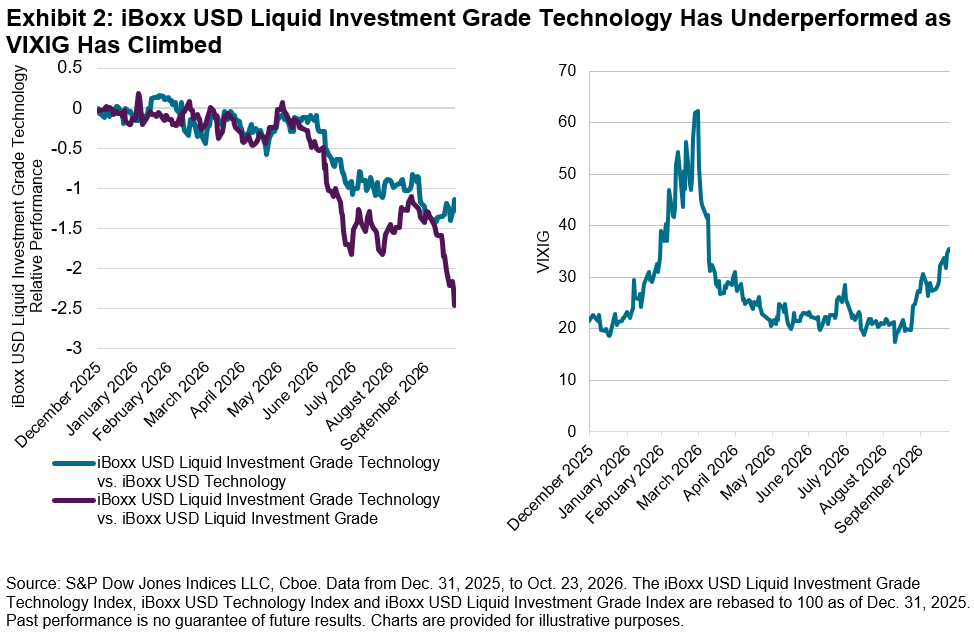
The impact of AI has also reverberated through the bond markets, as tech companies have increasingly relied on debt to finance their investments in AI. The iBoxx USD Liquid Investment Grade Technology Index has underperformed the broader iBoxx USD Technology Index and the iBoxx USD Liquid Investment Grade Index YTD. This is consistent with the liquid technology index’s greater weight toward large hyperscalers, whose credit spreads have widened amid heavy new issuance.2 AI debt worries are also reflected in the rise of VIXIG, which measures implied volatility for U.S. investment grade markets using options on the CDX North American Investment Grade Index.3
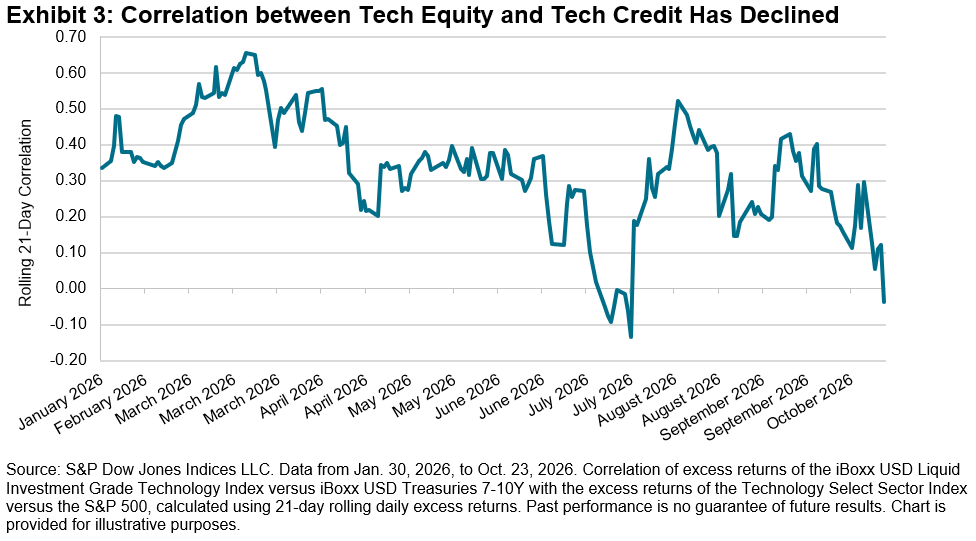
Combining the equity and debt perspectives, we observe in Exhibit 3 that the correlation between tech equity and tech credit excess returns has trended downward. While both have been under pressure, their day-to-day moves have increasingly diverged. The decoupling suggests the two asset classes are currently pricing the AI story differently. Equity investors may be weighing AI’s upside against its costs, while credit investors, whose returns are capped, focus more on the leverage required to fund it.
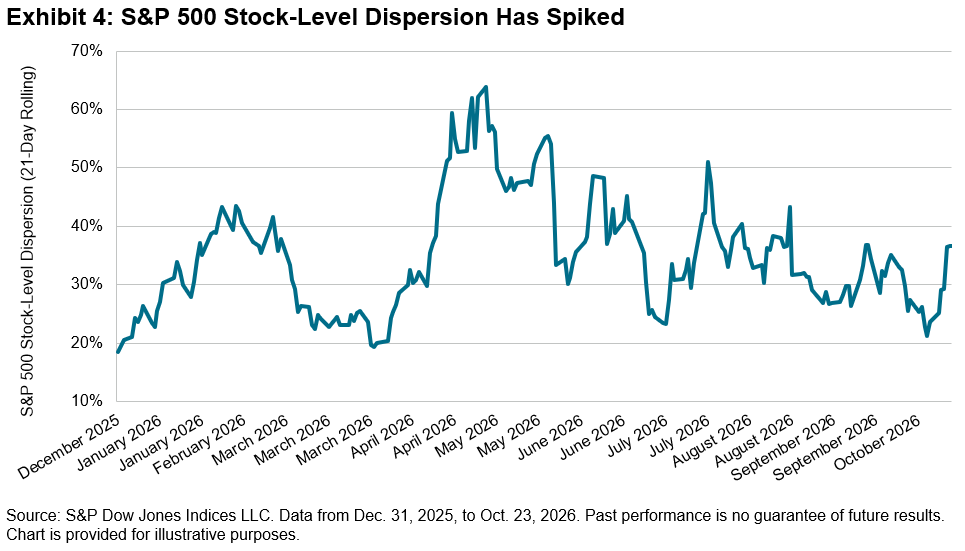
Returning to equities, do these market gyrations mean that it’s now a stock picker’s market?4 Dispersion, rather than correlations, can tell us about the value of stock-selection skill, which rises when dispersion is high. S&P 500 stock-level dispersion has risen sharply in recent weeks, as is typical during earnings season, with heavyweights Microsoft, Alphabet and Amazon reporting this week. But history tells us that it might be too early for active managers to rejoice.
The answer to our opening question may remain unknown, but understanding the impact of the AI trade across sectors and asset classes, as well as through the lens of volatility, may be useful in navigating today’s uncertain conditions.
1 As of Oct. 27, 2026.
2 Hodgson, Ramsay and Healy, Euan, “AI debt worries spark surge in default insurance trading”, The Financial Times, Oct. 20, 2026.
3 AI CDS spreads have widened as well. See US IG Credit: No sector is an island”, S&P Global Market Intelligence, Oct. 6, 2026.
4 Zuckerman, Gregory and Banerji, Gunjan, “Stock Pickers Burned by the AI Boom Think Their Moment Has Finally Arrived”, The Wall Street Journal, Oct. 19, 2026.
The posts on this blog are opinions, not advice. Please read our Disclaimers.