






For many Brazilian investors, accessing U.S. equities has traditionally involved a tradeoff. The S&P 500® tracks the performance of many of the world’s leading companies, including a vibrant technology sector driving much of the world’s AI innovation and capital expenditures. However, returns from Brazil’s local interest rates have competed with S&P 500 performance in BRL (S&P 500 (BRL)) and an international component can also introduce volatility from movements between the U.S. dollar and the Brazilian real. The S&P 500 Futures Quanto USD-BRL Currency Adjusted Index (S&P 500 Quanto) separates the Brazil and U.S. components by measuring U.S. equity futures performance while mitigating USD-BRL exchange-rate volatility.
The index measures the performance of the nearest-maturing quarterly E-mini S&P 500 futures contract trading on B3 and follows a quarterly roll schedule. It then applies quanto currency adjustment so that daily performance is settled in Brazilian currency rather than in the futures contract’s currency of denomination. The objective is not to add a directional currency bet, but to provide a cleaner measure of U.S. large-cap equity futures performance from a Brazilian perspective.
This currency-adjusted approach has produced a meaningful impact on relative performance. Exhibit 1, compares the cumulative performance of the S&P 500 Quanto, S&P 500 (BRL) and the S&P Brazil LargeCap over the past 10 years, illustrating the differential between U.S. and Brazilian equities as well as the impact of the quanto currency adjustment approach on The 500®.
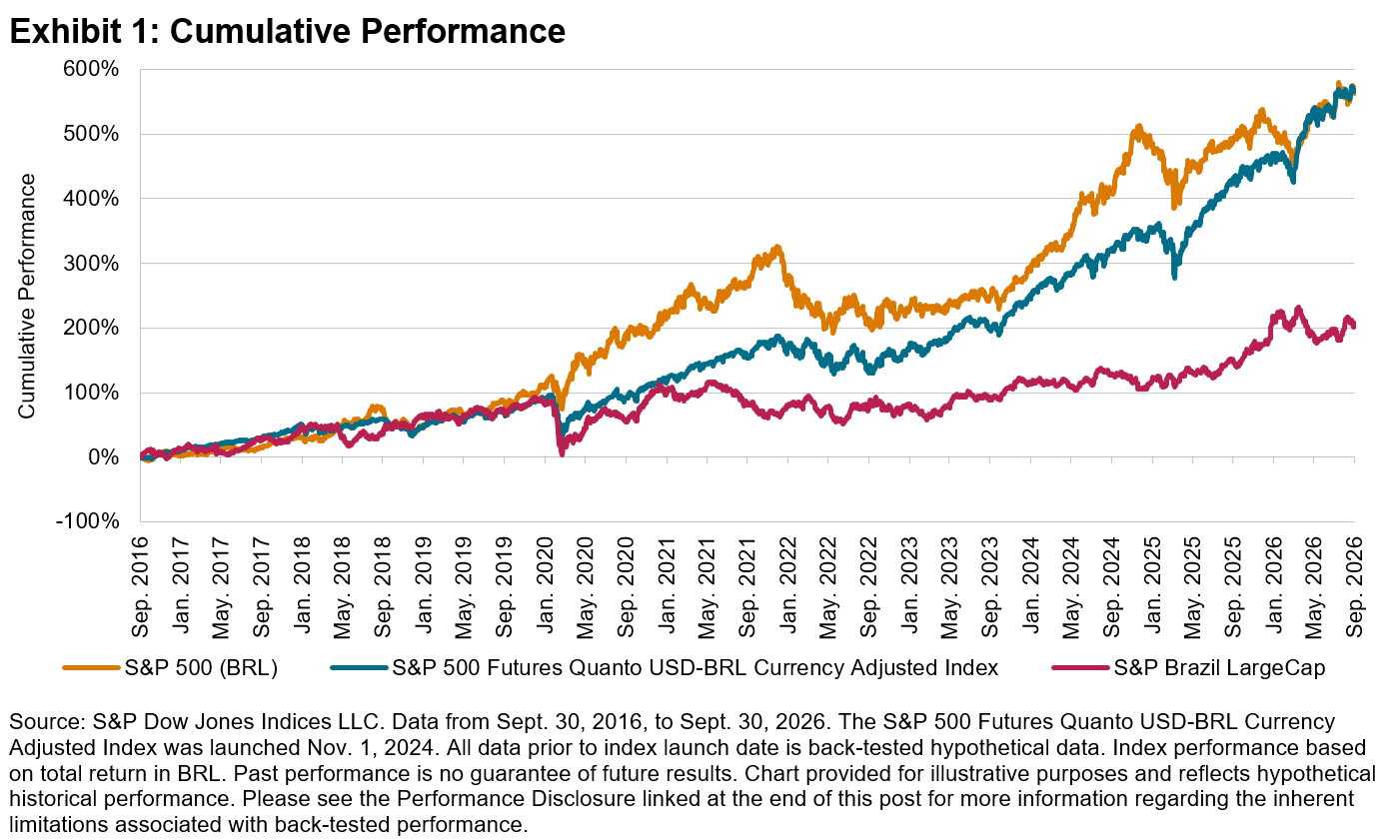
Exhibit 2 illustrates the performance of the 500 Quanto and S&P 500 (BRL) over various periods through the end of Q3 2026.
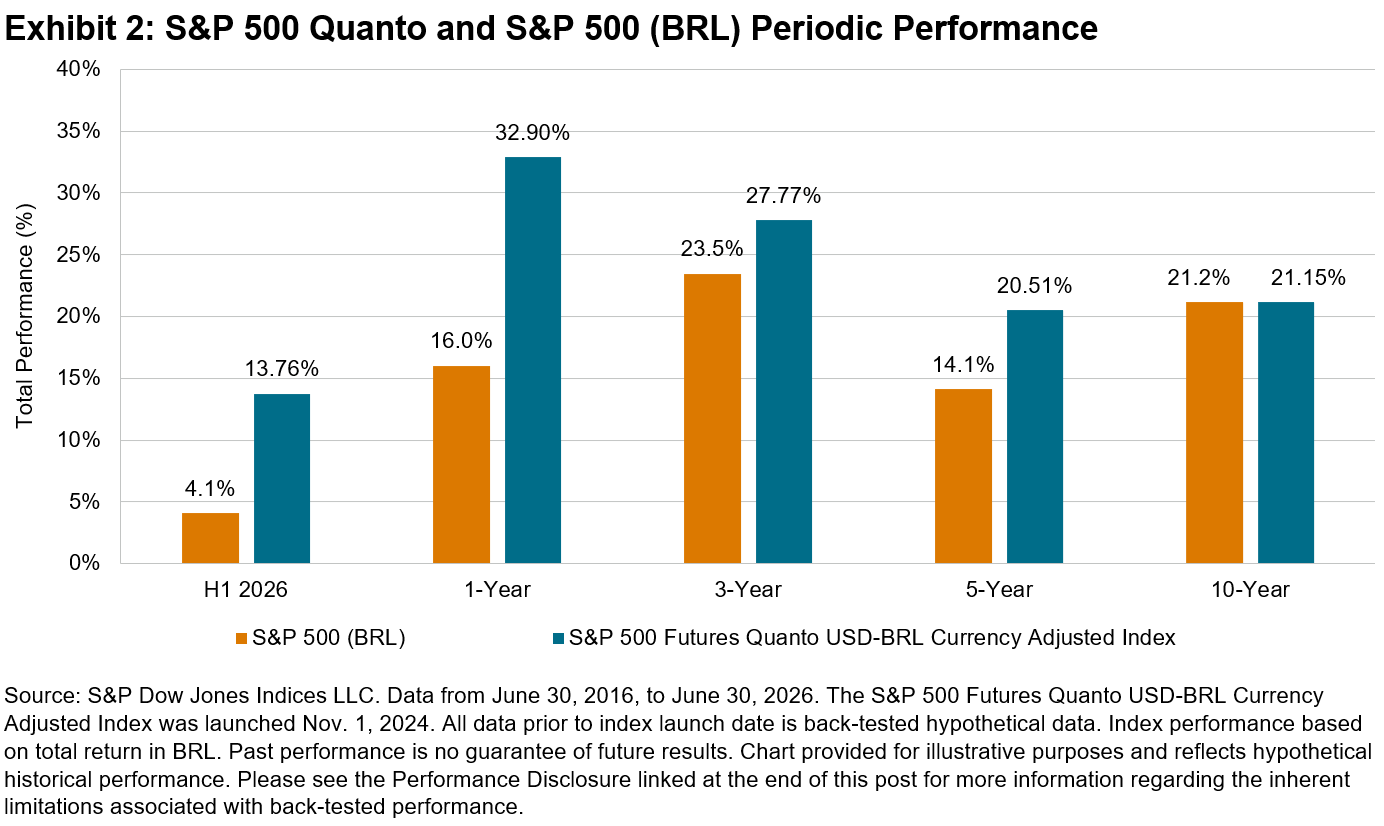
What does this benchmark comparison mean for Brazil? When evaluating the relative performance of active U.S. equity funds domiciled in Brazil, benchmark choices can lead to significant differences in outcomes. In S&P DJI’s SPIVA® Latin America Scorecards, we measure the performance of active U.S. equity funds against the S&P 500 (BRL). However, based on the performance differences mentioned previously, one would expect a greater proportion of active funds to underperform when measured against the S&P 500 Quanto. Exhibit 3 illustrates underperformance rates for Brazil-domiciled U.S. equity funds versus the S&P 500 (BRL) as reported in the SPIVA Latin America Mid-Year 2026 Scorecard, as well as how those same funds would have fared relative to the S&P 500 Quanto.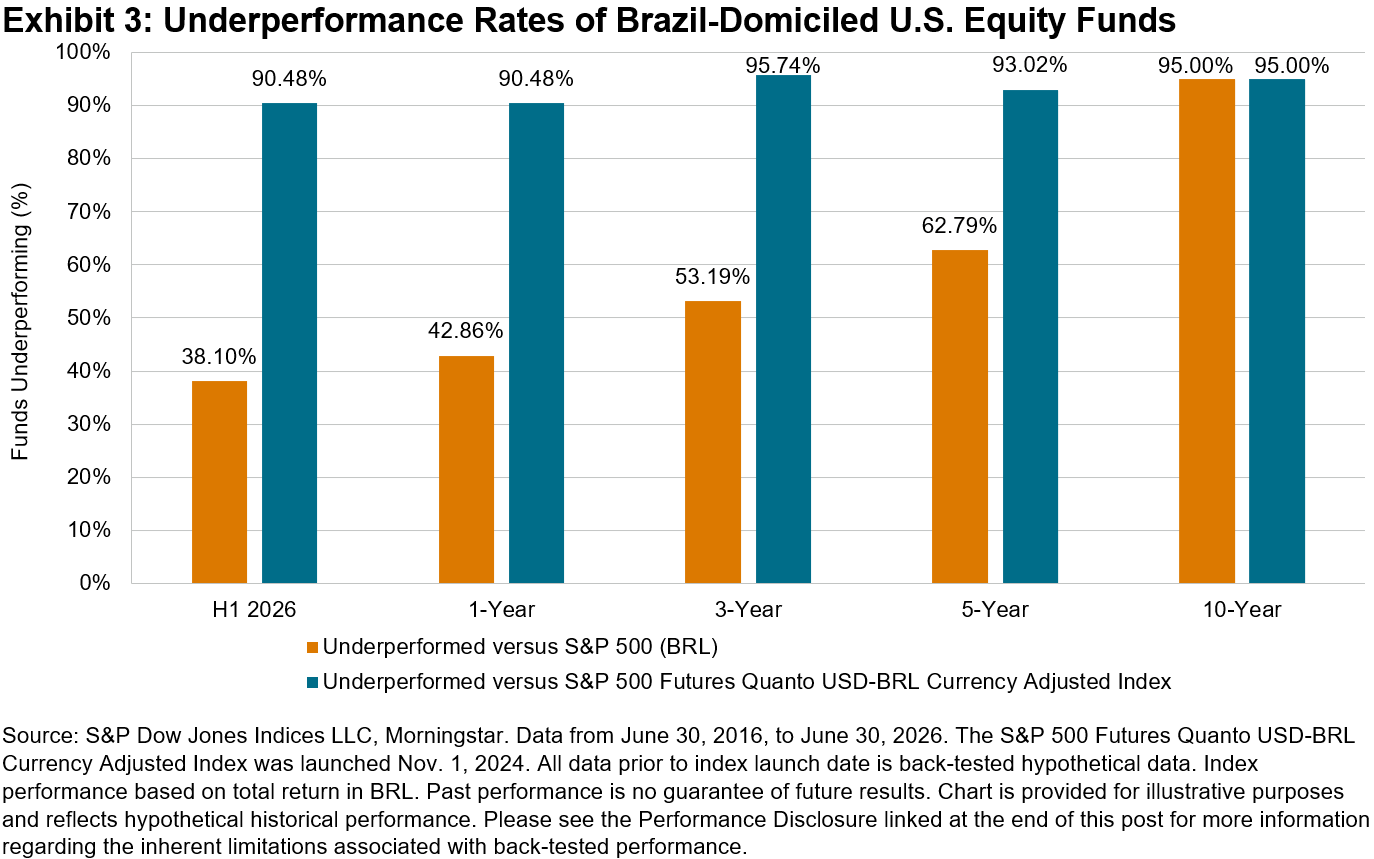
The results paint a very clear picture: although 38.1% of U.S. equity funds underperformed the S&P 500 (BRL) in the first half of 2026, 90.5% failed to beat the S&P 500 Quanto. Over longer back-tested horizons, the S&P 500 Quanto continued to outperform more than 90% of active U.S. equity funds, demonstrating how index innovation can address local market challenges with an eye to global diversification with the S&P 500.
This content may be AI-assisted and is composed, reviewed, edited, and approved by S&P Global.
The posts on this blog are opinions, not advice. Please read our Disclaimers.