











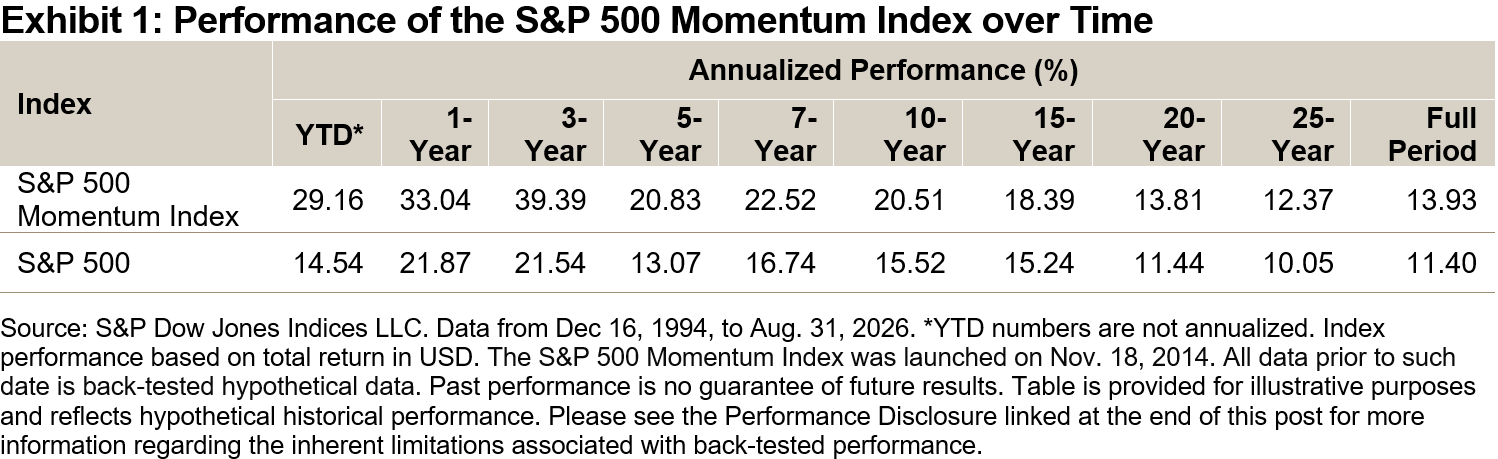
The S&P 500® Momentum Index tracks the top 20% of S&P 500 stocks by 12-month risk-adjusted price momentum.1 Backed by persistent market trends, the index has outperformed significantly relative to the broader market in recent years (see Exhibit 1).
The S&P 500 Momentum Index rebalances semiannually after the close of the third Friday of March and September, using the final business day of February and August as reference dates, respectively. This blog examines the recent September rebalance, detailing constituent changes, sector and industry group weights, and pre- and post-rebalance factor characteristics.
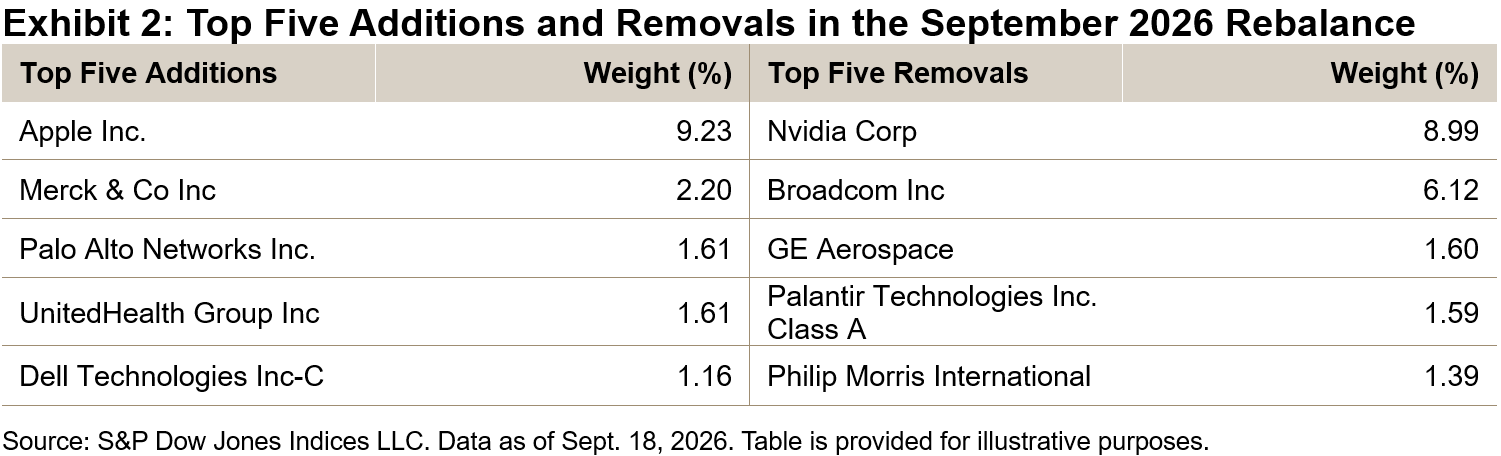
During the September rebalance, the index added and removed 54 constituents; Exhibit 2 highlights the five largest additions and removals. Notably, Apple entered the index with a weight of 9.23%, while Nvidia and Broadcom were removed (which were previously weighted at 8.99% and 6.12%, respectively). Following the rebalance, the index included two Magnificent 7 companies: Apple (9.23%) and Alphabet (8.95% between the combined share classes).
Sector Breakdown
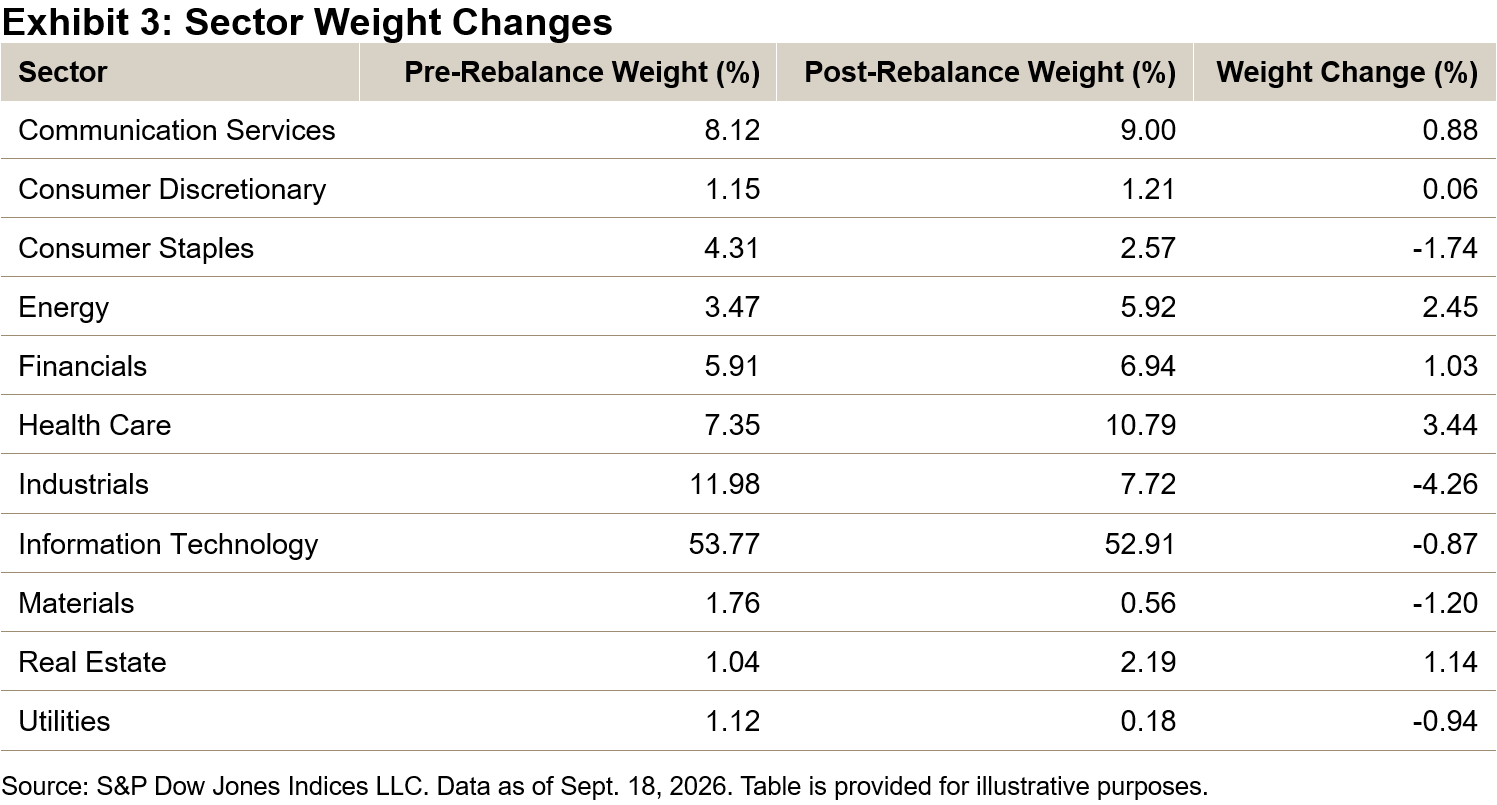
Information Technology remained the largest sector in the S&P 500 Momentum Index following the September rebalance, accounting for 52.91% of the weight. Health Care rose to become the second-largest sector, replacing Industrials, while the weights of all other sectors remained relatively unchanged.
Industry Group Breakdown
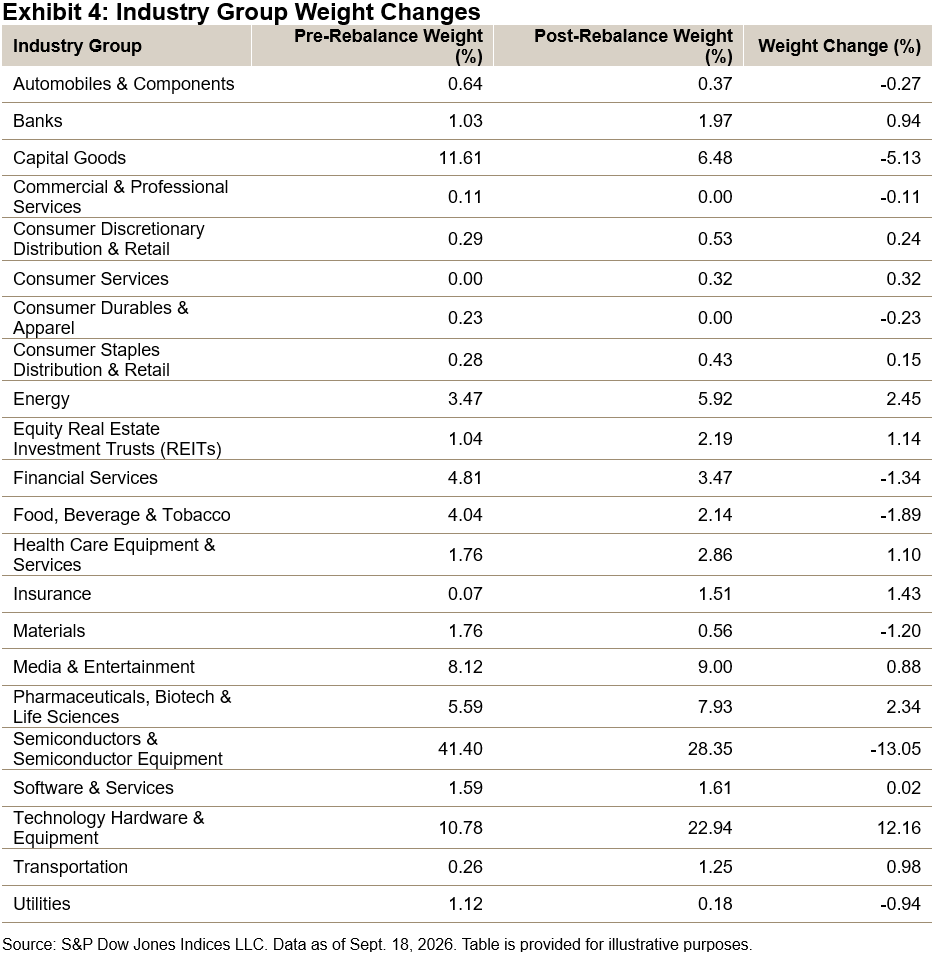
While overall weight of the Information Technology sector remained stable, its underlying industry weightings shifted significantly: the Semiconductor & Semiconductor Equipment industry group fell by 13.0%, while Technology Hardware & Equipment rose 12.1%, driven largely by Apple.
This rebalance reduced the index’s large overweight in semiconductors. Furthermore, Apple’s inclusion introduced potential diversification within AI-related themes, as its revenue is less directly tied to AI capital expenditures than that of major semiconductor firms.
Factor Tilts
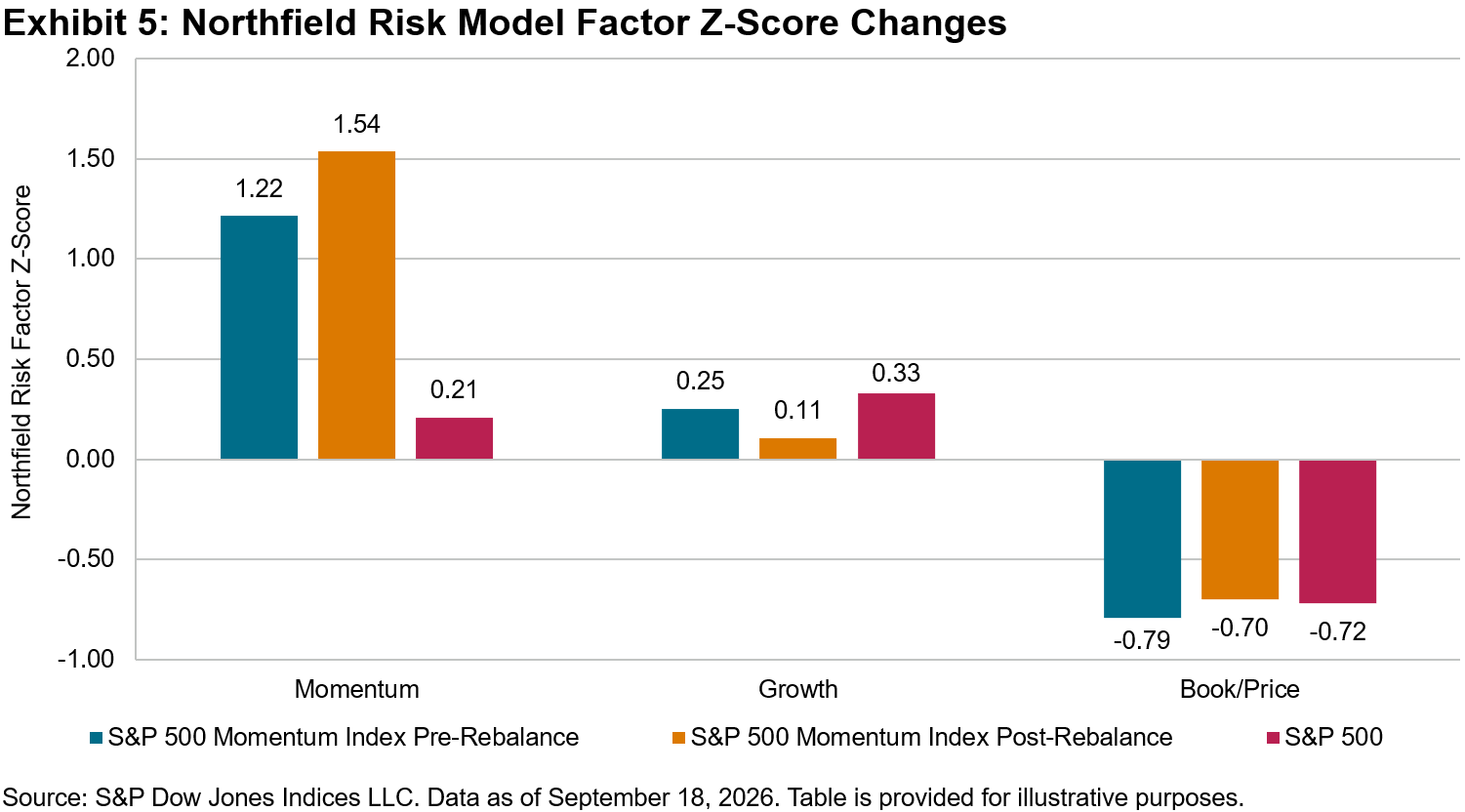
Exhibit 5 highlights the S&P 500 Momentum Index’s pre- and post-rebalance factor tilts relative to the S&P 500 using Northfield Risk Model Z-scores. As expected, the index exhibited a stronger momentum tilt following the rebalance, alongside a smaller growth tilt and an increased value tilt.
1 Please refer to the S&P Momentum Indices Methodology for more details.
The posts on this blog are opinions, not advice. Please read our Disclaimers.