











Income-oriented indexing has entered a new phase. What began with relatively straightforward option-writing indices has evolved into a broader toolkit of rules-based strategies designed to reflect more targeted outcomes. This evolution reflects a shift in investor demand beyond pure beta exposure and toward outcome-oriented solutions. In recent years, systematic derivative income strategies have grown meaningfully across both ETFs and structured products.
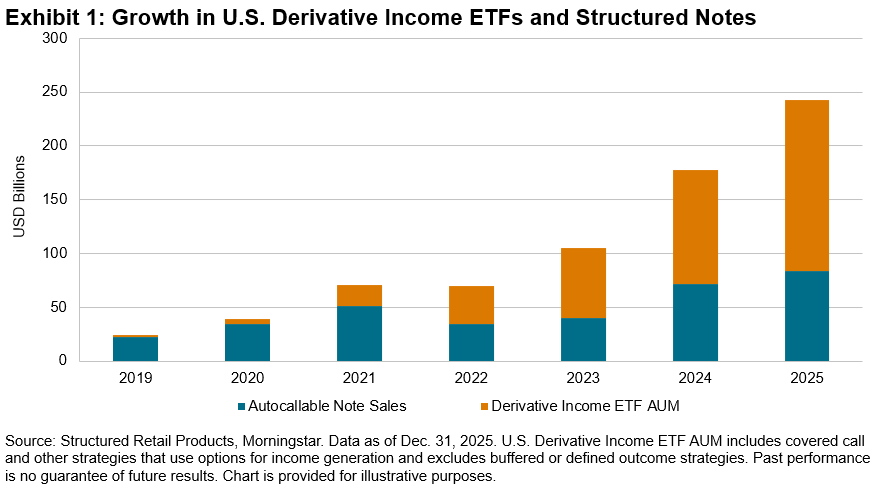
With the launch of the first autocallable ETF in 2025, sophisticated payoff structures that were once only accessible to a limited set of market participants via structured products are now available to the broader market. Indexing has helped make this innovation possible. Today, a single rules-based index can theoretically replicate the payoff structure of an autocallable—also referred to as an autocall—by combining multiple forms of optionality into a rules-based methodology incorporating features such as hypothetical contingent income, observation dates, barriers and potential early redemption. Recall that an index is not an investment product; one cannot invest directly in an index but rather an investment product based on an index.
S&P Dow Jones Indices recently launched two autocall indices: the S&P 500 Futures 40% Defined Volatility Autocall Index and the S&P U.S. Equity Momentum 40% VT Autocall Index. Each index takes a different approach to replicating an autocall payoff structure reflecting potential income generation. For more information, please see the S&P 500 Futures 40% Defined Volatility Autocall Index Methodology and the S&P U.S. Equity Momentum 40% VT 4% Decrement Autocall Index Methodology.
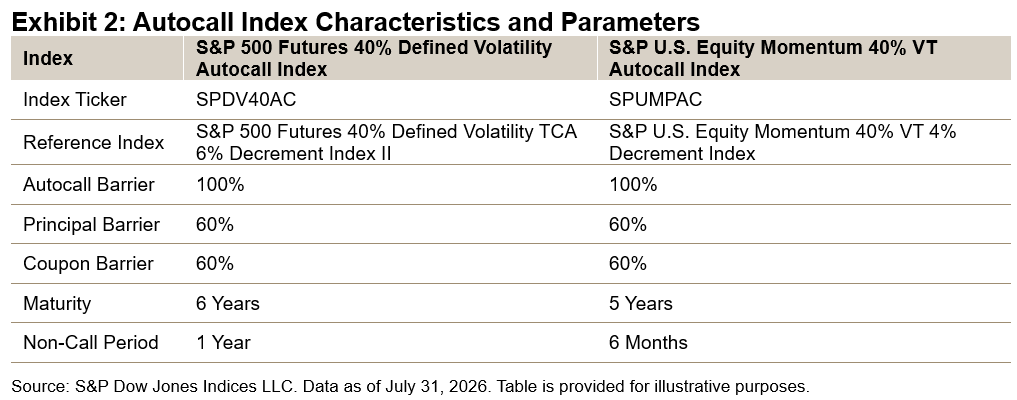
To better understand these indices, it’s necessary to understand how autocalls work. Autocall notes link coupon payments to the performance of a reference asset—in this case an underlying index. If the reference index remains above a predetermined level, the autocall pays a coupon. If the reference index experiences a certain decline, coupon payments may cease or principal may be at risk. In this way, autocall structures reflect tradeoffs; market participants may enjoy income derived from equity markets in exchange for some downside risk.
The S&P 500 Futures 40% Defined Volatility Autocall Index features a “dual yield” structure, with the potential for simulated income generation both from coupons and 50% of the upside participation of the reference index’s performance. This additional upside participation aims to mitigate the opportunity cost that an autocall structure may face during equity market rallies.
The S&P U.S. Equity Momentum 40% VT Autocall Index features a memory coupon that lasts for 12 months. For an eligible coupon as of a point in time, the memory coupon will also reflect any missed coupons from the past 12 months. The index also features a “pruning” mechanism that serves to systematically replace underperforming autocalls.
Both autocall indices employ a laddered structure whereby new autocalls are initiated on a staggered basis to help mitigate the impact of entry point risk and tail risk.
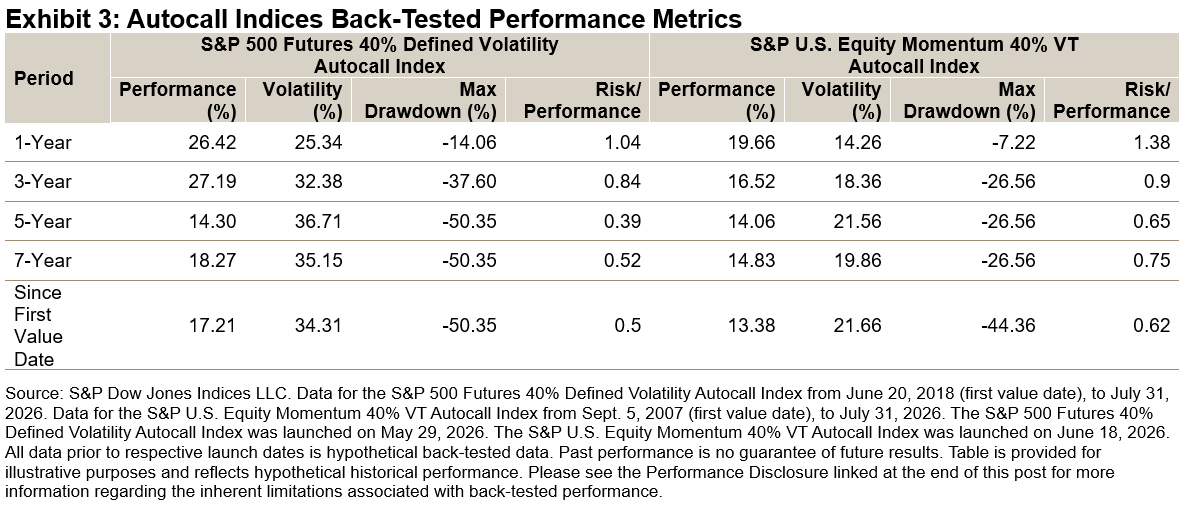
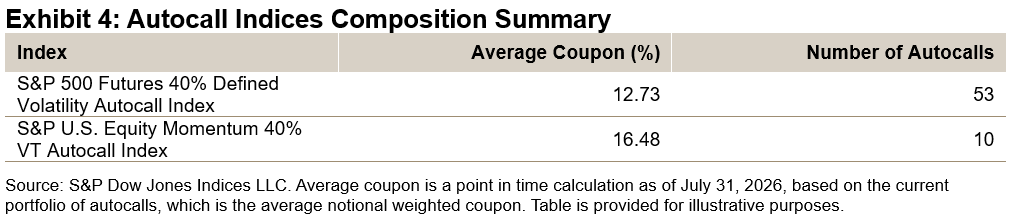
As investor demand for defined outcome strategies continues to evolve, indices may play an increasingly important role as a tool in making sophisticated payoff structures accessible via linked investment products to a broader set of market participants.
The posts on this blog are opinions, not advice. Please read our Disclaimers.