


Get Indexology® Blog updates via email.

In This List

Evolving Index Solutions Are Bringing Transparency to Private Markets

We Never Go out of Style

Technology Breakthroughs Meet Industrial Metals Strength

Integrating Dividend and GARP Index Strategies in the Australian Market

Building the Future: How China Leverages Energy and Infrastructure to Supercharge Artificial Intelligence

Evolving Index Solutions Are Bringing Transparency to Private Markets

Contributor Image
Wanying Wu

Senior Analyst, Private Markets Indices

S&P Dow Jones Indices

The investment landscape is undergoing a marked transformation as the private markets space has generated increasing interest among new classes of investors. This shift reflects a broader rethinking of diversification, return potential and portfolio construction strategies. As interest in private equity and private credit continues to expand, S&P Dow Jones Indices (S&P DJI) is positioned to support this growing demand through innovative index-based solutions that promote transparency, efficiency and accessibility.

Retail Investors: Unlocking Access to Private Markets

Private markets—which include private equity, private credit and others—have historically been the domain of institutional investors. Today, retail investors are rapidly gaining interest—U.S. retail fundraising in alternative investments reached USD 122 billion in 2025, and a State Street survey reported that 56% of institutional investors expect retail-style vehicles to account for over half of private market fund flows by 2027.2

Private markets currently represent roughly 10%-15% of global assets, and retail investor allocations remain well below that range in the U.S.,3 even though U.S. households controlled an estimated USD 90 trillion in total financial wealth by the end of 2024.4

Within this wealth pool, the mass-affluent segment (generally defined as USD 500,000-USD 2 million in investable assets) and the affluent group (USD 2 million-USD 5 million) together account for 36% of U.S. households. While these segments play a significant role in overall wealth distribution, their allocation weight in private markets remains disproportionately low—highlighting the potential for growth by better aligning their substantial investable assets with emerging private market strategies.4

However, there are some barriers. Retail investors face high minimums, illiquidity, limited secondary markets, opaque fee structures and a lack of transparency. These longstanding obstacles have hindered broader participation—until now. The push toward democratizing access to private markets is gathering momentum.

S&P DJI is developing solutions to help bridge this gap. Through the development of index-based solutions that are transparent, cost-effective and scalable, S&P DJI is working to address these concerns associated with private assets, and to provide detailed insights and robust performance evaluation tools in the private equity and credit strategy space.

Institutional Investors: Rethinking Portfolio Construction with Alternatives

For institutional investors, private market investments are no longer considered peripheral, taking on an increasingly central role in portfolio strategy. Global pension funds are making substantial allocations to private markets, now totaling more than USD 10 trillion.5 In many cases, alternatives account for over 25% of institutional portfolios.

Institutions are increasingly drawn to private markets for their return potential, diversification benefits and relative resilience in volatile public market environments. However, challenges remain: limited transparency, illiquidity and single-manager risk still shape decision-making.

As a result, institutional investors could be turning to index-based private markets solutions that can offer:

  • Cost-efficient implementation;
  • Fast and scaled deployment of alternatives;
  • Greater transparency and benchmark comparability; and
  • Diversification with less manager concentration risk.

By leveraging index-based solutions, institutions aim to strike a balance between the potential benefits of private market participation while mitigating the traditional constraints associated with these investments. At the same time, it is important to acknowledge that investing in private markets will differ from public markets, and that retaining these unique characteristics is part of the value proposition. Education will also play a critical role in helping investors understand the nature of private markets and how index-based approaches can enhance transparency.

Innovating Participation and Transparency in Private Markets

As a global leader in indexing, S&P DJI is playing a central role in reshaping tools that enable participation in private markets for both retail and institutional investors. S&P DJI’s role in private markets starts with our collaboration with Cambridge Associates, providing industry-standard benchmarks for private fund performance. We also publish indices that are designed to measure listed private equity and business development companies. Earlier this year, we introduced the S&P U.S. Private Stock Top 10 Index—our first step into indices with the objective of measuring late-stage venture-backed companies—reflecting the increasing availability of pricing data in this space. More recently, we launched the S&P Private Equity 50 Indices, which are designed to measure the performance of 50 of the largest available private equity funds for a year. The indices aim to provide market participants with an efficient and accessible view into leading North American and European private equity funds. The indices include:


As part of S&P Global, we continue to draw on enterprise-wide expertise and data to develop solutions across private equity, private credit and other evolving areas of private markets. These efforts are designed to increase transparency, lower barriers to entry and provide a consistent, data-driven framework for evaluating the performance of private markets.

With decades of expertise and deep relationships with a range of market participants across the ecosystem, S&P DJI is uniquely positioned to deliver index solutions that meet the evolving interests of both institutions and retail investors. By driving innovation in index design and creating trusted benchmarks for private markets, S&P DJI is helping to provide detailed insights and robust performance evaluation tools, enhance transparency and shape the future of private markets for the next generation.


  1. Habbel, Markus et al. “Avoiding Wipeout: How to Ride the Wave of Private Markets.” Bain & Company. August 2024.
  2. The “Retail Revolution” Will Drive 50%+ of Private Market Flows by 2027 – State Street Private Markets Survey | State Street Bank and Trust Company
  3. Skolnik, Or et al. “Why Private Equity Is Targeting Individual Investors.” Bain & Company. 2023.
  4. Household Wealth Surged 16% in 2024 on Stock Gains: Cerulli
  5. Global Pension Assets Hit Record High in 2024.” and “US Public Pension Funds Increased Allocations to Fixed Income in 2024.” Banking Exchange. Feb. 11, 2025, and March 4, 2025.


The posts on this blog are opinions, not advice. Please read our Disclaimers.

We Never Go out of Style

Contributor Image
Diego Zurita

Analyst, Global Equities & Thematics

S&P Dow Jones Indices

Style indices have behaved differently internationally and in the U.S. This year, U.S. growth stocks, represented by the S&P United States BMI Growth (up 14.8% as of the end of September 2025), outperformed the broader U.S. market (up 14.4%). Outside the U.S., the S&P Global Ex-U.S. BMI Value (up 30.7%) has performed better (see Exhibit 1). What can we learn about this?

First, how are value and growth defined for the S&P Global BMI Series? As per the Global BMI methodology, stocks are classified based on a growth-to-value score ratio. The scores are calculated using four standardized financial metrics for value and three for growth (see Exhibit 2). In short, value focuses on undervalued stocks, while growth cares more about potential.

This year’s dominance of growth in the U.S. is a story of two words: artificial intelligence. Generally, growth indices tend to be skewed to the Information Technology and Communication Services GICS® sectors. As of the end of September, the weight of IT in the S&P United States BMI Growth was 45.9% (see Exhibit 3). As the AI rally has continued this year, it is common that an index with a high weight in these stocks rises. Internationally, the S&P Global Ex-U.S. BMI Growth (up 24.9%) performance was also mainly attributed to IT stocks.

While growth slightly outperformed value in the U.S., internationally, the differential of value over growth was higher as market participants increasingly looked for undervalued stocks.

The S&P Global Ex-U.S. BMI Value ended 2024 below its 10-year average P/E ratio (see Exhibit 4), though it did end September slightly above its 10-year average. This index tends to be heavy on Financials and Industrials (see Exhibit 5), with the former benefiting from strong bank earnings, lowering interest rates and resilient economic activity, and the latter by increased defense spending, especially in Europe.

However, this dynamic doesn’t necessarily always hold. Since 2020, U.S. growth mostly outperformed the broader U.S. market, and value performed better internationally, but Exhibit 6 shows that style rotation has happened. Economic cycles, valuation disparity and investor sentiment play an important role in the dominance of one style over the other.

The performance of style strategies has not always been the same across regions. This year, specific conditions have led to growth’s outperformance in the U.S. and value’s outperformance internationally. Style dominance trends go ’round and ’round before fading into view again. Only time can tell which remains—for now.

The posts on this blog are opinions, not advice. Please read our Disclaimers.

Technology Breakthroughs Meet Industrial Metals Strength

Contributor Image
Sabatino Longo

Analyst, Global Equity & Thematic Indices

S&P Dow Jones Indices

September’s S&P Thematics Dashboard was led by strong performance across technology- and industrial metals-linked themes. Quantum Technology surged 38%, while precious and industrial metals rallied sharply amid macroeconomic signals. In contrast, different discretionary spending- and resources-related themes softened.

Quantum and Data Infrastructure Lead

Quantum Technology was the month’s standout. IBM and HSBC claimed the execution of the world’s first quantum-powered bond trades, delivering a 34% improvement in efficiency compared with traditional methods.1 Researchers also reported scientific progress, suggesting that quantum processors could outperform classical supercomputers in real-world applications.2 Together, these milestones boosted confidence in the commercial viability of quantum computing.

The positive sentiment also expanded into infrastructure, with Data Centers & High-Performance Computing advancing 21%, lifted by large-scale capital commitments such as OpenAI and Oracle’s USD 300 billion agreement and Nvidia’s pledge to invest up to USD 100 billion in AI capacity.3

Digital Assets Regain Momentum

After a quiet August, Cryptocurrency & Digital Assets rose 19% and Blockchain & Distributed Ledger Technology added 12%. European banks unveiled plans for a euro-denominated stablecoin.4 This move is intended to counter U.S. digital market dominance. Meanwhile, the U.S. Department of the Treasury issued an Advance Notice of Proposed Rulemaking seeking to implement the U.S. GENIUS Act’s guidance for stablecoin issuers and related service providers, helping foster innovation under clearer regulatory framework.5

Metals Momentum Continues

Metals extended their strong summer rally. Silver climbed 21%, with Costco reporting gold bullion as a top-selling e-commerce product.6 Gold gained 18% on safe-haven demand,7 and Copper rose 18% on evidence of Chinese stockpiling and electrification-driven demand.8 Broader mining equities benefited from renewed discussion of a potential commodity “super cycle”9 and speculation that the U.S. may take on more direct equity stakes in lithium production.10

Consumer and Resources Struggles

Not all areas participated in the rally. Discretionary spending-linked themes struggled, with Tourism (-5%) under pressure from sustained costs for operators and weaker international demand amid elevated airfares, extreme weather and geopolitical uncertainty, even as domestic travel remained resilient.11 Gambling also retreated (-6%). Another notable underperforming segment was Resources, with Wood (-5%) facing headwinds from environmental policies and new tariff measures.12 The S&P Global Timber & Forestry Index also lagged (-3%), marking its third-worst monthly performance of the year.

Beyond Performance: Robotics Innovation in China

Beyond performance, an emerging theme to spotlight this month is humanoid robotics, particularly in China. China launched large-scale “robot boot camps” to train and test humanoids across retail, healthcare and manufacturing environments. The new Chinese government-backed Robot Mall also invites the public to interact with service robots capable bridging the gap between laboratory prototypes and real-world use .13 These developments highlight China’s push to lead not only in AI infrastructure but also in its physical embodiment.

Conclusion

September underscored investors’ dual focus on continuing technological innovation and precious metal strength. From quantum computing and AI infrastructure to China’s humanoid robotics surge and a continuing precious metals rally, the month revealed how technology and the macro backdrop continue to drive thematic performance.

Check out thematic index performance and trends in the S&P Thematics Dashboard.

1 https://www.businessinsider.com/ibm-stock-price-quantum-computing-hsbc-bond-trading-markets-2025-9

2 https://web-assets.bcg.com/89/00/d2d074424a6ca820b1238e24ccc0/bcg-what-happens-when-if-turns-to-when-in-quantum-computing-jul-2021-r.pdf

3 https://www.theverge.com/ai-artificial-intelligence/776170/oracle-openai-300-billion-contract-project-stargate

4 https://www.reuters.com/business/finance/big-european-banks-form-company-launch-stablecoin-2025-09-25/

5 https://home.treasury.gov/news/press-releases/sb0254

6 https://www.businessinsider.com/gold-bars-costco-silver-coins-bullion-top-sellers-2025-10

7 https://www.reuters.com/markets/commodities/commodities-could-be-verge-new-super-cycle-2025-09-18/

8 https://www.msn.com/en-us/money/markets/copper-gains-as-supply-disruptions-and-strong-chinese-demand-weigh-on-markets/ar-AA1N3bNB?ocid=finance-verthp-feeds

9 https://www.reuters.com/markets/commodities/commodities-could-be-verge-new-super-cycle-2025-09-18/

10 https://www.theverge.com/news/790057/lithium-mine-us-trump-us-government-stake-thacker-pass

11 https://www.msn.com/en-us/money/markets/solid-us-consumer-spending-in-august-underscores-economys-resilience/ar-AA1NnKh2?ocid=BingNewsSerp

12 https://www.reuters.com/world/trump-sets-10-tariff-lumber-imports-higher-rates-wooden-products-2025-09-30/

13 https://apnews.com/photo-gallery/china-beijing-humanoid-robot-store-c9fb9f2880084b2cd6c5eda638d019fa

The posts on this blog are opinions, not advice. Please read our Disclaimers.

Integrating Dividend and GARP Index Strategies in the Australian Market

Contributor Image
Izzy Wang

Associate Director, Factors and Dividends

S&P Dow Jones Indices

The S&P/ASX 200 High Dividend Index measures a selection of high-dividend-yielding stocks, while the S&P/ASX 200 GARP Index (GARP standing for growth at a reasonable price) measures the performance of the top growth stocks with high quality and value composite scores selected from the respective underlying index universe. In this blog, we will explore how integrating these two index strategies potentially results in enhanced long-term risk-adjusted index performance based on hypothetical back-tested data.

Understanding the Indices

The S&P/ASX 200 High Dividend Index tracks the performance of 50 high-dividend-yielding companies from the S&P/ASX 200, after screening out A-REITS and low momentum stocks.1 Across back-tested time horizons, the S&P/ASX 200 High Dividend Index demonstrated a higher theoretical dividend yield and better total return performance than the S&P/ASX 200. Based on back-tested data, for the period July 31, 2011, to Aug. 31, 2025, the index would have had an average trailing 12-month dividend yield of 5.6% and an annual excess return of 1.91% when compared with the S&P/ASX 200.

On the other hand, the S&P/ASX 200 GARP Index could help to identify growth companies while considering valuation and quality. It starts with 150 stocks with high growth scores, then selects 50 stocks with the highest quality and value composite scores.2 Across back-tested time horizons, the S&P/ASX 200 GARP Index exhibited an ability to reflect growth opportunities. For the period from July 31, 2011, to Aug. 31, 2025, the S&P/ASX 200 GARP Index would have outperformed the S&P/ASX 200 by 2.05% per year.

Combination Results

While high-dividend index strategies are often concentrated in the Financials sector, the S&P/ASX 200 GARP Index tends to underweight Financials.3 As of Aug. 31, 2025, the Financials sector accounted for 43.6% and 6.6% of the S&P/ASX 200 High Dividend Index and S&P/ASX 200 GARP Index, respectively. Given these weights, the hypothetical combination of GARP and dividend index strategies would potentially complement sector weighting, demonstrate lower tracking error to the S&P/ASX 200 benchmark and ultimately improve risk-adjusted performance, all based on back-tested data.

We combined the two indices at various proportions moving from 100% in the S&P/ASX 200 High Dividend Index to 100% in the S&P/ASX 200 GARP Index by 10% increments, which resulted in 11 hypothetical combinations as illustrated in Exhibit 1. All hypothetical combinations are rebalanced semiannually. For the period July 31, 2011, to Aug. 31, 2025, a hypothetical composition of 50% in the S&P/ASX 200 GARP Index and 50% in the S&P/ASX High Dividend Index generated a higher total return at a lower volatility compared with either standalone index.

Comparing with the Regional Core Benchmark: S&P/ASX 200

Exhibit 2 shows the risk/performance profiles of the S&P/ASX 200, S&P/ASX 200 High Dividend Index, S&P/ASX 200 GARP Index and the 50/50 hypothetical composition. Across the back-tested time horizon from July 31, 2011, to Aug. 31, 2025, the 50/50 combination posted a higher annualized total return of 11.7% at a lower volatility of 12.82%, resulting in a better risk-adjusted return of 0.91. It outperformed the S&P/ASX 200 by 2.07% per year.

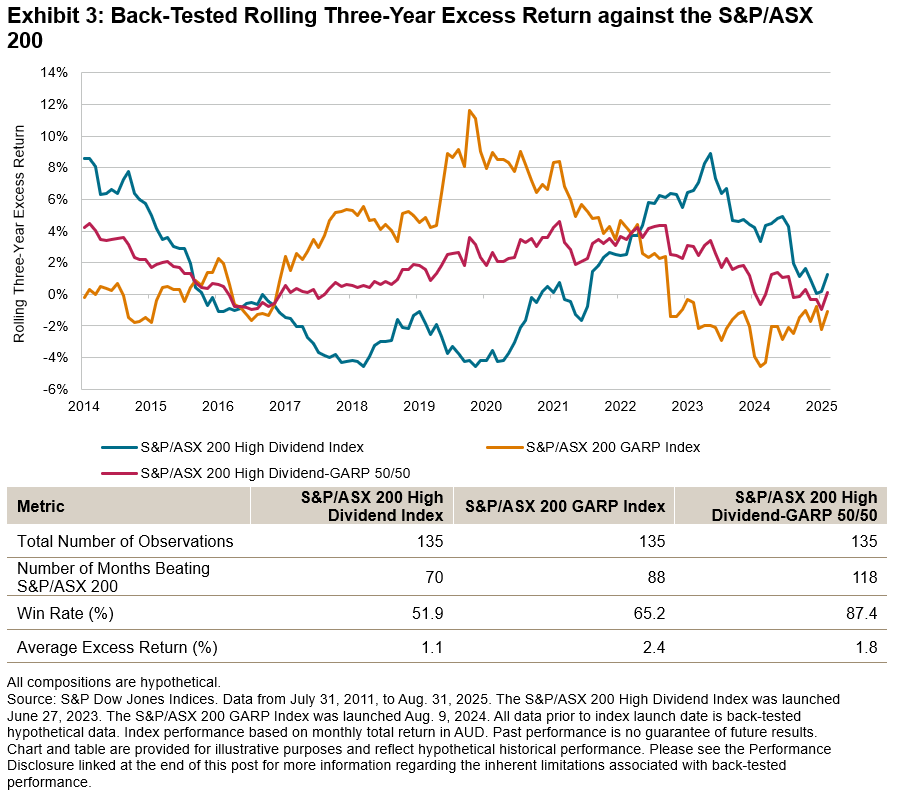
Exhibit 3 illustrates the rolling three-year back-tested performance of the S&P/ASX 200 High Dividend Index, S&P/ASX 200 GARP Index and a 50/50 hypothetical combination of the two indices. From the 135 samples observed from July 2011 to August 2025, the S&P/ASX 200 High Dividend Index and S&P/ASX 200 GARP Index would have outperformed the S&P/ASX 200 52% and 65% of the time, respectively. The outperformance rate was even higher after combining the indices. The 50/50 hypothetical composition outperformed the S&P/ASX 200 in 87% of the samples observed, with an average excess return of 1.8%. An outperformance rate of nearly 90% underscores the performance resilience of the 50/50 combination across various market conditions.

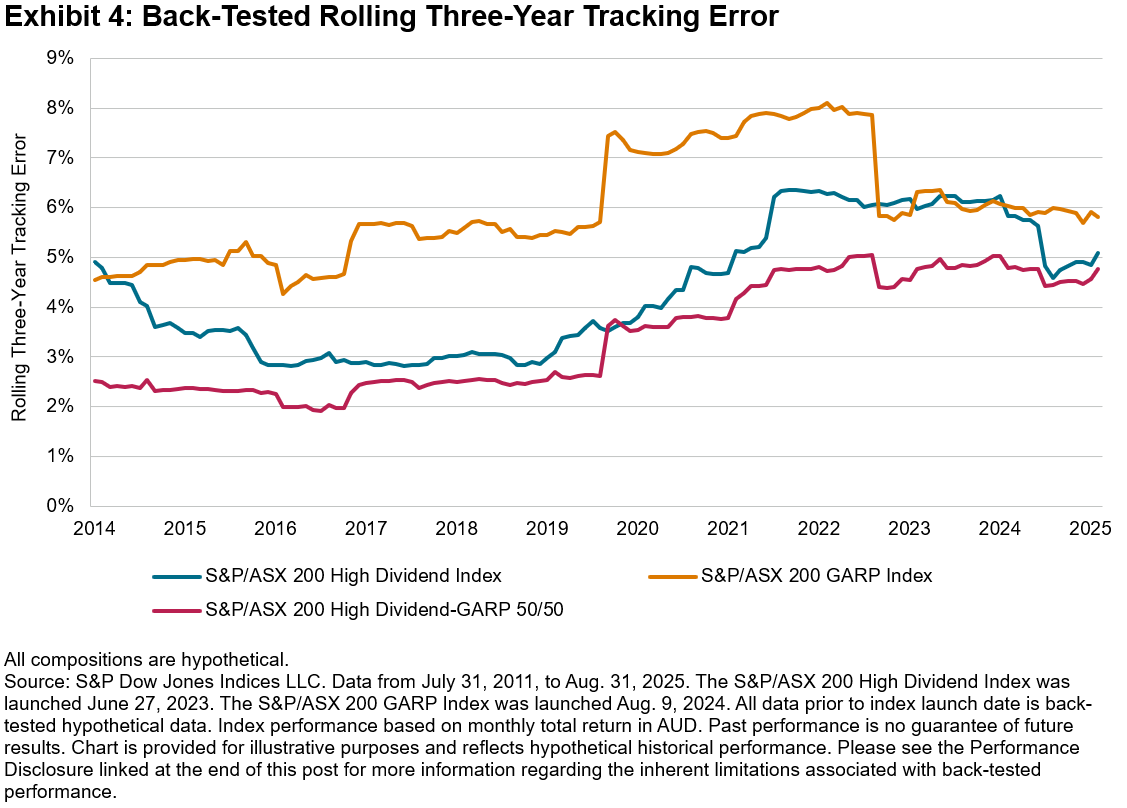
Thanks to diversification, a hypothetical 50/50 combination had a significantly lower tracking error against the S&P/ASX 200 than each component index. Exhibit 4 shows the rolling three-year tracking error. From July 31, 2011, to Aug. 31, 2025, the average tracking error of the 50/50 combination would have been 3.4%, which was lower than the 6.0% of the S&P/ASX 200 High Dividend Index and the 4.3% of the S&P/ASX 200 GARP Index.

In conclusion, the hypothetical combination of the S&P/ASX 200 High Dividend Index and the S&P/ASX 200 GARP resulted in a composition with a relatively low tracking error to its benchmark but better historical performance than the S&P/ASX 200, historically. This demonstrates the potential for factor index applications in the Australian market.

1 For index methodology, please refer to: https://www.spglobal.com/spdji/en/methodology/article/sp-high-dividend-indices-methodology/

2 For index methodology, please refer to: https://www.spglobal.com/spdji/en/methodology/article/sp-garp-indices-methodology/

3 Jason Ye (August 2025). Introducing the S&P/ASX 200 GARP Index


The posts on this blog are opinions, not advice. Please read our Disclaimers.

Building the Future: How China Leverages Energy and Infrastructure to Supercharge Artificial Intelligence

Contributor Image
Darius Nass

Associate Director, Global Equity Indices

S&P Dow Jones Indices

China’s vast development of renewable energy and infrastructure is more than just an engineering feat. It is the foundation for the age of artificial intelligence. From solar farms to high-speed rail and 5G networks, these investments provide the power and connectivity needed to operate AI at scale. The impact of these advancements is reflected by a variety of S&P DJI China benchmarks, which, through the inclusion of different share classes, offer distinct perspectives into the country’s capital markets. For example, the S&P China 500 and its subset, the S&P China 50 Index, provide a comprehensive view across listings, while the S&P China A 300 Index and S&P China A 50 offer a domestic perspective.

Energy as the AI Backbone

AI is energy-intensive, and China, the world’s largest electricity producer since 2011, has rapidly expanded renewables, lifting their share from 28% in 2021 to 36% today.1 In the first half of 2025, China added nearly 250 gigawatts of solar and wind energy, raising its total solar capacity above 1 terawatt, which accounts for over half of the global capacity.2

Despite its dominance, China is often underweighted in global benchmarks. In the S&P Global Clean Energy Transition Index, China accounts for approximately 13% of the index weight but 32% of the constituents. Structural factors such as state ownership, lower valuations and historical access constraints result in global benchmarks that understate China’s role. Interestingly, much of the index’s clean energy coverage (54%) falls under the GICS® Utilities sector, including electric and renewable power producers.3

In contrast, domestic benchmarks such as the S&P China 500 Energy Index and the S&P China 500 Utilities Index provide pure China coverage, measuring firms central to clean energy generation, transmission and distribution.

Infrastructure at Scale

Power alone cannot enable AI without logistics and networks. China operates 48,000 kilometers of high-speed rail (approximately 70% of global mileage),4 7 of the 10 busiest ports5 and is the global leader in shipbuilding.6 Digital infrastructure has expanded even faster—with 4.4 million 5G base stations and more than 1 billion subscribers, China accounts for approximately 60% of global 5G coverage.7, 8

These achievements are measured by the S&P Asia Infrastructure Index, which tracks leading regional infrastructure companies, with China accounting for approximately 21% of the index weight and one-third of its constituents.

Convergence in Markets

China’s “New Infrastructure” strategy integrates ultra-high-voltage grids, AI computing centers, 5G and smart transport, aligning energy and infrastructure directly with AI. This buildout is accompanied by scientific depth: in 2024 China spent CYN 3.6 trillion (approximately USD 500 billion) on R&D across science and technology, now ranking second globally. It leads in number of academic AI publications, AI patents and STEM PhDs, while the U.S. still leads in top generative AI models. The gap, however, is closing.9, 10

Over the past 12 months, broad-based strength has been visible across China’s sectors, with Information Technology (up 105.1%) benefiting from AI investment, Industrials (up 43.8%) supporting infrastructure buildout and Energy (up 13.9%) providing the foundation. Together, these results demonstrate how China’s strategic priorities are reflected in its markets.

Conclusion

As artificial intelligence becomes a defining theme of the next decade, China’s advances across energy, infrastructure and research provide a unique foundation for growth. This transformation is already visible in the capital markets, with S&P DJI’s China benchmarks offering complementary lenses that measure different aspects of the shift—whether broad, domestic or sector specific.

1 https://www.iea.org/energy-system/renewables

2 https://climateactiontracker.org/countries/china/policies-action/

3 Source: S&P Dow Jones Indices LLC. Data as of Sept. 12, 2025

4 https://www.scmp.com/economy/china-economy/article/3319006/china-vows-high-speed-rail-upgrade-after-years-record-breaking-expansion

5 https://www.ship-technology.com/features/the-top-10-busiest-container-ports-in-the-world/

6 https://www.csis.org/analysis/china-dominates-shipbuilding-industry

7 https://www.rcrwireless.com/20250428/5g/china-reaches-4-5g

8 https://www.mordorintelligence.com/industry-reports/5g-base-station-market

9 https://www.globaltimes.cn/page/202501/1327442.shtml

10 https://hai.stanford.edu/ai-index/2025-ai-index-report

The posts on this blog are opinions, not advice. Please read our Disclaimers.