











In the digital asset market, index rebalancing presents a heightened challenge relative to traditional asset classes. Market capitalizations in digital assets exhibit significantly higher short-term volatility, and the investable universe evolves rapidly as new assets emerge and others lose relevance. As a result, assets may cross eligibility thresholds more frequently than in traditional equity markets, potentially triggering constituent additions and deletions at each quarterly review. A well-calibrated index methodology must balance market representation against rebalance efficiency.
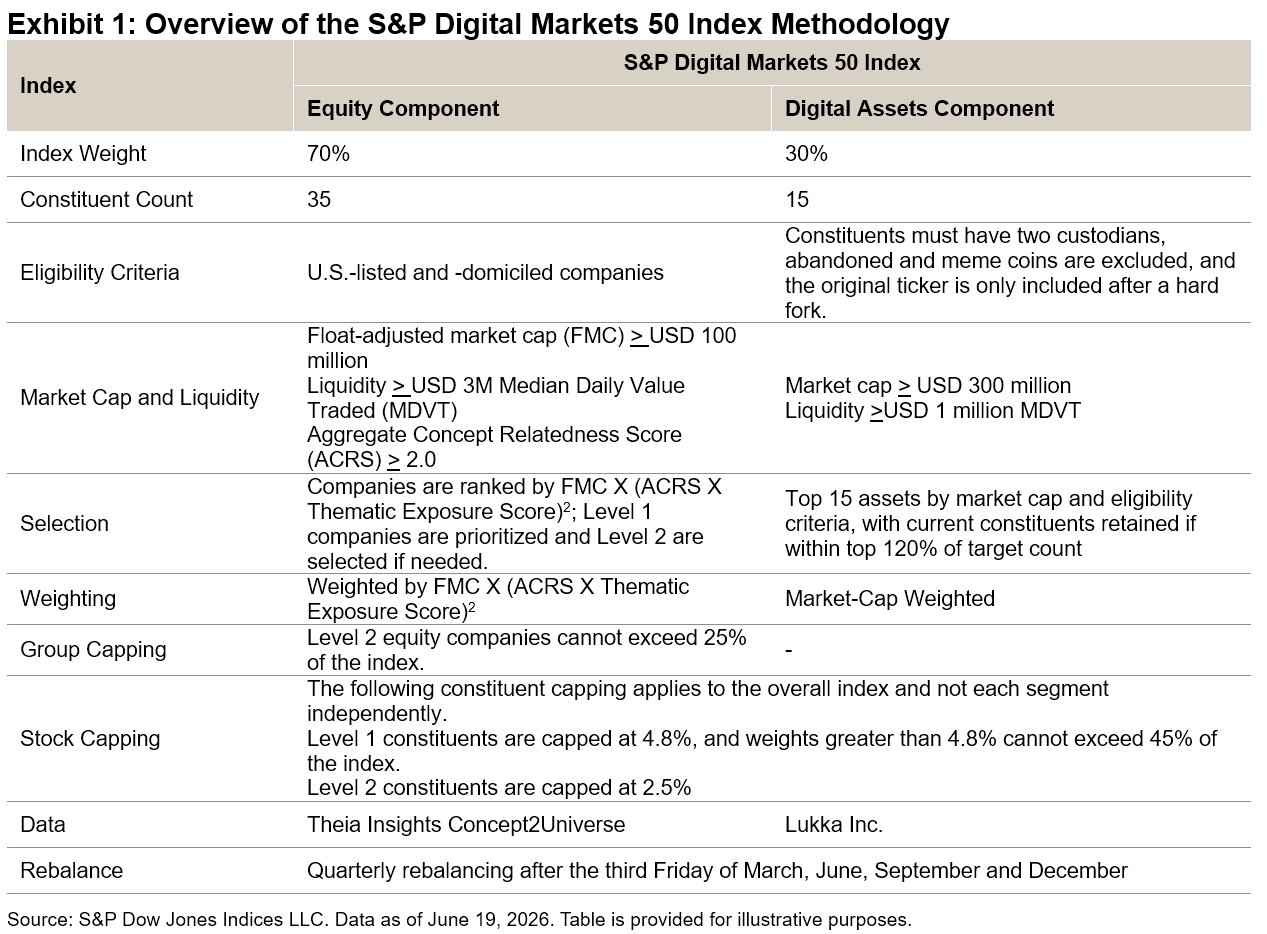
The S&P Cryptocurrency Broad Digital Asset (BDA) Index aims to address this through a buffer mechanism. New constituents must meet entry thresholds of USD 100 million in market capitalization and USD 100,000 in three-month median daily value traded (MDVT), while existing constituents are retained unless they fall below the lower buffer threshold of USD 80 million in market cap and USD 80,000 in three-month MDVT. This 20% cushion seeks to prevent unnecessary removals during temporary market declines.
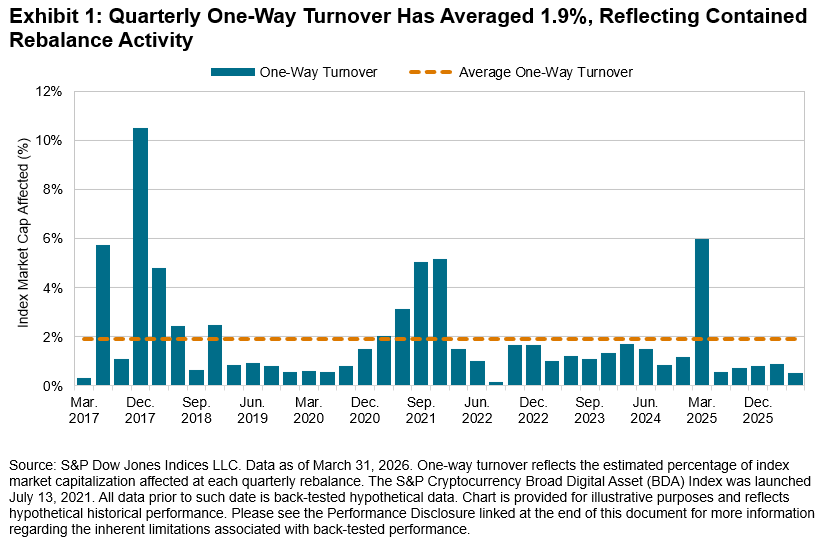
Since inception, the S&P Cryptocurrency BDA Index has maintained an average one-way turnover of approximately 1.9% per quarterly rebalance. Outside of periods associated with structural methodology changes or significant market regime shifts, turnover has generally remained at or below this average—suggesting that the buffer mechanism is functioning as intended.
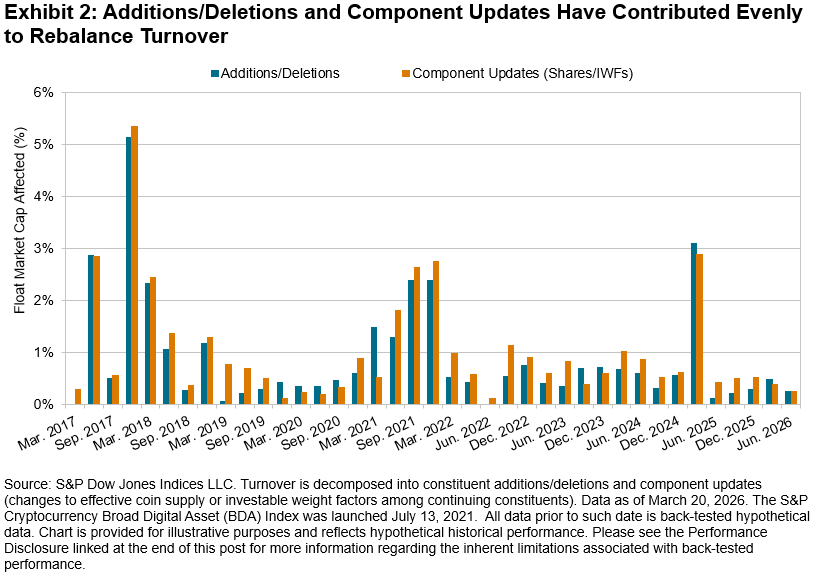
Decomposing quarterly turnover by source reveals that constituent additions/deletions and component updates (changes to effective coin supply and investable weight factors among continuing constituents) have contributed relatively evenly to rebalance activity over time. This pattern differs from traditional equity indices such as the S&P 500®, where updates to company-specific information have historically accounted for approximately 90% of quarterly rebalance turnover.1 In the S&P Cryptocurrency BDA Index, where all constituent changes occur at quarterly rebalances rather than on an as-needed basis, additions and deletions play a proportionally larger role—reflecting the evolving nature of the digital asset universe and the impact of eligibility threshold crossings in a high-volatility market.
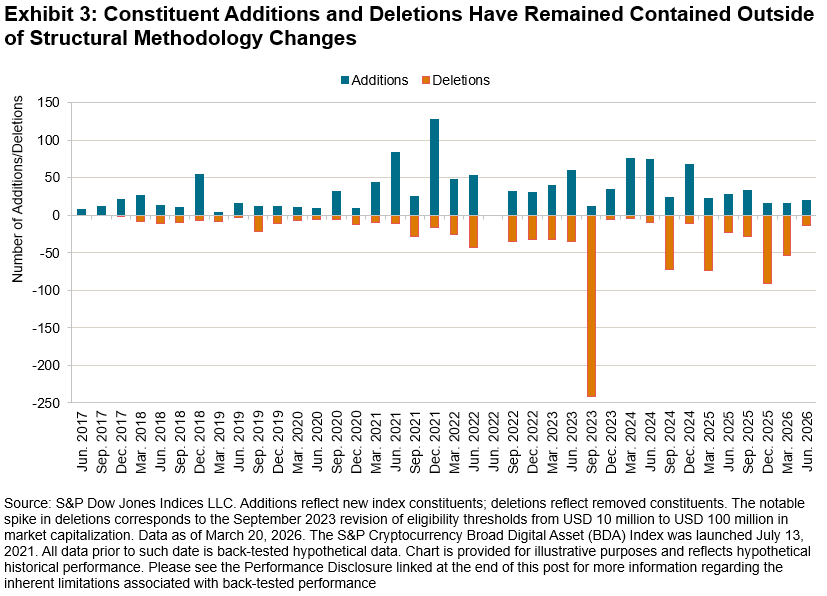
The addition and deletion profile confirms that outside of structural changes, constituent turnover remained contained. The buffer mechanism aims to mitigate—though does not eliminate—the risk of borderline assets oscillating between inclusion and exclusion across consecutive rebalances, a pattern that would generate unnecessary turnover without enhancing index representativeness.
Notable peaks in constituent changes corresponded to specific methodology updates, including the September 2023 revision to eligibility thresholds, rather than routine market volatility.2
Conclusion
Rebalance turnover plays an importation role in digital asset index design. The observed turnover profile of the S&P Cryptocurrency Broad Digital Asset Index demonstrates that the buffer structure has helped manage constituent changes even in a market characterized by elevated volatility. Unlike traditional equity indices where rebalance turnover is overwhelmingly driven by constituent weights, the S&P Cryptocurrency BDA Index has experienced a more balanced contribution from both constituent changes and component updates—a reflection of the rapidly evolving digital asset universe. By distinguishing between a temporary dip and a persistent decline in investability, the buffer reduced unnecessary constituent changes while preserving the index’s ability to reflect meaningful shifts in the digital asset landscape.
The author would like to thank the Data Excellence team, especially Jorge Ballesteros, for his contributions to this blog.
¹ Preston, H. “What Drives S&P 500 Rebalance Turnover?” S&P Dow Jones Indices, Indexology Blog, March 28, 2023.
2 In September 2023, the market capitalization eligibility threshold was revised from USD 10 million (buffer: USD 8 million) to USD 100 million (buffer: USD 80 million). This structural update resulted in an elevated number of deletions as existing constituents were reassessed against the higher requirements. For further detail, please refer to S&P Digital Assets Indices Methodology, Appendix D.
The posts on this blog are opinions, not advice. Please read our Disclaimers.