


Get Indexology® Blog updates via email.

In This List

Values in the Vault

Still Quality by Design: A Deep Dive into the Recent Performance of the S&P SmallCap 600

The Peruvian Stock Market: Insights on Performance and Benchmarking

Exploring the Depth of Mega Caps: A Look at the S&P 100 Ex-Top 20 Select Index

Above Mexico’s Stock Arena: The Finale

Values in the Vault

Contributor Image
Maya Beyhan

Global Head of Sustainability, Index Investment Strategy

S&P Dow Jones Indices

The S&P 500® Christian Values Screened Index distinguishes itself by excluding companies from the S&P 500 that engage in certain activities that do not align with the Evangelical Christian Investment Framework defined by Bountiful Financial. This framework employs specific exclusions based on S&P Global Energy Horizons revenue-based business involvement screens,1 catering to market participants who wish to uphold their religious values.

During each rebalancing, the index maintains the sector weights of The 500™ by redistributing the weight of excluded stocks to the remaining companies within the same GICS® sector. This analysis examines the effects of excluding companies and the subsequent weight redistribution on the index’s performance over the one-year period ending Oct. 31, 2025. The findings of this analysis are summarized in Exhibit 1.

During this period, the S&P 500 Christian Values Screened Index outperformed The 500 by 0.61%. This outperformance is attributed to the stronger performance of the remaining companies after their weights were redistributed. However, the excluded companies collectively contributed 0.29% to the performance of The 500.

To fully understand the implications of these changes, it is essential to consider both the excess performance of the S&P 500 Christian Values Screened Index relative to the S&P 500 and the contribution of the excluded companies to the S&P 500’s performance. By subtracting the contribution of the excluded companies from the index’s excess performance, we arrive at a net impact of 0.32% from the weight distribution.

An interesting aspect to consider is the long-term historical performance of the excluded companies in comparison to The 500. This analysis can provide valuable insights into the impact of religious values-driven choices on index performance over time. However, it’s important to emphasize that the performance of these companies can fluctuate, and the S&P 500 Christian Values Screened Index is not specifically designed to outperform the S&P 500.

Exhibit 2 illustrates the historical performance of the five highest-weighted excluded companies over the past decade.

Only Eli Lilly & Company, which was excluded for its involvement with stem cells, outperformed the S&P 500, achieving an excess performance of 707.21%. In contrast, the other four companies underperformed the index: RTX Corporation and UnitedHealth Corporation, excluded due to involvement with blinding laser weapons and abortion, respectively, underperformed by 22.43% and 35.39%, respectively. Additionally, Johnson & Johnson, also excluded for its association with stem cells, underperformed by 140.98%. Furthermore, Wells Fargo & Company, which was excluded due to its involvement with predatory lending, underperformed The 500 by 191.06%.

In summary, the S&P 500 Christian Values Screened Index offers a view into the performance of companies that align with specific religious values. The back-tested performance of the index underscores the significance of weight redistribution and the contributions of both included and excluded companies. This careful construction could help market participants to understand the dynamics of index performance while adhering to religious values-centric approaches.

1 See the S&P 500 Christian Values Screened Index Methodology for more information.

The posts on this blog are opinions, not advice. Please read our Disclaimers.

Still Quality by Design: A Deep Dive into the Recent Performance of the S&P SmallCap 600

Contributor Image
Florence Chapman

Senior Analyst, U.S. Equities

S&P Dow Jones Indices

Prior to the start of 2025, the S&P SmallCap 600® outperformed the Russell 2000—another prominent small-cap U.S. equity index—in 20 of the full calendar years to December 2024. However, the S&P SmallCap 600 has underperformed the Russell 2000 by 9% YTD, putting it on track to record its worst year of relative performance since its launch in October 1994 (see Exhibit 1). This reversal reflects an unusual market phase in which quality has fallen out of favor and risk appetite has grown, fueling what could be described as a “junk rally.”1

Historically, the S&P SmallCap 600’s quality-by-design construction has contributed to its outperformance.2 Unlike the Russell 2000, new additions to the S&P SmallCap 600 must have a history of positive earnings,3 giving the index a statistically significant tilt toward the quality factor. Exhibit 2 shows that this helped to explain the S&P SmallCap 600’s relative performance: the S&P SmallCap 600 typically outperformed the Russell 2000 by a greater amount in years when the average monthly quality-minus-junk (QMJ) factor performance was higher.

However, the performance associated with quality has been lower in recent times. Over the past three years, average monthly QMJ returns were negative (see Exhibit 3) as investor sentiment rotated toward the lower-quality segment of the market. This shift appears to have created headwinds for the S&P SmallCap 600 whose quality tilt limited its weight in the most speculative performers, potentially driving the Russell 2000’s recent performance gains.

A Brinson performance attribution sheds further light on the S&P SmallCap 600’s underperformance so far in 2025. Constituent membership accounted for most of the index’s lag, with four industry groups of Materials, Health Care and Industrials collectively contributing -4.7% to the total effect (see Exhibit 4). In each of these sectors, the attribution suggests that leadership came from companies excluded from the S&P SmallCap 600 due to weaker fundamentals or inconsistent profitability.

A similar pattern emerged during the COVID-19 pandemic, when sharp shifts in sentiment and rapid rebounds disproportionately rewarded lower-quality companies.4 In those episodes, the S&P SmallCap 600’s earnings screen also limited weight in the most speculative names driving performance, creating short-lived performance gaps versus the Russell 2000 (see Exhibit 2). When market sentiment later rebounded in 2021 toward a preference for profitability, the S&P SmallCap 600 recovered more strongly than its peer index. Recent shifts toward higher-risk, lower-quality stocks reflect comparable swings in relative performance between the two indices.

In summary, the S&P SmallCap 600’s relative performance so far in 2025 highlights the importance of index construction and its impact on index characteristics. In a market driven by risk over quality, it is somewhat unsurprising that the S&P SmallCap 600’s significant quality tilt did not prove to be a tailwind. Yet, history reminds us of the potential outperformance effects of incorporating an earnings screen to distinguish between small companies that have never posted positive earnings and those that have.5

The author would like to thank Cristopher Anguiano for his contributions to this blog.

1 It’s a junk rally.” Financial Times. Oct. 29, 2025.

2 See Anguiano, Cristopher. “Quality by Design: A Deep Dive into the S&P SmallCap 600.” S&P Dow Jones Indices. July 30, 2025.

3 For full details of the S&P SmallCap 600 Index methodology, please see S&P U.S. Indices Methodology. For full details of the Russell 2000 methodology, please see Russell US Equity Indexes.

4 See Preston, Hamish. “S&P SmallCap 600: A Pandemic Case Study.” S&P Dow Jones Indices. Jan. 26, 2022.

5 See Preston, Hamish. Fei Wang and Sherifa Issifu. “Celebrating 30 Years of the S&P SmallCap 600®.” S&P Dow Jones Indices. Oct. 31, 2024.

The posts on this blog are opinions, not advice. Please read our Disclaimers.

The Peruvian Stock Market: Insights on Performance and Benchmarking

Contributor Image
Hector Huitzil

Senior Analyst, Global Equity Indices

S&P Dow Jones Indices

S&P Latin American equities have done well in 2025, with Peruvian equities demonstrating strong performance even beyond this year (see Exhibit 1). The S&P Peru Select 20% Capped Index had an annualized performance of 15.3% when back-tested over the past decade, outperforming many regional equity markets. Despite higher volatility, its risk-adjusted performance was strong.

Political instability notwithstanding, Peru boasts one of the most stable economies in the region, with a Q2 2025 GDP five-year growth average of 3.2%, inflation at 1.1% and a BBB- Stable sovereign rating.1 As a major copper producer, rising commodity prices have significantly boosted performance, with over 60% of total returns in the past five years attributed to the Materials sector (see Exhibit 2). Notably, five companies accounted for nearly 90% of the S&P Peru Select 20% Capped Index’s performance (see Exhibit 3).

Essential Benchmarks

There are many benchmarks for the Peruvian equity market, which could make it challenging to choose the right one. The choice depends on one’s goals. Broad benchmarks like the S&P Peru Total Index reflect all listed companies, while the S&P Peru Select 20% Capped Index focuses on the largest, most liquid locally domiciled stocks.

In conclusion, the Peruvian market, with fewer than 50 listed stocks, has demonstrated impressive performance over the past decade. The Materials and Financials sectors, capitalizing on the country’s rich natural resources, have driven this growth within a stable economic environment. Additionally, the benchmark will continue to tell the dynamic story of this developing market, while helping market participants align their tools with their investment goals.

1 “Emerging Markets Monthly Highlights Fed Easing Supports Funding Conditions.” S&P Global Ratings. Data as of Sept. 18, 2025. Sovereign rating as of Sept. 9, 2025.

The posts on this blog are opinions, not advice. Please read our Disclaimers.

Exploring the Depth of Mega Caps: A Look at the S&P 100 Ex-Top 20 Select Index

Contributor Image
Algreen Bakasa

Director, U.S. Equity Indices

S&P Dow Jones Indices

What Lies Beneath the Headline Names in the S&P 100?

Introducing the S&P 100 Ex-Top 20 Select Index, which measures the performance of companies within the S&P 100, excluding the largest 20 constituents ranked by float-adjusted market capitalization. This blog examines the depth, diversification and shifting leadership that can be obscured by the dominance of the very largest names.

The “Next 80” Make Up a USD 13.4 Trillion Segment

As shown in Exhibit 1, the companies outside the largest 20 make up a USD 13.4 trillion segment, over twice the size of Japan’s equity market and nearly four times larger than the U.K. market and the U.S. mid-cap segment (as measured by the S&P MidCap 400®). Far from a niche slice of the U.S. equity landscape, the “next 80” represent a major portion of the global equity opportunity set.

Beyond its global scale, comparing this segment with the S&P 100 offers additional insight. While the top 20 names often dominate market headlines, the remaining 80 companies represent a meaningful share of the mega-cap U.S. equity segment. Since 2001, these companies have accounted for approximately 45% of the S&P 100’s total weight on average, ranging from 32% to 56% (see Exhibit 2). This variability reflects shifts in mega-cap leadership and reinforces the concept of examining the “next 80” as a distinct lens.

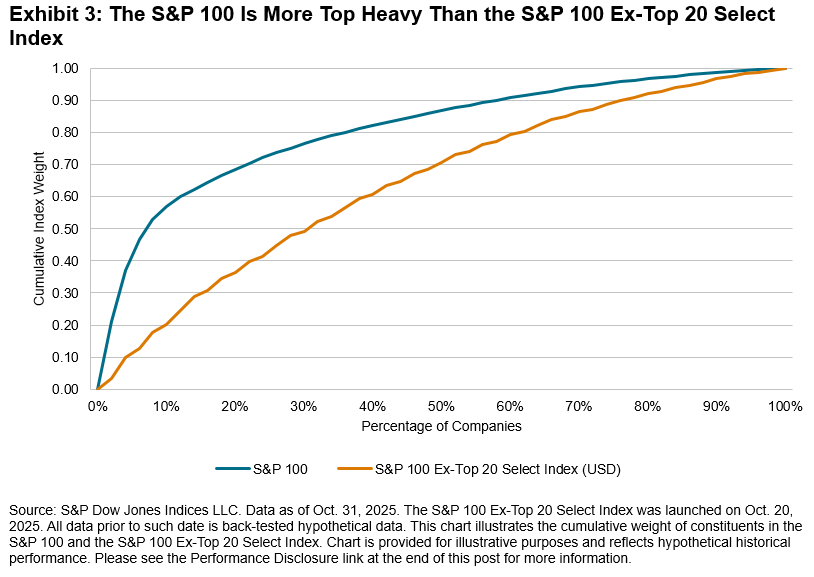
The S&P 100 Ex-Top 20 Select Index offers a more evenly distributed profile compared with the S&P 100, which is heavily concentrated in its largest names. Exhibit 3 shows that the top decile of constituents accounted for 55% of the S&P 100’s weight, versus about 22% in the S&P 100 Ex-Top 20 Select Index. This shows how steeply weight accumulates at the top of the S&P 100, highlighting the extent to which its performance can be driven by a relatively small set of names.

Broadening the Sector Profile

Differences in index size and constituent concentration are also reflected in sector weights. As shown in Exhibit 4, Information Technology represents nearly 25% of the S&P 100 Ex-Top 20 Select Index, well below the 42% weight in the S&P 100. This lower weight in Tech is paired with greater representation across other sectors, most notably Health Care (18%), Financials (17%) and Industrials (14%). Removing the largest 20 names resulted in a more balanced sector profile, reducing concentration in a few dominant sectors and broadening representation across the drivers of mega-cap U.S. equity performance. While the S&P 100’s Tech weight rose from about 20% in 2010 to over 40% in 2025, the S&P 100 Ex-Top 20 Select Index increased moderately from roughly 9% to about 20%. Meanwhile, sectors such as Health Care, Financials, Industrials and Materials had higher weights in the S&P 100 Ex-Top 20 Select Index.

Performance trends aligned with each index’s sector composition. The S&P 100 outperformed in recent years as concentrated mega-cap Tech leadership led performance, while the S&P 100 Ex-Top 20 Select Index tended to hold up better during periods when market leadership broadened.

Conclusion

The S&P 100 Ex-Top 20 Select Index offers a complementary lens on the S&P 100 by highlighting a large, diversified segment beyond the top 20 names. Its meaningful scale and broader sector mix provide additional perspective on the composition, concentration dynamics and long-term characteristics of the mega-cap U.S. equity landscape.

The posts on this blog are opinions, not advice. Please read our Disclaimers.

Above Mexico’s Stock Arena: The Finale

Contributor Image
Maya Beyhan

Global Head of Sustainability, Index Investment Strategy

S&P Dow Jones Indices

As we wrap up our discussion on the S&P/BMV IPC CompMx Trailing Income Equities ESG Tilted Index, it is important to explore the context surrounding its recent performance and emphasize the cyclical dynamics of sector movements.

In our previous blog, we examined how the index had underperformed relative to the broader S&P/BMV IPC as of Aug. 29, 2025, primarily due to underweighting the strong-performing Materials sector, which tends to include more companies with relatively lower dividend payouts. As of Oct. 31, 2025, the S&P/BMV IPC CompMx Trailing Income Equities ESG Tilted Index underperformed the S&P/BMV IPC by 7.75% year-to-date.

However, this underperformance should be analyzed in a broader context. A look at historical trends offers greater insight. Exhibit 1 summarizes the annual performance of the S&P/BMV IPC CompMx Trailing Income Equities ESG Tilted Index and the excess performance compared to the S&P/BMV IPC. Since its launch on Aug. 2, 2021, the index managed to outperform the S&P/BMV IPC in three out of five calendar years, exceeding the broader market by 0.86%, 0.46% and 4.76% in 2021 (since launch), 2022 and 2024, respectively.

Exhibit 2 illustrates the calendar year performance of Materials, Industrials and the S&P/BMV IPC, as well as the excess performance of the S&P/BMV IPC CompMx Trailing Income Equities ESG Tilted Index versus the S&P/BMV IPC. We can see that historically, during periods when the Materials sector underperformed the S&P/BMV IPC, the S&P/BMV IPC CompMx Trailing Income Equities ESG Tilted Index outperformed the broader market.

The sole exception was in 2024, when the Materials sector outperformed the S&P/BMV IPC by 7.09%, yet the S&P/BMV IPC CompMx Trailing Income Equities ESG Tilted Index still surpassed the broader benchmark by 4.76%, marking the highest performance since its launch.

This finding can be attributed to the interactions between sectors. Exhibit 2 also highlights the performance of the Industrials sector, which is characterized by higher dividend-paying companies and thus is overweight in the index. Historically, when this sector outperformed the S&P/BMV IPC, the S&P/BMV IPC CompMx Trailing Income Equities ESG Tilted Index benefited similarly, leading to stronger performance compared to the broader market. For instance, in 2024, the Industrials sector outperformed the S&P/BMV IPC by 14.68%, which helped mitigate the negative impact of the Materials sector’s strong rise and contributed to an excess performance of 4.76% for the S&P/BMV IPC CompMx Trailing Income Equities ESG Tilted Index.

Looking ahead, it is vital to acknowledge the inherent cyclical nature of sector performance. These findings suggest that the S&P/BMV IPC CompMx Trailing Income Equities ESG Tilted Index might not be merely reactive to prevailing trends, and the index has historically helped mitigate sector-specific volatility. By understanding historical performance patterns, there may be a clearer context for the future.

The posts on this blog are opinions, not advice. Please read our Disclaimers.