


Get Indexology® Blog updates via email.

In This List

Navigating Brazil’s Currency Volatility with USD Credit

Canada’s Materials Sector Strikes Gold

Beyond Mega Caps: Exploring the S&P 500 Ex-S&P 100 Select Index

Crypto’s Resurgence

Rethinking U.S. Equity Exposure: A New Index Approach

Navigating Brazil’s Currency Volatility with USD Credit

Contributor Image
Sally Wang

Associate Director, Fixed Income Product Management

S&P Dow Jones Indices

Brazil’s fixed income market is one of the deepest in emerging markets, with an outstanding government debt of over BRL 8 trillion (roughly 75% of GDP) and a corporate bond market dominated by floating-rate instruments tied to the interbank deposit certificate (CDI).

Domestic market participants are accustomed to high nominal yields; local treasury bills linked to the Selic often offer double-digit returns, creating a strong home-market bias. However, attractive as these base rates may appear to some market participants, they are not a substitute for diversified credit exposure. For institutional allocators, USD-denominated corporate bonds can provide access to global issuers, industry sectors and credit premium not fully represented in Brazil.

The challenge, however, is that unhedged USD credit exposure tends to come with significant FX volatility—in many cases, BRL moves can overwhelm the underlying credit performance. This tension between the richness of local carry and the diversification of global markets raises a central question for asset allocators: How can Brazilian market participants tap global credit markets while managing excessive currency risk?

Introducing the iBoxx BRL Hedged USD Credit Indices

To address this challenge, S&P Dow Jones Indices (S&P DJI) has introduced two new indices: the iBoxx USD Liquid Investment Grade BRL Hedge Carry Index (BRL) and the iBoxx USD Liquid High Yield BRL Hedge Carry Index (BRL).

Using a cash-bond-futures framework, the new indices seek to reduce currency volatility while preserving yield potential. To balance credit access with risk management, the iBoxx USD Liquid Investment Grade BRL Hedge Carry Index (BRL) has a 30% weight in the iBoxx $ Liquid Investment Grade Index (BRL) for core credit, has a 70% weight in cash earning the CETIP interbank rate to act as a volatility buffer and margin source and applies a -30% overlay in BRL futures via the S&P/B3 BRL-USD Mini Futures Index (BRL) ER to provide a structural hedge against currency risk.

From a Brazilian point of view, these indices offer a way to measure USD credit while addressing FX risk. By embedding a structural hedge, they have historically tended to show smoother BRL-adjusted performance that could integrate more naturally into local strategies. At the same time, the high local carry has helped to enhance yield potential, all while reducing overall volatility.

From a global perspective, this is a rules-based index that can help translate international credit market exposures into Brazilian market terms, leveraging the full capability of the S&P/B3 and iBoxx Fixed Income index Series.

Comparing the back-tested index level time series of the new iBoxx USD Liquid Investment Grade BRL Hedge Carry Index (BRL) with the iBoxx $ Liquid Investment Grade Index TR (BRL) shows that the new index often reduced volatility while maintaining competitive returns. There were also reduced drawdowns, where hedging mitigated the sharp FX-driven losses often seen in stress periods. A similar pattern was also observed in the iBoxx USD Liquid High Yield BRL Hedge Carry Index (BRL).

Exhibits 4 and 5 show that the iBoxx USD Liquid Investment Grade BRL Hedge Carry Index (BRL) saw volatility fall from 15.12% to 2.56% when compared to the benchmark, while the Sharpe ratio climbed from 0.75 to 3.61. For the iBoxx USD Liquid High Yield BRL Hedge Carry Index (BRL), volatility fell from 13.03% to 10.13%, while the Sharpe ratio improved modestly from 0.96 to 1.85, demonstrating an improvement on risk-adjusted return.

Part of a Broader Story: S&P DJI’s Brazilian Fixed Income Suite

These launches build on a decade of collaboration in Brazil. The new BRL hedged indices show the breadth of our capabilities, from sovereign debt to corporate credit, from local instruments to global assets framed in Brazilian terms. It is built on a decade of collaboration with B3 and experience in the Brazilian market.

This is not just another index suite—it’s part of a comprehensive toolkit that can help to empower issuers, allocators and individual market participants to navigate Brazil’s evolving financial landscape.


The posts on this blog are opinions, not advice. Please read our Disclaimers.

Canada’s Materials Sector Strikes Gold

Contributor Image
Anna Mittra

Associate Director, Global Exchanges

S&P Dow Jones Indices

Canadian equity markets have a reputation for their sector concentration and cyclical swings, often reflecting the country’s deep ties to commodities and resource-driven growth. Over the past decade, sector performance has rotated dramatically, with Energy, Materials and Information Technology each taking their turn at the top. This constant reshuffling has reinforced the importance of diversification, while also highlighting how macroeconomic forces—from global oil shocks to pandemic-driven demand for digital solutions—have left a distinct imprint on sector performance in Canada.

Exhibit 1 highlights Information Technology leading the charts for 6 out of 10 years and stands out for its growth around the 2020 global pandemic, delivering back-to-back gains of over 60% and 80% in 2019 and 2020, respectively, as Canadian tech firms thrived in a digital-first environment. Energy, on the other hand, experienced a sharp rebound in 2021 as oil prices recovered from pandemic lows. The materials sector is rising the charts in 2024 as supported by rising gold prices and increased demand for commodities. In contrast, defensive sectors such as Consumer Staples and Utilities rarely topped the chart but consistently provided stability, often helping buffer strategies during downturns. While Financials remains Canada’s largest sector, the weight of Materials ensures that commodity trends continue to play a defining role in the market’s direction.

Exhibit 2 highlights the strong outperformance of the Materials sector year-to-date, advancing over 50%—more than double the gains of the next-best performing sector within the S&P/TSX Composite Index. The rally has been driven in large part by the strength of gold, as several of Canada’s largest mining companies, including Agnico Eagle and Barrick, benefited from higher bullion prices amid ongoing macro uncertainty. Gold producers dominate the sector’s composition, representing the majority of the top constituents in the S&P/TSX Capped Materials (see Exhibit 3).

The Materials sector in Canada is heavily influenced by precious metals prices. Exhibit 4 shows that the performance of the S&P/TSX Capped Materials has historically tracked closely with movements in gold prices. The index’s capped methodology supports diversification by limiting the weight of any single issuer, while still maintaining close alignment with movements in gold prices. With gold climbing to multi-year highs, Canadian mines have driven the sector’s performance ahead of all others.

The current outperformance of Materials serves as a reminder that Canada’s market structure features listed explorers and producers of commodities—which are inputs needed for the manufacturing of semiconductors, batteries, LCD screens, electric vehicles and other high demand goods. Contributing to a more complete picture of diversification beyond sectors like Financials and Technology, the country’s deep mining base could provide insight into the forces driving global markets today.

The posts on this blog are opinions, not advice. Please read our Disclaimers.

Beyond Mega Caps: Exploring the S&P 500 Ex-S&P 100 Select Index

Contributor Image
Algreen Bakasa

Director, U.S. Equity Indices

S&P Dow Jones Indices

Introduction

The representation of S&P 100® companies in the S&P 500® has grown over the past two decades: the blue-chip subset of The 500™ accounted for 70% of the large-cap U.S. equity benchmark’s weight at the end of June 2025, up from 45% at the end of 1998. However, market participants may find it beneficial not to overlook the “other 400” members of the S&P 500, as measured by the S&P 500 Ex-S&P 100 Select Index.

Size: A USD 15 Trillion Market in Its Own Right

The S&P 500 Ex-S&P 100 Select Index measures the performance of S&P 500 companies that are not members of the S&P 100. Far from a niche slice of the U.S. equity market, this segment represents more than USD 15 trillion in market capitalization—larger than the equities markets of Japan, the U.K. or Canada, and many times the size of the S&P MidCap 400® or S&P SmallCap 600®. Hence, overlooking the other 400 names in The 500 risks missing a substantial share of the global equity opportunity set.

Sectors: Diversification beyond Mega-Cap Tech

The S&P 500 Ex-S&P 100 Select Index focuses on diversification beyond the blue-chip exposure of the S&P 100, offering broader sector representation and a more balanced perspective on the drivers of large-cap U.S. equity performance.

Exhibit 3 shows that the S&P 500 Ex-S&P 100 Select Index had more balanced sector weights compared to the S&P 100 at the end of June 2025. For example, the index had a lower weight in Information Technology and Communication Services and a much greater weight in Industrials, Real Estate and Utilities.

The difference in sector composition was not just a recent phenomenon: Exhibit 4 shows that the S&P 100 and the S&P 500 Ex-S&P 100 Select Index have had distinct sector weights since the 1990s. While the S&P 100 became increasingly dominated by Information Technology and Communication Services, the S&P 500 Ex-S&P 100 Select Index consistently showed broader representation across GICS® sectors (see Exhibit 4).

Conclusion

The S&P 500 Ex-S&P 100 Select Index shines a light on the “other 400” large-cap U.S. companies often overlooked by mega-cap dominance. With a market size rivaling that of many countries’ equity markets, and sector weights that broaden perspectives on the drivers of performance, the S&P 500 Ex-S&P 100 Select Index could serve as a complementary lens on U.S. large-cap equities.

The posts on this blog are opinions, not advice. Please read our Disclaimers.

Crypto’s Resurgence

Contributor Image
Sherifa Issifu

Associate Director, Global Exchanges

S&P Dow Jones Indices

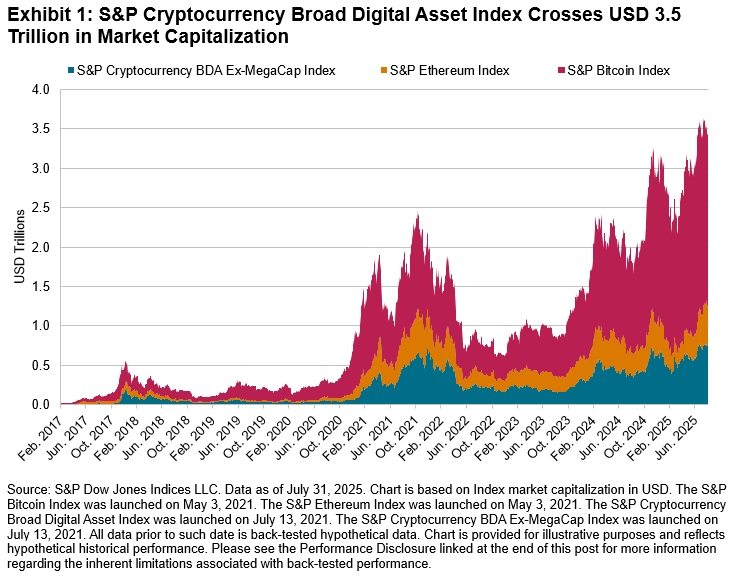
Two decades ago, crypto didn’t exist, and even a decade ago, it was still an emergent asset class. In the last few years, crypto has increased in maturity, crossing USD 1 trillion in market capitalization in 2021 and currently sitting at USD 3.5 trillion at the end of July 2025 based on the S&P Cryptocurrency Broad Digital Asset (BDA) Index. Its increased size is not the only indicator of its increasing maturity; market participants have been offered additional tools to help in their asset allocation decisions with a growing network of associated exchange-traded products, such as futures, options, ETFs and other wrappers. The crypto product ecosystem is expected to continue growing, with a robust pipeline of ETF filings globally. In addition, a shift in the global regulatory landscape for DeFi-related products is helping to create a framework for market participants in this asset class.

Crypto ETF filings followed a similar path as the underlying cryptocurrencies, with Bitcoin (BTC) and Ethereum (ETH) representing the first spot ETF filings. Bitcoin launched in 2009 as the first cryptocurrency and Ethereum launched in 2015, ushering in a second wave of crypto innovation introducing smart contracts and decentralized apps. It is not surprising that early ETF filings across various regions followed the same path, shown in Exhibit 2. In 2025, there is a growing list of single coin ETPs on a multitude of other coins outside of the mega-caps of BTC and ETH (S&P Cryptocurrency MegaCap Index) with other large-cap coins like Solana and Cardano (which are included in the S&P Cryptocurrency LargeCap Index) expected to have their own ETFs in the U.S., and XRP being recently approved in the U.S.. Recent changes to Crypto ETP SEC Filing guidelines on Sept. 17, 2025, may potentially pave the way for more crypto spot ETFs according to Reuters.

Looking further into ETF data in Exhibit 3, according to ETFGI,1 there were only two digital asset ETPs in 2015, but there are now over 300 products as of July 2025, with a collective AUM of 220 USD billion, a figure that was only at 3 USD billion in 2020. This exponential rate of growth shows the heightened demand for crypto-related products.

Over the past two years, it’s not just the number, but the variety of crypto-focused ETFs that has expanded dramatically. While single-coin ETF products based on Bitcoin and Ethereum led the adoption of cryptocurrency, we are also starting to see multi-coin, diversified “crypto basket” products looking at the top 5 and 10 largest crypto assets. The start of non-market-cap-weighted products and capping on the largest coins like Bitcoin and Ethereum has also been a recent trend, with indices and products applying principles of diversification from traditional finance. Crypto is also being increasingly thought of as a diversifier in asset allocation decisions with the launch of more multi-asset strategies that combine crypto with traditional asset classes such as equities and commodities.

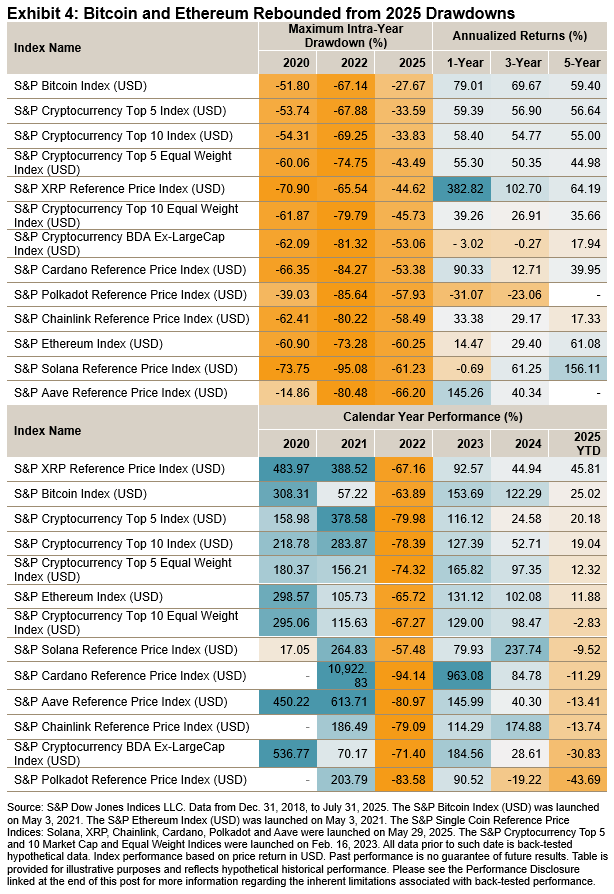
However, the journey to get there hasn’t been smooth. The resilience of the AUM growth is even more impressive against the backdrop of the crypto drawdowns at the start of 2025, which was marred by uncertainty and risk-off undertones due to geopolitical tension, tariffs and concerns around whether U.S. exceptionalism would hold. At the end of March, the S&P GSCI Gold was in positive territory, sporting a return of 18%, whereas the S&P Bitcoin Index, S&P Cryptocurrency MegaCap Index and S&P Ethereum Index were down 12%, 18% and 45%, respectively, in Q1 2025 and had an even more severe drawdown compared to their peak.

Despite this market turbulence, the largest cryptocurrencies have shown resilience, with Bitcoin and Ethereum nearing all-time highs as of July 2025. However, there remains some underperformance, with smaller coins still lagging.

While crypto remains a highly volatile asset class, its increased institutional adoption is expected to continue, with highly anticipated regulatory milestones expected to be a key part of shaping crypto for years to come. Regulatory developments, like the GENIUS Act and Clarity Act in the U.S. and MiCA in Europe, as well as expected changes in APAC adoption, could be determinants of where crypto goes next.

1ETFGI reports Crypto ETFs listed globally gathered 3.69 billion US dollars of net inflows in April.” ETFGI. May 30, 2025.

The posts on this blog are opinions, not advice. Please read our Disclaimers.

Rethinking U.S. Equity Exposure: A New Index Approach

Contributor Image
Jason Anderlik

Product Strategist

Global X

With global fragmentation accelerating and geopolitical risks rising, the traditional assumptions underpinning U.S. equity investing may be due for a fresh look. While the S&P 500® has long served as the cornerstone for broad-based U.S. market exposure, globalization has reshaped the revenue profile of many constituents. Today, more than a quarter of the companies in the index generate the majority of their revenue outside the U.S.1

In response, S&P Dow Jones Indices LLC (S&P DJI) has created two newly innovative benchmarks that aim to refine how S&P DJI measures U.S. equity large-cap companies: the S&P 500 U.S. Revenue Leaders Index and the S&P 500 U.S. Revenue Market Leaders 50 Index.

Reassessing Traditional Market Exposure

Globalization was once a tailwind. But increasingly, foreign revenue may introduce hidden risks that can complicate a U.S.-focused investment thesis. Companies with significant overseas exposure may face regulatory uncertainties, operational inefficiencies and currency translation losses that don’t always show up in domicile-based analyses. Moreover, in an environment of rising tariffs and shifting trade alliances, these risks are potentially more realizable.

This factor is especially important today, as the U.S. continues to outpace peer economies. Between 2019 and 2024, the U.S. economy grew faster than every other G7 country, driven by a surge in technology investments, infrastructure spending and resilient consumer demand. Investors seeking to align portfolios with this growth may benefit from a more targeted lens.

Two Indices, One Goal: A Stronger U.S. Core

In response to this development, S&P DJI constructed indices that emphasize domestic economic alignment over global reach and licensed those indices to Global X for use with exchange-traded funds.

  • The S&P 500 U.S. Revenue Leaders Index selects companies from the S&P 500 that derive the majority of their revenue from within the U.S. The result is a purer proxy for U.S. economic exposure that reduces the impact of foreign revenue streams.
  • The S&P 500 U.S. Revenue Market Leaders 50 Index goes a step further. It filters for companies that not only have at least 50% U.S. revenue but also rank highly on a Market Leader Score. This score is based on sustained free cash flow margins, return on invested capital and market share. These three metrics are closely linked to quality and operational resilience, and they provide a factor-based approach to pure-play U.S. equity indexing.

Conclusion

The world of 2025 looks very different from the one in which the S&P 500 was incepted. In this new landscape, the licensing relationship between Global X and S&P DJI offers a timely new measure of U.S. equity investing. This approach recognizes the evolving realities of global markets and the potential strategic value of domestic focus.

These indices aren’t just alternatives; they represent a new framework for investors who want to be precise about what “U.S. exposure” means.

The author would like to thank Scott Helfstein for his contributions to this blog.

1FactSet Research Systems. (n.d.). S&P 500 [United States Revenue Percentage]. Data accessed July 7th, 2025.

Disclosures:

Information provided by Global X Management Company LLC.

Investing involves risk, including the possible loss of principal. Diversification does not ensure a profit nor guarantee against a loss.

The Indexes’ focus on companies that earn the majority of their revenue in the United States may increase sector concentration and reduce exposure to internationally diversified firms, which could cause the Indexes to underperform the broader S&P 500 when foreign-revenue companies outperform. In addition, the Market Leader Score is derived from historical quantitative factors (free cash-flow margins, return on invested capital and market share) that may not predict future performance and can lead to higher turnover and associated costs.

This material represents an assessment of the market environment at a specific point in time and is not intended to be a forecast of future events, or a guarantee of future results. This information is not intended to be individual or personalized investment or tax advice and should not be used for trading purposes. Please consult a financial advisor or tax professional for more information regarding your investment and/or tax situation.

Past performance does not guarantee future results.

The S&P 500 U.S. Revenue Leaders and S&P 500 U.S. Revenue Market Leaders 50 Indices (the “Indices”) are products of S&P Dow Jones Indices LLC or (“S&P DJI”). S&P®, S&P 500®, US 500™, The 500™ are trademarks of Standard & Poor’s Financial Services LLC or its affiliates (“S&P”); Dow Jones® is a registered trademark of Dow Jones Trademark Holdings LLC (“Dow Jones”). These marks have been licensed by S&P DJI and sublicensed for use by Global X for certain purposes. Exchange-traded funds based on the Indices are not sponsored or sold by S&P DJI, Dow Jones, S&P or their respective affiliates and none of such parties make any representation regarding the advisability of investing in any such funds nor do they have any liability for any errors, omissions, or interruptions of the Indices.


The posts on this blog are opinions, not advice. Please read our Disclaimers.