


Get Indexology® Blog updates via email.

In This List

Yippy Yields and Dollar Dilemmas

One Year Live: The S&P 500 Economic Moat Index Outperforms Its Benchmark

Go Beyond Index Data: Unlocking the Full Value of Index Providers

Diversification Redefined: Exploring the S&P 500 Diversified Sector Weight Index

Direct Indexing: Customization, Transparency and Control

Yippy Yields and Dollar Dilemmas

Contributor Image
Agatha Malinowski

Quantitative Analyst, Index Investment Strategy

S&P Dow Jones Indices

Equity markets have made a remarkable recovery following a turbulent start to the second quarter, with the S&P 500® closing out May up 6%. However, ongoing uncertainties surrounding tariffs and their inflationary impact, concerns about the fiscal deficit and potential shifts in foreign demand for U.S. Treasuries have weighed on the bond market, with the iBoxx $ Treasuries down 1% in May—marking its first monthly loss this year.

Despite declines across the yield curve on June 4, 2025, following a soft labor market report, 2-Year and 30-Year U.S. Treasury yields have surged by over 23 and 27 bps,1 respectively, since the end of April, with the 30-Year Treasury yield briefly surpassing 5% following weak demand in the 20-Year U.S. Treasury auction. As a result, the spread between short- and long-term U.S. Treasury yields has widened, suggesting that investors may be demanding greater compensation for holding longer-term debt. Exhibit 1 highlights the spread between 2-Year and 30-Year U.S. Treasury yields, which has increased to over 100 bps, reaching levels not seen since 2022.

Rising yields also may affect the potential for diversification across asset classes. Traditionally, bonds have tended to exhibit an inverse correlation to equities, with notable outliers such as most of 2024. However, after witnessing negative correlations so far this year, Exhibit 2 reveals that the six-month correlations between The 500™ and the S&P U.S. Treasury Bond Current 30-Year Index have turned positive. If sustained, a positive relationship could be indicative of a potential headwind for risk-adjusted performance for combinations of both asset classes.

In addition to their impact on diversification, we can also examine the currency dynamics associated with an increase in bond yields, which could be particularly relevant for global asset owners who may be affected by currency hedging decisions. Notably, despite the rise in long-term U.S. Treasury yields, the U.S. dollar has weakened, with the S&P U.S. Dollar Futures Index down 4% quarter-to-date. Although the dollar stabilized in May, the currency’s weakness coinciding with rising bonds yields marks a departure from their typical positive relationship, as shown in Exhibit 3. Recent risks, including fiscal concerns and doubts about the dollar’s safe haven status, may have contributed to this diverging trend.

While the future trajectory of U.S. Treasury yields remains uncertain, we can look to market expectations for long-dated U.S. Treasury volatility, as measured by the options market with the Cboe 20+ Year Treasury Bond ETF Volatility Index (VXTLT). After declining from the highs observed during the market turbulence in April, Exhibit 4 shows that VXTLT rose along with longer-dated yields, surpassing the 20 mark on May 21, 2025, and closed above the 17 handle as of June 4.

Looking ahead, although numerous unknowns remain, the impact of U.S. Treasury yields on the term premium, along with the associated diversification and currency dynamics, could have significant implications for asset owners across asset classes.

1 Data as of June 4, 2025.

The posts on this blog are opinions, not advice. Please read our Disclaimers.

One Year Live: The S&P 500 Economic Moat Index Outperforms Its Benchmark

Contributor Image
George Valantasis

Director, Factors and Dividends

S&P Dow Jones Indices

Long before Warren Buffett popularized the term “economic moat” in his 1986 “Berkshire Hathaway Letter to Shareholders,”1 savvy investors have zealously sought out businesses with sustainable competitive advantages. On April 15, 2024, S&P Dow Jones Indices (S&P DJI) took a pioneering step by introducing a purely systematic approach to identify and track companies possessing this trait.

Since its launch, the S&P 500® Economic Moat Index has made a strong debut, outperforming the S&P 500 during its live period and YTD in 2025. Additionally, it has provided downside protection compared to the benchmark. To mark the index’s one-year anniversary, this blog will examine its short- and long-term performance, assess its defensive characteristics during historical drawdowns and highlight its current profitability. For those interested in delving deeper into the index’s methodology, index characteristics and performance, our team published a paper following the index launch last year.

Performance Comparison

Exhibit 1 shows that the S&P 500 Economic Moat Index outperformed the S&P 500 over the one-year period since its launch (April 15, 2024, to April 15, 2025) and YTD in 2025. Furthermore, it outperformed The 500™ during the two most significant drawdowns in the live period: the tech sell-off in the summer of 2024 and the tariff-related decline in early 2025.

Exhibit 2 highlights the notable outperformance of the S&P 500 Economic Moat Index in both absolute and risk-adjusted returns over the long term when compared to The 500. Not only did the index surpass the S&P 500 in absolute terms across all time periods, but it also exhibited lower volatility and a downside capture of 88.55.

Defensive Characteristics

Exhibit 3 shows the historical downside protection offered by the S&P 500 Economic Moat Index during past market selloffs. Over the six major drawdowns shown, the S&P 500 Economic Moat Index recorded an average drawdown of 11.4% versus 13.1% for The 500.

Enhanced Profitability

Exhibit 4 showcases the improved profitability metrics such as return on assets (ROA), return on equity (ROE) and return on invested capital (ROIC) of the S&P 500 Economic Moat Index versus the S&P 500 Equal Weight Index. The improved profitability metrics make sense given that one of the key benefits of wide-moat companies is their ability to generate and sustain high returns on capital.

Conclusion

The S&P 500 Economic Moat Index represents the first fully systematic strategy specifically designed to identify companies with sustainable competitive advantages. Since its launch just over a year ago, the index has made a strong start, outperforming its benchmark while exhibiting defensive characteristics and delivering superior profitability. When examining indices that show resilience and consistent growth, the S&P 500 Economic Moat Index stands out as a compelling strategy that prioritizes durability and market leadership.

1 https://www.berkshirehathaway.com/letters/1986.html

The posts on this blog are opinions, not advice. Please read our Disclaimers.

Go Beyond Index Data: Unlocking the Full Value of Index Providers

Contributor Image
Brandon Hass

Global Head of Client Solutions Group, Direct Indexing and Model Portfolios

S&P Dow Jones Indices

Index providers do far more than supply the benchmarks that index-based products aim to track. They also offer a range of services that wealth managers may look to in an effort to sharpen their strategies, streamline operations and deepen advisor engagement. Yet, some firms still treat index providers solely as data vendors—underutilizing a broader toolkit available to wealth and asset managers as they seek to gain a competitive edge.

According to new research from Cerulli Associates, most wealth manager home-office executives view index providers primarily as inputs for performance measurement and benchmarking.1 But a select group—particularly those developing customized solutions, proprietary products or building model portfolios—are beginning to unlock the true potential of what index providers can offer. These firms are turning to index providers not just for data but for collaboration, and in doing so, they’re discovering new ways to differentiate and scale.

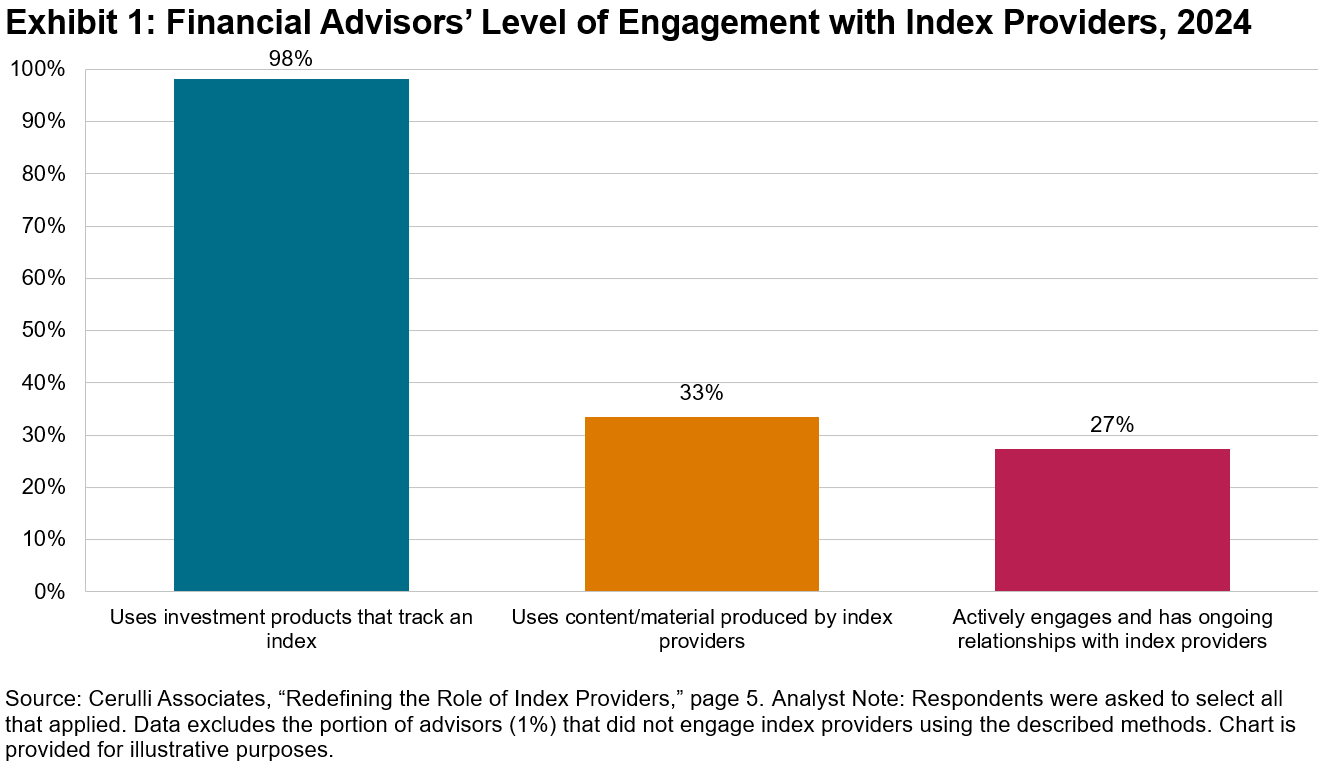
Financial Advisors’ Level of Engagement with Index Providers

A recent blog examined the forces contributing to the rise of indexing in wealth management. While the vast majority of financial advisors use index-based investment products, most aren’t engaging with index providers in other ways (see Exhibit 1).

This invites the question: what other opportunities might be available for wealth managers that seek to leverage index providers’ offerings? Index providers provide various solutions, such as data and thought leadership. Forming a strategic relationship with an index provider that taps into these capabilities can help build a foundation for developing products and solutions that advisors can incorporate into client portfolios in support of their practices.

From Index Construction to Product Development Support

The Cerulli Associates paper explores how index providers can support the product development lifecycle. That includes helping firms choose the right index exposure, offering transparency on index methodology, and advising on how index data is delivered and integrated into internal systems.

For advisory firms looking to stand out in a crowded and highly competitive field, brand alignment also matters. When launching new index-based products, licensing a brand from a known provider may lend recognition to such products, especially for firms that don’t yet have household-name status with advisors or end investors.

Furthermore, index providers can help clients customize existing indices or commission a white-label index using their own intellectual property.

Resources for Education, Distribution and Advisor Engagement

Beyond the mechanics of benchmark construction, index providers are also sources of educational content and thought leadership—another potentially underleveraged tool, especially for wealth managers.

Firms can tap into these resources to inform advisors, support distribution, and supplement product narratives with index-related information. For example, index providers can contribute to educational campaigns that explain the methodology behind a new index objective, share market context, or offer historical performance data. Providers may also support advisor meetings or webinars, giving wealth managers a way to deliver expert insights on indices directly to the field.

As wealth management incorporates outsourced portfolio construction and more scalable solutions, firms that make the most of the full range of services that index providers offer may find themselves better equipped to meet advisor needs and investor expectations. Read the full report by Cerulli Associates to learn about other ways asset and wealth managers can optimize their engagement with index providers.

1 The Cerulli Associates whitepaper “Redefining the Role of Index Providers” was sponsored by S&P Dow Jones Indices.

The posts on this blog are opinions, not advice. Please read our Disclaimers.

Diversification Redefined: Exploring the S&P 500 Diversified Sector Weight Index

Contributor Image
Wenli Bill Hao

Director, Factors and Dividends Indices, Product Management and Development

S&P Dow Jones Indices

The S&P 500® continues to be a trusted benchmark for the broad U.S. market, measuring the performance of U.S. large-cap companies across various sectors. As the market moves, certain stocks and sectors grow to represent a larger share of the index, highlighting their significant influence on the economy. While this is the natural result of market-cap weighting, some market participants are exploring alternative strategies in pursuit of enhanced diversification.

In this blog, we introduce the S&P 500 Diversified Sector Weight Index, which aims to mitigate concentration risk and address sector imbalances by reweighting companies within The 500™. This innovative approach employs a hierarchical equal sector weight methodology, utilizing Syntax’s FIS® sector taxonomy.

FIS’s Sector Taxonomy

This six-level classification system captures the diverse business models and product lines of companies. As shown in Exhibit 1, the FIS sector taxonomy consists of 8 sectors, 24 sub-sectors, 72 industries, 193 sub-industries, 311 business activities and over 3000 individual product lines in the S&P 500 universe.

Index Methodology

The S&P 500 Diversified Sector Weight Index equally weights each of the eight primary sectors defined by Syntax FIS with quarterly rebalancing.1 Within each sector, level 2 sub-sectors are equally weighted, as are level 3 industries, and so forth down to business activities level (see Exhibit 2). At the lowest level, within each business activity,2 stocks are weighted proportionally based on the revenue generated within that specific activity.

Diversification Beyond Primary Business

Unlike traditional classification systems that categorize companies solely by their primary business segment, the FIS classification scheme enables a single company to be represented across multiple sectors and industries. As a result, if a company generates revenue from more than one business activity, its final weight in the index is the sum of the weights from each of its business activities.

As shown in Exhibit 3, over 41% of S&P 500 companies engage in business activities across more than one FIS sectors, collectively accounting for 62% of the index’s total weight.

A Short- and Long-Term View of Performance

Exhibit 4 illustrates that S&P 500 Diversified Sector Weight Index has historically outperformed the S&P 500 Equal Weight Index in terms of both absolute returns and risk-adjusted returns, across both short- and long-term periods.

Characteristics of the S&P 500 Diversified Sector Weight Index

Sector Level Diversification

Exhibit 5 illustrates that the S&P 500 Diversified Sector Weight Index boasts the smallest sector weight spreads and a higher effective number of sectors3 compared to its counterparts.

Stock Level Diversification

Although primarily designed to equalize sector weights and balance business risks, the S&P 500 Diversified Sector Weight Index has also historically reduced single-stock concentration. Compared to The 500, it maintained a higher effective number of stocks and featured lower maximum stock weights (see Exhibit 6).

Conclusion

The S&P 500 Diversified Sector Weight Index has had a more balanced representation of sectors and business risks within the S&P 500 universe. Furthermore, it has historically had lower single-stock concentration. Moreover, the S&P 500 Diversified Sector Weight Index has historically outperformed the S&P 500 Equal Weight Index.

1 Please refer to S&P 500 Diversified Sector Index methodology for more detailed info.

2 Within each Business Activity, each company is assigned a weight based on the product of (1) the weight of that Business Activity and (2) the trailing last 12 months’ revenue that the company derives from that Business Activity, divided by the sum of revenue that all companies derive from that Business Activity. If a company derives revenue from multiple Business Activities, a company’s final weight is the sum of the weights from each of the company’s Business Activities.

3 Effective number of sectors is defined as the inverse of the sum of squared sector weights for each index.

The posts on this blog are opinions, not advice. Please read our Disclaimers.

Direct Indexing: Customization, Transparency and Control

How can S&P DJI indices be used with direct indexing? Direct indexing is helping reshape the future of investing, enabling customized solutions that go beyond traditional passive strategies. With hundreds of thousands of our indices available for direct indexing, the possibility for customization is extensive. 

The posts on this blog are opinions, not advice. Please read our Disclaimers.