

Get Indexology® Blog updates via email.

In This List

Customizing Bitcoin Exposure to Mitigate Risk Systematically

Introducing the S&P 500 Market Leaders Index

Introducing the S&P 500 Realized Dispersion Indices

Defining Outcomes Systematically with Indices

Tariff Turmoil Shines Spotlight on S&P/ASX Geographic Revenue Exposure Indices

Customizing Bitcoin Exposure to Mitigate Risk Systematically

Bitcoin and lower volatility may seem like opposites, but could it be time to rethink that perspective? S&P DJI’s Michael Mell and Cyber Hornet ETFs’ Mike Willis look inside a blended custom index with 75% weighted to the S&P 500 and 25% weighted to Bitcoin futures as a unique approach to risk management.


The posts on this blog are opinions, not advice. Please read our Disclaimers.

Introducing the S&P 500 Market Leaders Index

Contributor Image
Elizabeth Bebb

Director, Factor & Dividend Indices

S&P Dow Jones Indices

The S&P 500® Market Leaders Index is designed to track companies within the S&P 500 that hold significant market share and sustainable competitive advantages. Unlike the broader S&P 500, this index zeroes in on companies that consistently outperform their peers in terms of return on invested capital (ROIC), free cash flow (FCF) generation and substantial market presence. In this blog, we will delve into how this index is constructed, examine its back-tested performance and highlight its unique characteristics.

Methodology Overview

The S&P 500 Market Leaders Index selects companies using a Market Leader Score based on the average of three key metrics.

  1. High Market Share: This metric may indicate competitive advantages like economies of scale, network effects or strong brand power. Companies with high market share often have better pricing power and higher returns.
  2. Sustained High ROIC: Calculated as the five-year average of net income divided by total equity plus total debt, this metric assesses profitability and reflects a company’s efficiency in capital utilization. Market leaders often exhibit stronger ROIC due to their dominant market positions.
  3. Consistent High FCF Margin: Companies that maintain consistently high FCF margins over five years, combined with high ROIC, tend to be able to effectively redeploy cash flow, helping them maintain market share.

The top 50 companies ranked by Market Leader Score are included in the index and are weighted by float-adjusted market capitalization (FMC).

Historical Performance Characteristics

The S&P 500 Market Leaders Index has demonstrated impressive long-term performance compared to the benchmark. As shown in the back-tested period covered in Exhibit 2, it has outperformed with lower volatility, leading to better risk-adjusted returns. The index not only offered greater upside potential but also a defensive stance. Notably, during the recent tariff-related drawdowns, the S&P 500 Market Leaders Index outperformed the benchmark by 2.23%

Historical Drawdowns

The S&P 500 Market Leaders Index has often benefited from downside protection during past market sell-offs.

Higher Quality Constituents

Historical fundamental analysis of the index reveals a greater focus on profitability metrics that align closely with the quality factor.

Sector weights have been diversified and historically skewed toward Consumer Staples, Health Care and Information Technology compared to the benchmark, with underweights in Energy and Industrials. As of Dec. 31, 2024, the index showed overweights in Consumer Staples, Financials and Information Technology, while Health Care was underweight.

Historical Macroeconomic Performance

The S&P 500 Market Leaders Index tended to outperform the benchmark in most market environments but had the highest performance in periods of falling growth, regardless of inflation.

Conclusion

The S&P 500 Market Leaders Index tracks 50 of the most consistently high-performing companies in the U.S. equity market. By focusing on ROIC, FCF margin and market share, the index seeks to identify market leaders with sustainable competitive advantages. Historically, this approach has identified higher-quality companies that exhibited defensive qualities and strong risk-adjusted performance.

1 For more information please see the full methodology.

2 Further explanation of the macroeconomic analysis is available in the blog A Historical Perspective on Factor Index Performance across Macroeconomic Cycles.

The posts on this blog are opinions, not advice. Please read our Disclaimers.

Introducing the S&P 500 Realized Dispersion Indices

Contributor Image
Anna Mittra

Associate Director, Global Exchanges

S&P Dow Jones Indices

Market participants are continuously seeking innovative tools to better understand market dynamics and manage risk. This week marks the launch of the S&P 500® Realized Dispersion Indices. These indices are designed to measure the historical dispersion of The 500™ over various time periods, providing valuable insights into market volatility and the performance of individual stocks relative to the broader market. They also serve as an analytical complement to the Cboe S&P 500 Dispersion Index (DSPX), which measures implied dispersion over the next 30 days.

Understanding Dispersion and Its Importance

Dispersion is an important statistical measure that quantifies the range of outcomes among the components of an index during a specific period. By evaluating how individual stocks perform in relation to the overall index, it’s possible to gain insights into individual patterns and underlying risks.

The S&P 500 Realized Dispersion Indices offer two primary measures: the S&P 500 1-Day Realized Dispersion Index, which reflects historical dispersion over a single trading day; and the S&P 500 30-Day Realized Dispersion Index, which provides insights over a rolling 30-calendar day period. The full universe is used for the S&P 500 1-Day Realized Dispersion Index, while the 30-day version is limited to stocks that remain in the index for the entire rolling period and maintain non-zero weights; corporate actions like spin-offs are excluded to avoid distortions. These indices utilize daily and monthly returns, as well as adjusted close weights of each S&P 500 constituent, alongside the daily and monthly returns of The 500 itself. This comprehensive approach makes it possible for market participants to gain a nuanced understanding of market behavior and the performance of individual stocks.

Exhibits 1a & 1b show the historical hypothetical levels of the index over the period for which data is available. The spikes highlight volatile market conditions where individual stocks experienced varying degrees of price movements, which often resulted in greater differences in performance. This divergence in stock returns relative to one another typically manifested as increased dispersion, making patterns and underlying risks across the market easier to observe.

It’s useful to highlight the difference between macro volatility and dispersion, particularly through the lens of historical market events. Dispersion reflects how differently individual stocks move from one another, while volatility captures the overall intensity of market movement. Correlation measures the degree to which two securities move in relation to each other. During the Black Monday crash of 1987 and the Dot-Com burst of March 2000, dispersion reached an all-time high as stock performance diverged significantly—some soared while some crashed, driven by lower correlations. In contrast, events like the Global Financial Crisis of 2008 and COVID in 2020 were marked by high volatility and high correlations, where most stocks moved in the same direction. Recognizing these patterns could provide insights into the fundamental drivers of equity market risk and return.

Exhibit 2 compares the S&P 500 30-Day Realized Dispersion Index with the DSPX, highlighting the relationship between historical and implied dispersion over time. Realized dispersion reflects the variability of individual stock returns over the past 30 days, while DSPX reflects the market’s expectation for dispersion over the next 30 days. The two series generally moved together but there were notable gaps during periods of heightened uncertainty. These divergences can offer insights into shifts in market sentiment and can help identify when the market overestimated or underestimated future stock return differences.

Conclusion: A Practical Addition to the Investment Analytics Toolkit

The launch of the S&P 500 Realized Dispersion Indices marks a notable development in the tools available to investors seeking to navigate market volatility. By providing a transparent measure of realized dispersion, these indices may help investors better understand the underlying dynamics of risk and return in the U.S. equity market.

For more information on the S&P 500 Realized Dispersion Index Methodology, please refer to the S&P U.S. Indices Methodology, available at www.spglobal.com/spdji.

The posts on this blog are opinions, not advice. Please read our Disclaimers.

Defining Outcomes Systematically with Indices

How are index innovations helping market participants address volatility and uncertainty? S&P DJI’s Anu Ganti and Calamos Investments’ Matt Kaufman discuss index-based approaches to defined outcomes.


The posts on this blog are opinions, not advice. Please read our Disclaimers.

Tariff Turmoil Shines Spotlight on S&P/ASX Geographic Revenue Exposure Indices

Contributor Image
Sean Freer

Director, Global Exchange Indices

S&P Dow Jones Indices

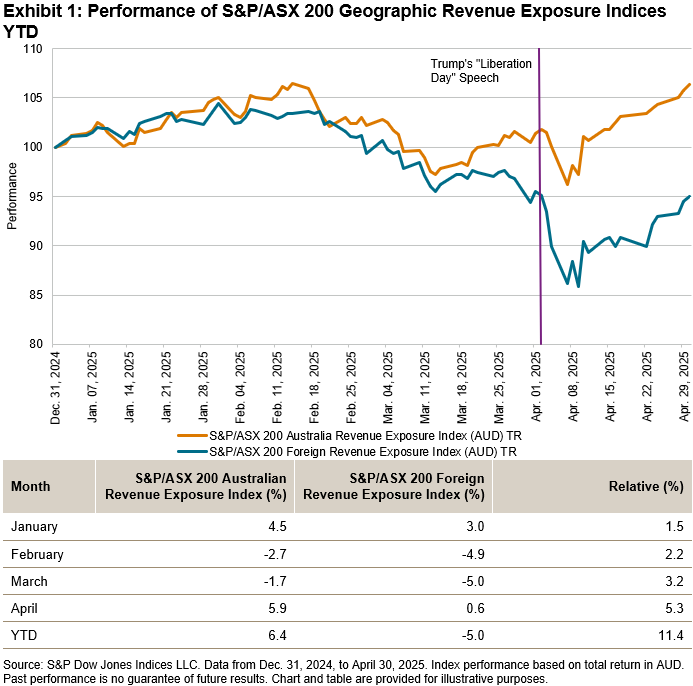
With the surprisingly widespread U.S. tariff hikes announced by President Trump in early April, the geographic source of corporate revenues is coming under the spotlight, as reciprocal trade agreements are being redrawn globally.

The resulting volatility of share prices following Trump’s April 2 “Liberation Day” speech is not surprising, given the globalization and interconnectedness of company revenue sources and supply chains. Some companies are more exposed to a potential trade war than others; for example, those that have products or inputs to products that are highly reliant on foreign markets (such as miners and automakers), while other companies may be more domestically focused (such as banks, telecommunications and utilities companies).

The S&P/ASX 200 Geographic Revenue Exposure Indices offer insight into the performance of Australian companies. The S&P/ASX 200 Australia Revenue Exposure Index includes companies from the S&P/ASX 200 that have greater-than-average revenue exposure to Australia. Conversely, the S&P/ASX 200 Foreign Revenue Exposure Index includes the companies with greater-than-average exposure to markets outside Australia. The indices are weighted by float market cap.1

A Return to Domestic Outperforming

After a lengthy period of underperformance, the S&P/ASX 200 Australia Revenue Exposure Index has reverted to a strong period of outperformance over the past two years. More recently, the S&P/ASX 200 Australia Revenue Exposure Index has outperformed the S&P/ASX 200 Foreign Revenue Exposure Index in each of the first four calendar months of 2025, with April being a watershed month.


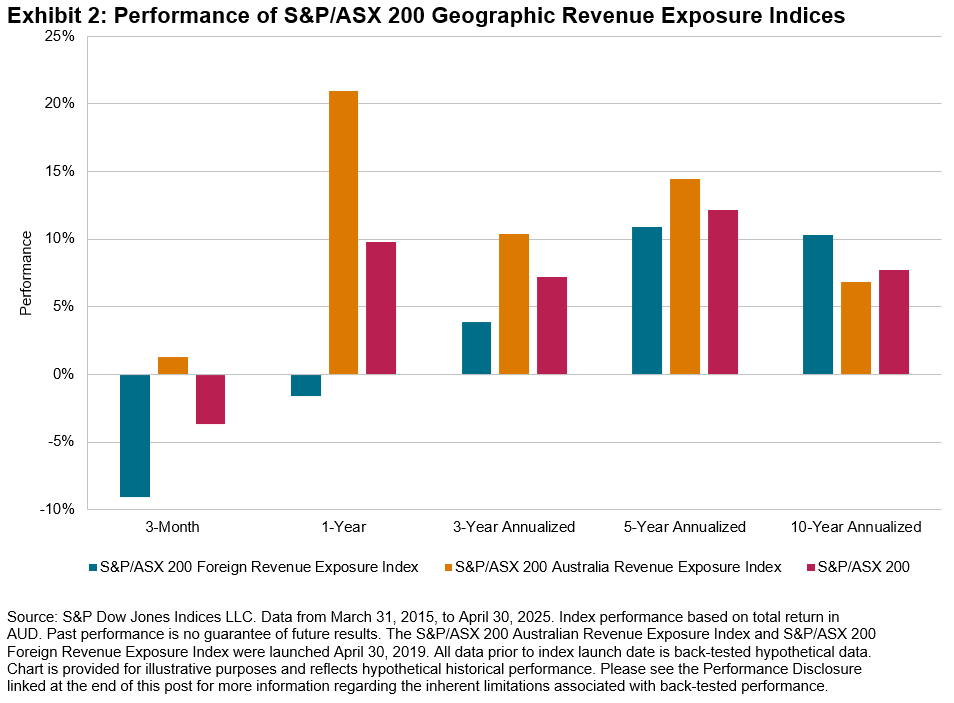
The recent strong performance numbers have resulted in the S&P/ASX 200 Australia Revenue Exposure Index outperforming within all the time periods up to the 5-year period ending April 30, 2025, whereas the S&P/ASX 200 Foreign Revenue Exposure Index outperformed over the 10-year period.

Performance Drivers

While trade policy has certainly influenced the short-term price movements, several other factors have influenced longer-term performance, including fluctuations in both currency and interest rates.

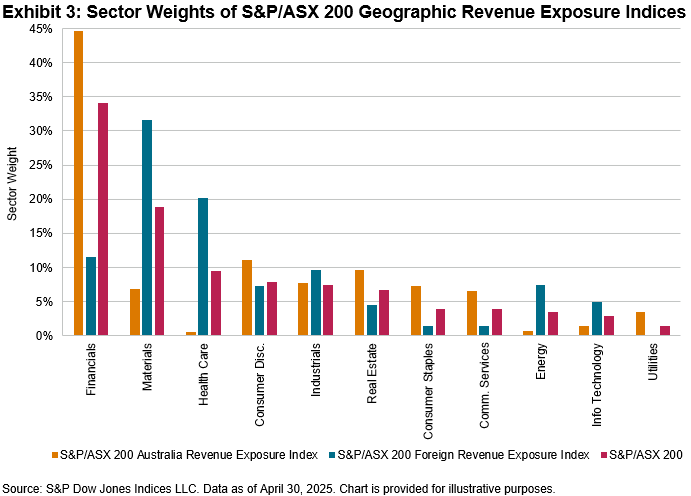
The types of companies and sectors represented in each index also help identify performance drivers. The S&P/ASX 200 Foreign Revenue Exposure Index is overweight in companies in the Materials, Health Care and Information Technology sectors relative to the S&P/ASX 200, while the S&P/ASX 200 Australia Revenue Exposure Index is tilted toward the Financials, Real Estate, Communication Services, Consumer Staples and Consumer Discretionary sectors.


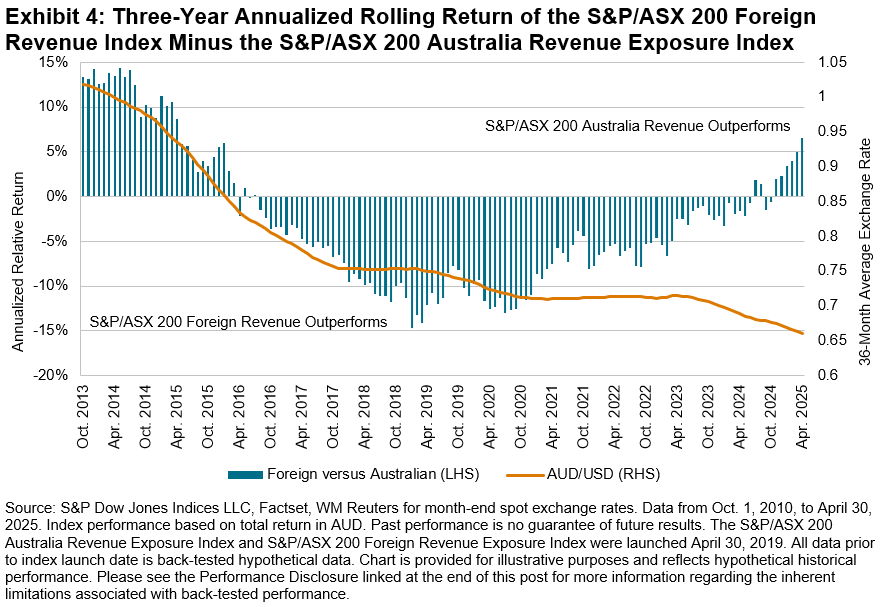
Over periods beyond five years, the S&P/ASX 200 Foreign Revenue Exposure Index has outperformed on the back of strong returns within the aforementioned overweighted sectors; Materials, Health Care and Information Technology. Many companies in these sectors have benefitted from a weakening Australian dollar from 2013 to 2022.

However, more recently, a somewhat stabilized exchange rate and the interest rate increases in 2022 and 2023 have supported the large banks, while domestic consumer companies and those in the Real Estate sector have also performed well during the past two years despite cost-of-living concerns.

If we review rolling three-year annualized periods, we can see more clearly the phases in which companies with greater domestic revenue exposure outperformed and vice versa. Since the Australian dollar dropped below 80 cents to the U.S. dollar, the foreign revenue exposure index consistently outperformed the Australian revenue exposure index by more than 5% until about two years ago, when the rising interest rates supported Financials—a large component in the S&P/ASX 200 Australian Revenue Exposure Index.

The S&P/ASX Geographic Revenue Exposure Indices highlight how trade policy, currency movements and interest rates can have a meaningful impact on differing segments of the Australian equity market. The S&P/ASX 200 Geographic Revenue Exposure Indices group constituents as either majority foreign or domestic earners and are a useful lens to analyze market performance during different macro events or stages of an economic cycle.

1 Please refer to the methodology document for S&P Global Revenue Exposure Indices for more information: https://www.spglobal.com/spdji/en/documents/methodologies/methodology-sp-global-revenue-exposure-indices.pdf

The posts on this blog are opinions, not advice. Please read our Disclaimers.