


Get Indexology® Blog updates via email.

In This List

Terrible Twos

Resilience amid Rising Volatility: The S&P 500 Low Volatility Index

Market Leaders with Strong Domestic Revenue: Introducing the S&P 500 U.S. Revenue Market Leaders 50 Index

Navigating Developed Markets: The S&P World Index Explained

Navigating the Global Index Landscape amid Tariff Volatility

Terrible Twos

Contributor Image
Joseph Nelesen

Head of Specialists, Index Investment Strategy

S&P Dow Jones Indices

Life has been a little eventful since we last checked in. Under normal circumstances, this blog would review March and Q1 performance of S&P 500® sectors and blends. Yes, tariffs are the elephant in the room we’ve been unable to avoid all year, but as of April, that elephant seems to have invited the rest of the herd inside for a rampage.

In April, the tariff narrative went global, sparking a 10.5% drop in The 500TM over the course of two days, the steepest two-day decline since the dawn of the COVID-19 pandemic in March 2020. As shown in Exhibit 1, no sector was spared from the pain over the first week of April, with performance ranging from a 3.8% drop for Consumer Staples to Energy’s 15.3% fall.

Although every sector declined YTD in April, not all fell as much as the broader market. At any given time, at least one sector must be outperforming the others, with historically cyclical and defensive sectors faring better or worse depending on market direction. In a previous blog, we illustrated the relative performance of cyclical and defensive blends of sectors through the first two months of 2025, using a simple methodology of creating two blends that combine five higher-risk or five lower-risk sectors, as discussed in recent research.1

In Exhibit 2, we show daily excess returns of each five-sector blend (cyclical and defensive) for every trading day of 2025, through April 4.

Two observations might stand out from this plot, one quite intuitive and the other perhaps more curious. First, the upward sloping trend of the cyclical data points and the downward slope of the defensive blend data illustrate that each has had a historical tendency to directionally outperform in markets where we would expect them to. Second, the spread of excess performance outcomes for the cyclical blend appears more tightly grouped than that of the defensive blend. Why might this be so?

The answer is that cyclical sectors are where we find most of the Magnificent 7, which have been responsible for a disproportionate share of The 500’s decline. More precisely, while the Magnificent 7 averaged 31.9% of total weight in the benchmark YTD through April 4, they were responsible for contributing more than half of the benchmark’s decline over the same period. Many of these stocks were already on unsteady ground after disruption of the AI competitive landscape in Q1, and now that tariffs have been announced to be broader and larger than anticipated, their sectors’ higher-than-average foreign revenue exposure has caused a new wave of worries.

Exhibit 3 illustrates the weight of each blend in The 500 and the proportion of Magnificent 7 weight in each, suggesting that the cyclical blend’s fortunes may be more closely (but not entirely) tied to those of the largest stocks in the benchmark, which would make relative outperformance more constrained when those large stocks lead performance up or down.

Despite this concentration of mega-cap stocks in the cyclical blend, it has still managed to slightly outperform The 500 by 0.3% YTD, as shown in Exhibit 4. Of course, the defensive blend has withstood the barrage even better, outpacing the benchmark by 9.9%.


1  Cyclical and defensive blends are composed of the top five and bottom five sectors as ranked by historical beta and volatility. Real Estate, ranked in the middle of the 11 S&P 500 sectors, is excluded from this analysis.

The posts on this blog are opinions, not advice. Please read our Disclaimers.

Resilience amid Rising Volatility: The S&P 500 Low Volatility Index

Contributor Image
Kevin Multhaup

Senior Analyst, Factors and Dividends Indices

S&P Dow Jones Indices

Until recently, the continuous rise of the S&P 500® seemed unstoppable. However, with the return of market volatility and macroeconomic uncertainty, there has been a growing appetite for defensive strategies and risk mitigation.

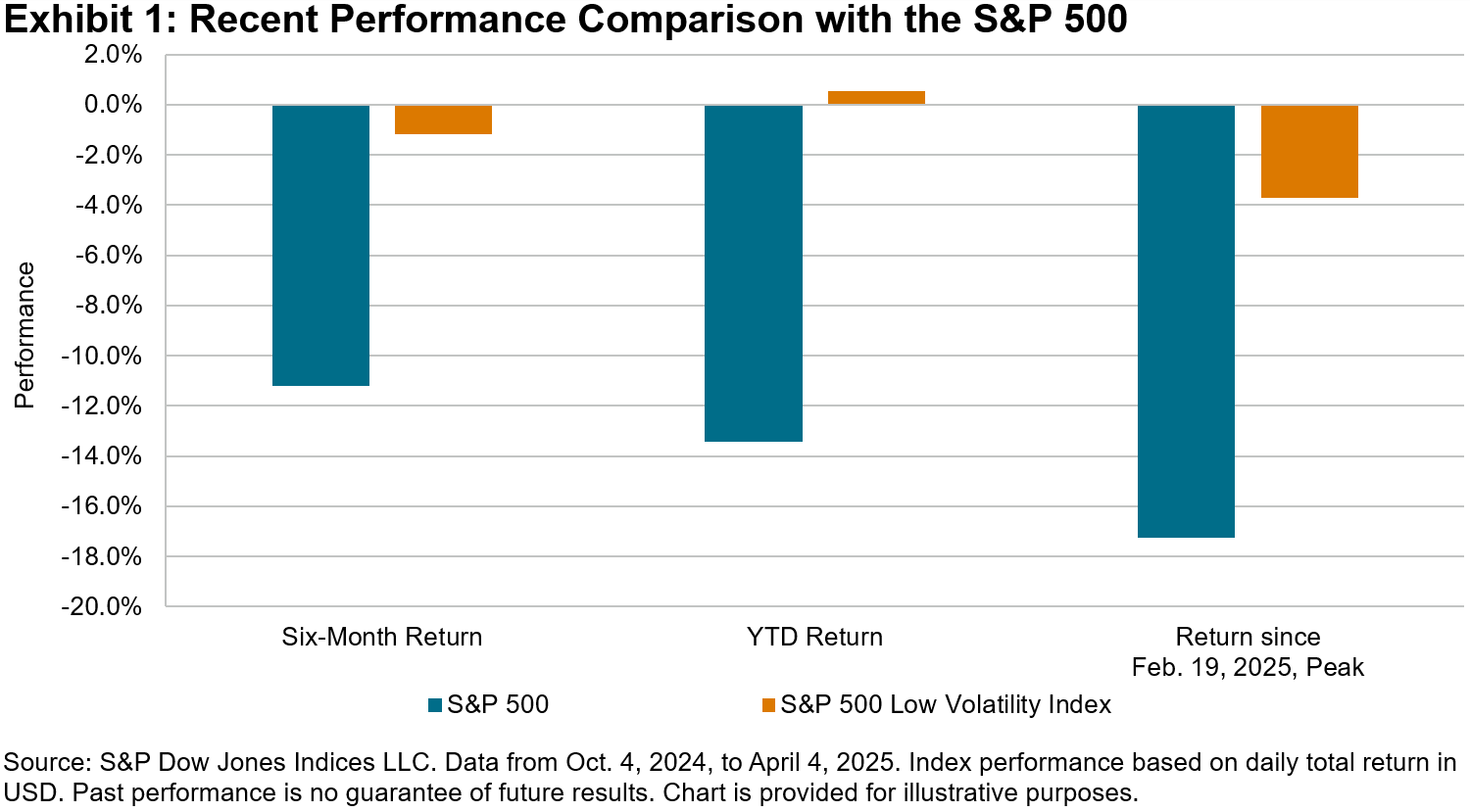
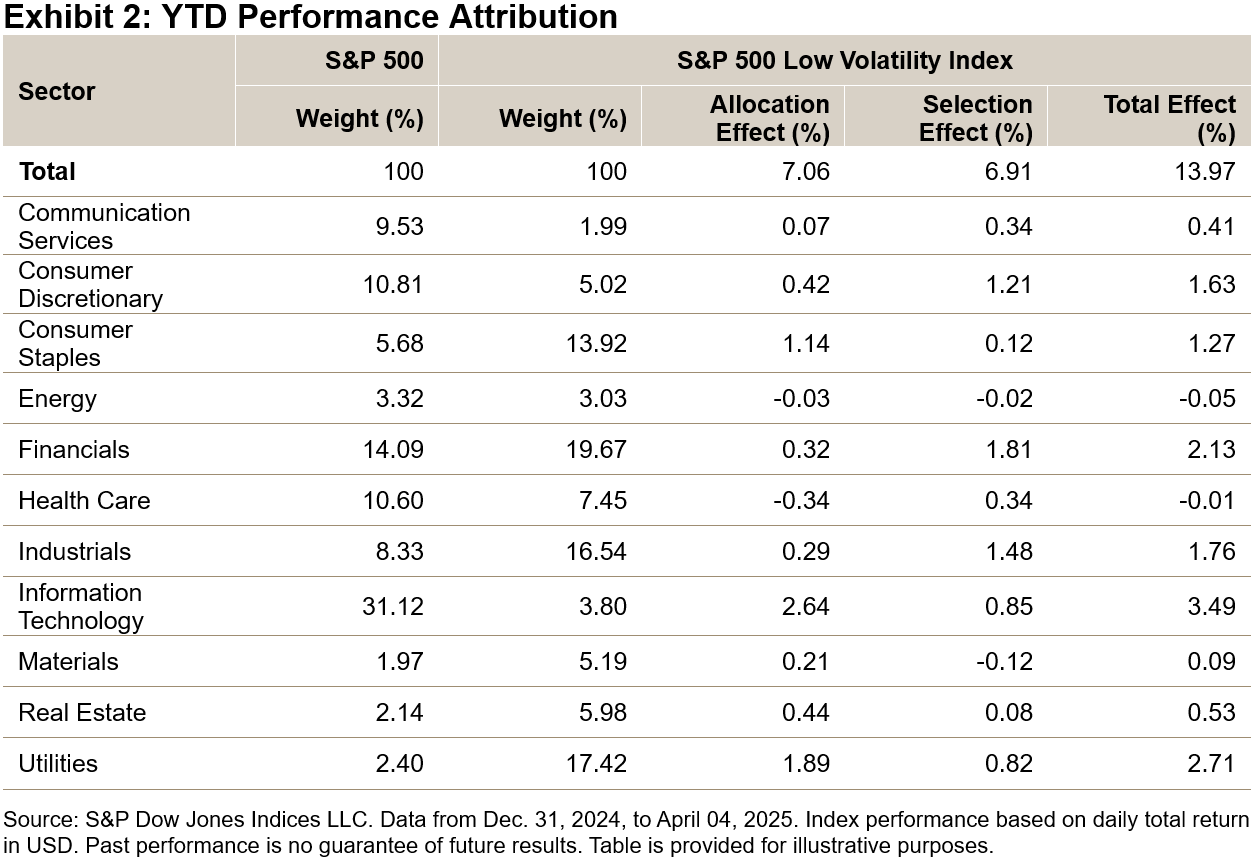
The S&P 500 Low Volatility Index has emerged as a standout performer, further solidifying its reputation for stability in uncertain times. This index tracks the 100 companies within the S&P 500 with the lowest volatility and has demonstrated significant outperformance YTD. As of April 4, 2025, the index was up 0.5%, surpassing the S&P 500 by 14.0%. Since the market’s peak on Feb. 19, 2025, to April 4, 2025, the index was down 3.7%, while the S&P 500 was down 17.3% (see Exhibit 1).

Diversified Approach to Risk Mitigation

Beyond its defensive stance, this index offers a diversified approach to risk mitigation by reducing exposure to mega-cap stocks and increasing weight to defensive sectors such as Utilities and Consumer Staples (see Exhibit 2). This positioning has contributed to its recent outperformance, which can be attributed to a combination of allocation and selection effects.

Domestically Biased Revenue Exposure

Another factor potentially contributing to the recent outperformance of the S&P 500 Low Volatility Index is the higher proportion of revenue generated by its constituents within the U.S. Exhibit 3 illustrates the weighted-average revenue exposure of the index compared to its benchmark. On average, the constituents of the S&P 500 Low Volatility Index derived 72.60% of their revenue from the U.S., in contrast to 59.67% for the S&P 500.

Defensiveness from a Long-Term Perspective

The S&P 500 Low Volatility Index has a track record of outperforming the broader market during significant drawdown events. As illustrated in Exhibit 4, the index consistently outperformed during most major drawdowns since the late 1990s.

Moreover, this index’s defensive approach has not hindered its long-term return potential. As illustrated in Exhibit 5, since 1990—including some back-tested performance—the index has nearly matched the performance of the S&P 500, underscoring its long-term credentials.

Performance in Different Market Conditions

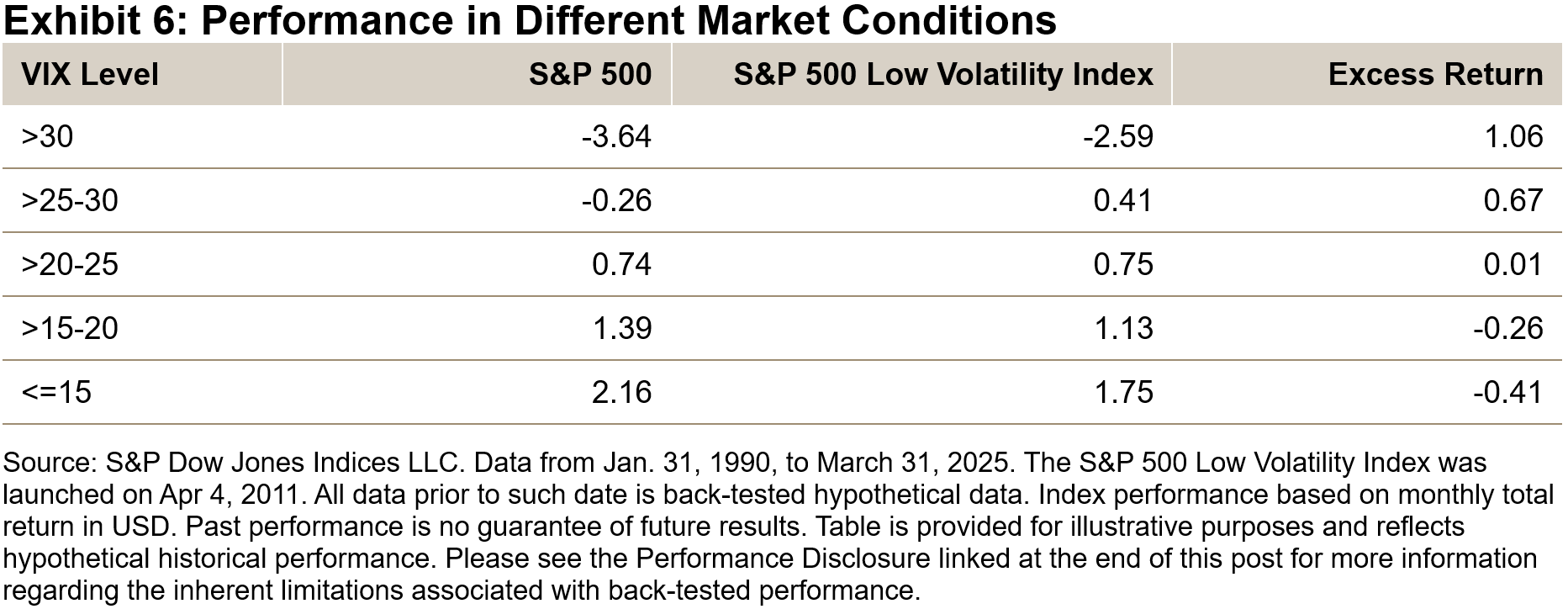
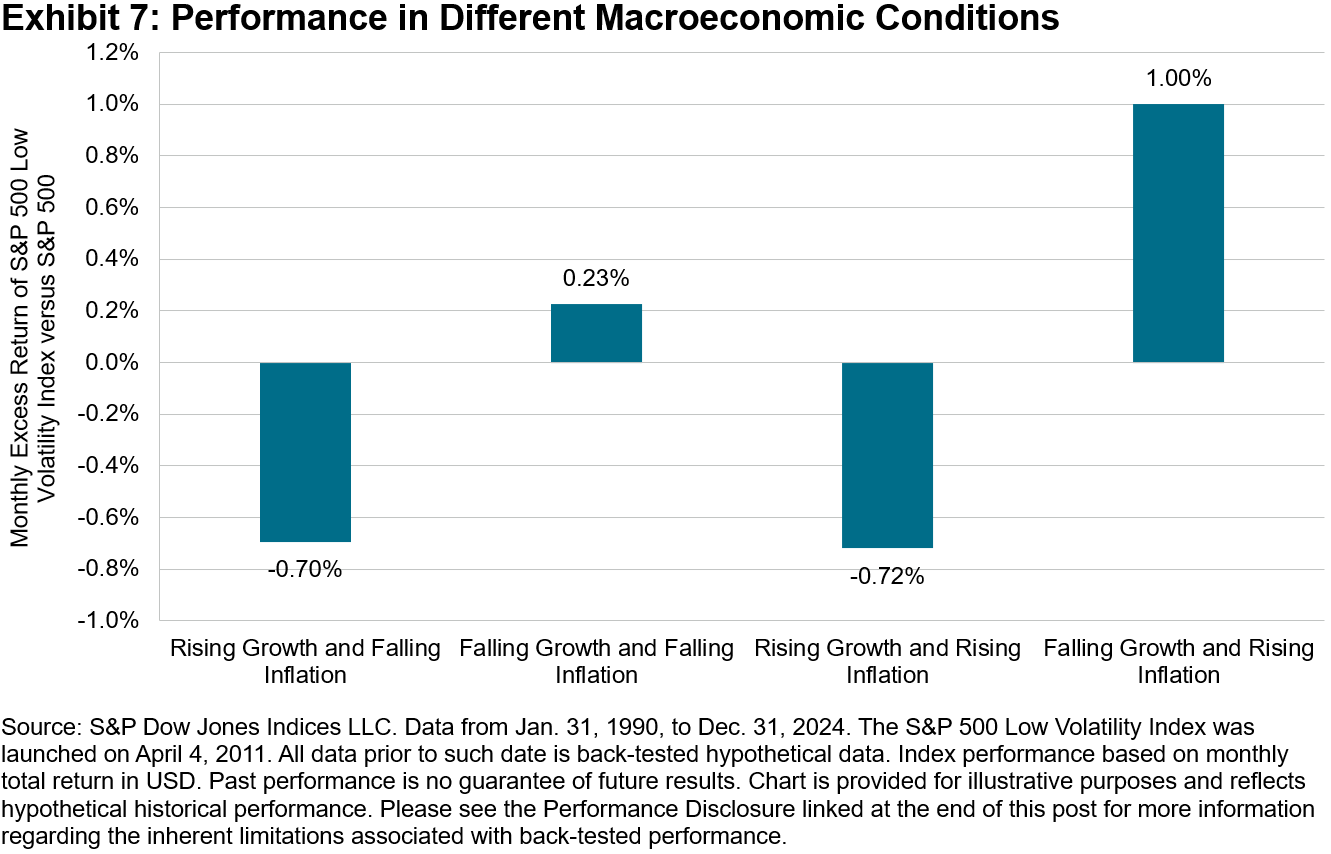
Exhibits 6 and 7 show the performance of the S&P 500 Low Volatility Index in different market and macroeconomic conditions. The defensive qualities of the index are here further showcased, as the index overperformed the benchmark in periods of market stress and in macroeconomic environments of falling GDP growth.

Conclusion

By focusing on stocks with the lowest volatility, the S&P 500 Low Volatility Index has recently shown robust outperformance relative to the broader market. Its diversified exposure to defensive sectors, bias towards domestically oriented stocks, coupled with reduced reliance on mega-cap ones, has also significantly contributed to its lower drawdowns and long-term risk-adjusted outperformance.

The posts on this blog are opinions, not advice. Please read our Disclaimers.
Market Leaders with Strong Domestic Revenue: Introducing the S&P 500 U.S. Revenue Market Leaders 50 Index

Contributor Image
George Valantasis

Director, Factors and Dividends

S&P Dow Jones Indices

In March 2025, S&P DJI launched the S&P 500® U.S. Revenue Market Leaders 50 Index. This index tracks companies within the S&P 500 that generate at least 50% of their revenue from domestic sources and are recognized as market leaders based on a “market leader score.”

This launch is particularly relevant as it emphasizes domestically focused companies, especially in the current climate of increased volatility. Year-to-date returns through April 4, 2025, show the index outperforming The 500™ by 9.33%.

In this blog, we will explore the methodology behind the S&P 500 U.S. Revenue Market Leaders 50 Index, its historical performance and its defensive, high-quality characteristics.

Methodology Overview

Revenue Screening

To be eligible for inclusion in the S&P 500 U.S. Revenue Market Leaders 50 Index, companies must be part of the S&P 500 and derive at least 50% of their revenue1 from the U.S. As a result, only companies that primarily derive their revenue domestically are considered for inclusion.

Market Leaders Score

Next, the top 50 stocks from this subset are selected based on their market leaders score, which is calculated using the average z-score across three key metrics: i) sustained high return on invested capital (ROIC); ii) sustained high free cash flow margin; and iii) high market share. By focusing on companies with the highest market leader scores, the index tends to track high-quality firms that may be positioned to outperform and demonstrate defensive characteristics over the long term.

Weighting and Rebalance

Stocks are weighted using a free-float market capitalization (FMC) approach, with a single stock cap of 4.5%. The index rebalances semiannually in June and December. For a more comprehensive overview of the three market leader indicators, please refer to Exhibit 3.

Performance Review

Exhibit 4 presents the back-tested performance of the S&P 500 U.S. Revenue Market Leaders 50 Index compared to The 500 in both absolute and risk-adjusted returns. In addition to its recent success, the index has shown long-term outperformance. Since June 30, 2014, the S&P 500 U.S. Revenue Market Leaders 50 Index has surpassed the benchmark in absolute returns while maintaining lower volatility, resulting in a risk-adjusted return of 0.97. Moreover, the index has achieved a superior maximum drawdown and downside capture ratio versus The 500.

Exhibit 5 illustrates the historical downside protection offered by the S&P 500 U.S. Revenue Market Leaders 50 Index during past market selloffs. Over the four major drawdown periods shown, the S&P 500 U.S. Revenue Market Leaders 50 Index recorded an average maximum drawdown of just 8.7%, which is approximately two-thirds of the S&P 500’s average drawdown of 13.0%.

Exhibit 6 highlights the enhanced profitability metrics of the S&P 500 U.S. Revenue Market Leaders 50 Index compared to the S&P 500 U.S. Revenue Leaders Index (see our recent blog to learn more about the latter index). By selecting the top 50 securities based on market share score, the index demonstrated improved return on equity (ROE), return on invested capital (ROIC) and return on assets (ROA).

Conclusion

While the S&P 500 U.S. Revenue Market Leaders 50 Index has demonstrated strong recent performance, it has also outperformed the S&P 500 over the long term in both absolute and risk-adjusted terms, all while providing downside protection during periods of market stress. The S&P 500 U.S. Revenue Market Leaders Index reflects profitable, market-leading companies with a U.S. focus, which is especially relevant in the recent market environment.

  1. As measured by FactSet GeoRev
  2. For more information on the S&P 500 U.S. Revenue Market Leaders 50 Index, please see the index methodology.
  3. For more information on Syntax’s Market Share Score, please see the methodology.

The posts on this blog are opinions, not advice. Please read our Disclaimers.

Navigating Developed Markets: The S&P World Index Explained

Contributor Image
Diego Zurita

Analyst, Global Equities & Thematics

S&P Dow Jones Indices

Reliable and comprehensive benchmarks are indispensable in a landscape where global diversification is at the forefront. The S&P World Index tracks the performance of large- and mid-cap stocks from 24 developed markets, providing a consistent universe for historical market analysis and implementation of investment strategies.

The S&P World Index was launched in 2009, building on the legacy of the S&P Global BMI (Broad Market Index). Currently, the S&P World Index encompasses over 1,500 companies, reflecting approximately 85% of the market capitalization of the developed markets included in the index.

The index is constructed following a rules-based approach for size and liquidity. Companies must have a float-adjusted market cap of at least USD 100 million to be included in the index as of the annual rebalance in September. To ensure replicability, only liquid stocks are considered; companies must meet a 12-month median value traded ratio of 20% and a six-month median daily value traded of USD 0.25 million The large- and mid-cap stocks represent the top 85% of the local market’s total available capitalization. For further details about the index’s construction, please refer to the methodology.

As a co-founder of the Index Industry Association, S&P DJI adheres to industry best practices and evolving regulatory standards, reinforcing its role as a reliable and accurate benchmark provider for global market participants. The index methodology is reviewed regularly by an independent oversight committee, ensuring it evolves alongside market dynamics while maintaining its foundational principles.

Home bias—the tendency to invest predominantly in domestic equities—can limit diversification potential. The S&P World Index encompasses international equities from 24 developed countries, illustrating its comprehensive coverage (see Exhibit 2).

Moreover, the S&P World Index offers diversified weight across sectors. Exhibit 3 summarizes the weights of the Global Industry Classification System (GICS®) sectors for this benchmark.

In order to provide benchmarks across the developed market opportunity set from targeted perspectives, the S&P World Index Series offers over 380 subindices that include sector, style and currency versions, as well as specific regional views (e.g., the S&P World Ex-U.S. Index).

In addition, the series includes sustainability-focused indices, such as the S&P World Scored & Screened Index, leveraging S&P DJI’s world-class sustainability datasets.

The S&P World Index is relevant to the passive investing conversation, as historic data suggest it’s difficult to outperform. SPIVA® (S&P Indices Versus Active) U.S. Year-End 2024 Scorecard results show that over the past 15 years, the S&P World Index has performed better than 92.5% of the actively managed funds that aim to beat it, which is even higher than the 89.5% outperformance rate of the S&P 500.

In conclusion, the S&P World Index provides comprehensive coverage of developed market equities and is a world-class benchmark backed by the highest standards of quality and integrity offered by S&P DJI. In an upcoming blog, we will showcase the S&P World Ex-U.S. Index and its outperformance of U.S. equities during the start of 2025.

The posts on this blog are opinions, not advice. Please read our Disclaimers.

Navigating the Global Index Landscape amid Tariff Volatility

Contributor Image
Michael Brower

Former Associate Director, Index Investment Strategy

S&P Dow Jones Indices

In an environment of rapidly evolving trade conditions, understanding the nuances of index performance across countries is essential. As trade policies fluctuate and central banks carefully evaluate the economic outlook, the repercussions for markets and global commerce may be significant.

Reflecting on the past couple of years, it is noteworthy that the 12-month total return differential between the S&P United States LargeMidCap and the S&P World ex-U.S. Index turned negative in March 2025 for the first time since October 2023, marking a notable shift from the 20% difference in 2024, a period characterized by strong performance for U.S. equities. This recent change not only highlights the evolving landscape of global indices but also emphasizes the importance of closely monitoring international market trends, as they can have substantial implications for growth trajectories.

The wavering of U.S. stocks is no less apparent when compared to a titan on the other side of the globe. In both 2024 and YTD 2025, the S&P China BMI outperformed the S&P Emerging Ex-China BMI by a wide margin, a significant reversal from 2023 when it underperformed by 33%.

Shifting our focus from performance to risk, we see a continuation of diversification benefits witnessed in the past for both U.S. and Chinese equities. In Exhibit 3, we calculate the trailing 12-month volatility differential between the S&P World Index and S&P World Ex-U.S. Index, and the S&P Emerging BMI and S&P Emerging Ex-China BMI, respectively. When the spread was positive, the inclusion of a country increased the volatility in the benchmark. When the spread was negative, the country acted as a volatility diversifier. Notably, both the U.S. and China have continued to be volatility diversifiers in 2025 (see Exhibit 3).1

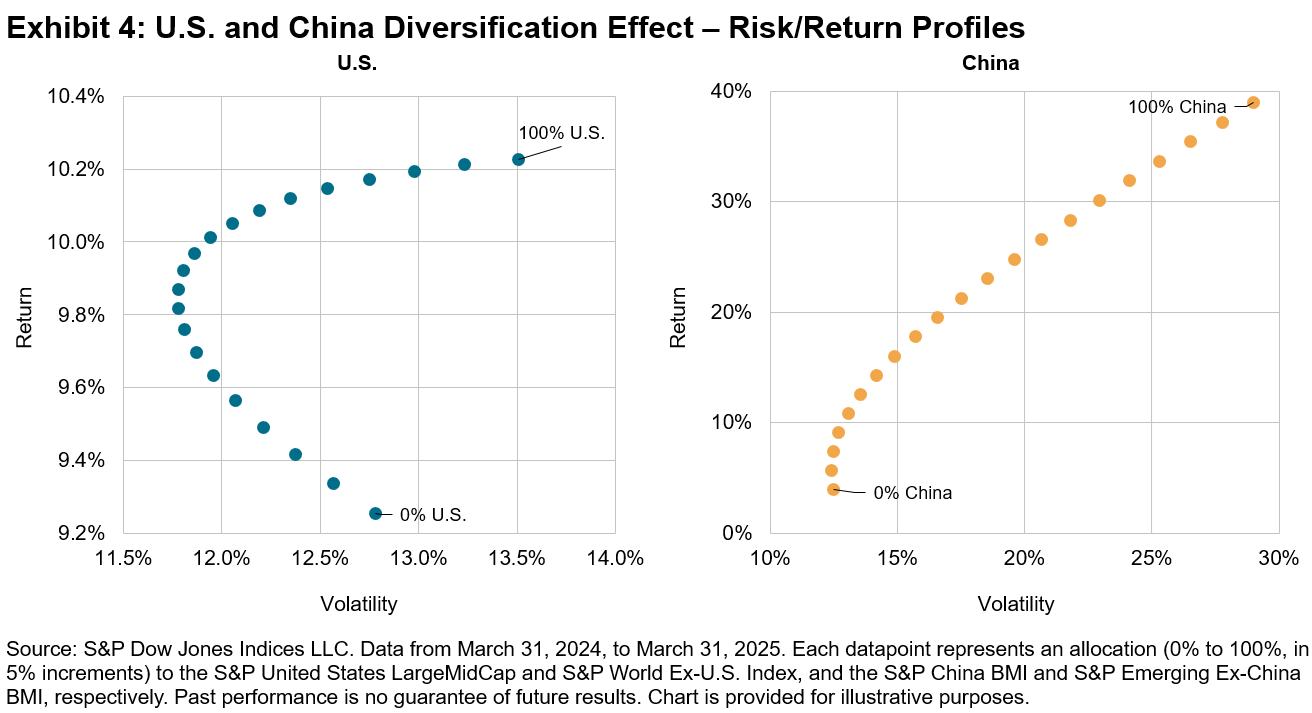
As we consider these diversification characteristics, it’s important to recognize that the current shift in trade protectionism may signal a change in market dynamics for U.S. equities. By leveraging a comprehensive toolkit, different combinations of equity indices, such as hypothetically blending the S&P United States LargeMidCap with the S&P World Ex-U.S. Index and S&P China BMI with the S&P Emerging Ex-China BMI, could produce a different risk/return profile. Exhibit 4 displays the risk/return tradeoff of these combinations over the last year.

In summary, thoughtful approaches could be increasingly important for global investors seeking to harness opportunities and mitigate risks in today’s complex landscape. By better understanding the potential benefits of country diversification, market participants can make more informed decisions as they seek to navigate these dynamics.

The author would like to thank Benedek Vörös for his contributions to this post.

1  We recognize that the U.S. represents more than 70% of the S&P World Index. Nonetheless, it’s essential to highlight that this U.S. segment is made up of large multinational corporations whose revenue sources extend across multiple regions.

The posts on this blog are opinions, not advice. Please read our Disclaimers.